Journalism of Courage
 4 min read


At the half-way stage of the World Chess Championship match between Viswanathan Anand and Boris Gelfand,neither player has been able to pull off a win as the scores stand tied at 3-3. The spate of draws have elicited a diverse set of reactions in the chess community. Former champion Garry Kasparov questioned Anands levels of motivation,saying he was playing safe instead of going for more open and attacking varations while other commentators like GM Sergey Shipov have branded the games and the innovations the players have come up with,an invaluable addition to chess theory.
A look at how the first six games of the 12-game match have panned out.
Game One: Anand set his defense rolling with the queen pawn opening but Gelfand surprised him with the Grunfield defense,an opening that has not been associated with the challenger and one that has a dubious history Kasparov used it unsuccessfully against Karpov and Kramnik in past championship matches. However,the element of surprise and the depth of Gelfands preparation helped him turn the tables soon as he threatened with two bishops and a potential passed pawn. Anand found the right combination of moves to secure the draw.
Game Two: In his first game with black,Anand went for the Semi-Slav variation,an option he would continue with through to the half-way stage. Anand played fast and accurate,the first indication that this was a line that would hold few surprises to the champion. Gelfand gave up his knight for blacks bishop,but the strong central seat in which Anands knight was perched convinced Gelfand to offer the draw in 25 moves.
Game Three: The only game of the first half of the match that tended towards a result,but Anand couldnt find the right combination under time pressure that could convert his advantage to an outright win. After Gelfands 20th move,an inaccuracy,Anand had his chances to hold on to an advanced pawn,but with less than two minutes on his clock,the champion missed the correct continuation as Gelfand drew the match via the threat of perpetual checks.
Game Four: Anand continued to mine the Anti-Meran variation of the Slav defense with black. Gelfand had a slight advantage of holding a pair of bishops to Anands bishop and knight going into the end game. He was,however,unable to prevent the exchange of a bishop pair and the position attained neutrality soon. Though the result was a draw,the game threw up the relatively rare visual spectacle of seeing the d file occupied entirely by white and black pieces around moves 17 and 18.
Game Five: For the first time in the match,either player departed from the queen pawn opening. Anand started with e4,but what was as much of a surprise was that Gelfand did not go for his favourite Petrov defense,an opening he was expected to employ extensively in the final. Gelfands Sicilian Sveshnikov simplified the position with ease and draw was signed after only ninety minutes,in what was the shortest game of the final.
Game Six: After the surprise of the Sicilian in the previous,Anand returned to the Slav defense,for the third time in as many games with black. White had a minor advantage which was more or less neutralised by Anands novelty 148230;0-0 which sacrificed a pawn to further development. It was clear that the move and the particular line being played out was analysed thoroughly by Anand and his team as White found little to play for,after returning the captured pawn. The draw was signed in 29 moves.

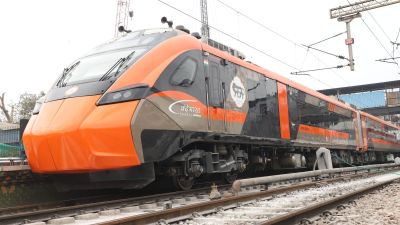
Railway Minister Ashwini Vaishnaw on Saturday said Vande Bharat Sleeper trains will be introduced across all states, including Kerala. He made the comments during a press briefing at New Delhi railway station after inspecting the Howrah–Guwahati–Howrah Vande Bharat Sleeper rake, which is set to be launched this month.