


Tags:


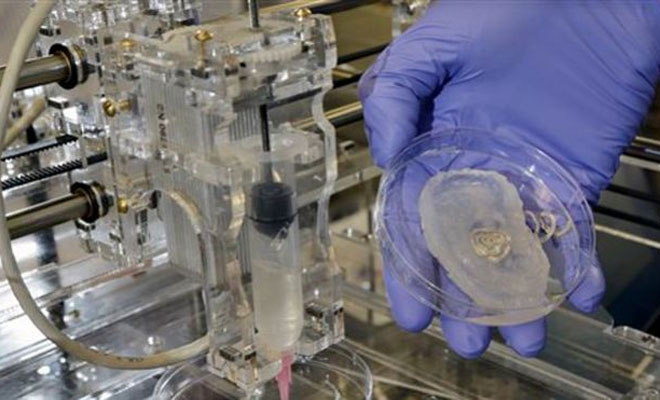
Scientists,including an Indian-origin researcher,have created a 3D-printed 8216;bionic8217; ear that can 8220;hear8221; radio frequencies far beyond the range of normal human capability.
Using off-the-shelf printing tools,the scientists at Princeton University explored 3D printing of cells and nanoparticles followed by cell culture to combine a small coil antenna with cartilage,creating a 8216;bionic8217; ear.

8220;In general,there are mechanical and thermal challenges with interfacing electronic materials with biological materials,8221; said Michael McAlpine,an assistant professor of mechanical and aerospace engineering.
8220;Our work suggests a new approach 8211; to build and grow the biology up with the electronics synergistically and in a 3D interwoven format,8221; said McAlpine.
Last year,a research effort led by McAlpine and Naveen Verma,an assistant professor of electrical engineering,and Fio Omenetto of Tufts University,resulted in the development of a 8220;tattoo8221; made up of a biological sensor and antenna that can be affixed to the surface of a tooth.
This project,however,is the team8217;s first effort to create a fully functional organ: one that not only replicates a human ability,but extends it using embedded electronics.
8220;The design and implementation of bionic organs and devices that enhance human capabilities,known as cybernetics,has been an area of increasing scientific interest,8221; the researchers wrote in the article in the journal Nano Letters.
8220;This field has the potential to generate customised replacement parts for the human body,or even create organs containing capabilities beyond what human biology ordinarily provides,8221; said the researchers.
Ear reconstruction 8220;remains one of the most difficult problems in the field of plastic and reconstructive surgery,8221; they wrote.
The team turned to a manufacturing approach called 3D printing. These printers use computer-assisted design to conceive of objects as arrays of thin slices.
The printer then deposits layers of a variety of materials 8211; ranging from plastic to cells 8211; to build up a finished product.
This is the first time that researchers have demonstrated that 3D printing is a convenient strategy to interweave tissue with electronics.
The technique allowed the researchers to combine the antenna electronics with tissue within the highly complex topology of a human ear.
The researchers used an ordinary 3D printer to combine a matrix of hydrogel and calf cells with silver nanoparticles that form an antenna. The calf cells later develop into cartilage.


