


Tags:


Two weeks ago,when the Okhla compost plant in Delhi was awarded carbon credits by the United Nations Framework Convention on Climate Change,35-year-old Leju Valson,Manager Operations at the Okhla plant,had quietly chuckled. The plant,he says,had been accumulating carbon credits since 2009,but this time when credits swelled to 18,225,making it Indias first municipal compost plant to receive carbon credits,it had finally made news. Were the first compost plant to receive carbon credits. These credits are like shares which are traded on the carbon market by nations. Developed nations have a mandate to reduce greenhouse gas emissions and one way they can do this is by investing in environment-friendly technologies in developing countries that accrue carbon credits, says Valson.
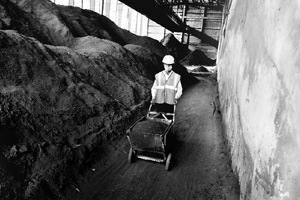
Its 9 am. The plants morning shift had already begun at 6 am. Fresh piles of municipal solid waste have just arrived at the plant. Deliveries of municipal waste come at least twice a day. Heaps of waste are stacked in orderly rowsfresh malodorous heaps right out in the front,with stray animal and bird visitors,older mounds behind the fresh ones,darker and browner,ready for the composting process to take over.


Waste is a misplaced resource, says Valson. Its primarily a city problem and it needs to be treated in the cities. After collection of municipal waste from households,there are three ways of disposalcomposting units,bio-methanation to produce bio-gas,and recovering heat energy in the form dry fuels from combustible fractions. Municipal solid waste from households comprises organic waste,moisture,plastics,sand and combustible fractions. One of the major problems in treating urban waste comes at the very first stage of collection from households. For composting units,segregation of waste to collect only organic waste is the most laborious task. Our societies dont behave like western countries,where they segregate waste at household level. Ideally,when household waste is collected,food/organic waste should be separated from plastics and ceramics, Valson says.
Of 200 tonnes of waste per day,about 15-20 per cent is converted into compost. When garbage comes from sabzi mandis,it is rich in organic waste,so we get a higher yield of compost, says Valson,laughing that the smells are also richer on those days. The composting process takes about seven weeks,with 10 hours of pre-screening processes per day. The waste is subjected to multiple levels of mechanical screening and refining. First the waste is passed through 200 mm screenstrommel separators with rotating screensthen through 80 mm screens where air density separators are employed to pick out heavier organic particles. By then,moisture,ceramics,plastics and dry combustibles have been removed to leave organic waste behind. After four weeks,the organic waste is passed through 35 mm screens,and finally through 16 mm screens that remove fine sand and silt and also have magnetic separators to remove nails. Seven weeks later,fine,pure compost is ready for use in the farming sector.
As the bobcat machines rev up to separate silt from the waste,Valson says,There is no waste that cant be put to use except for plastics!
This isnt his first brush with managing waste. At home in Kottayam,Kerala,Valson says he grew up watching his father compost household waste. I remember,for my sisters wedding,we had 700-800 guests. My father made compost out of all the waste from that wedding and used that in the fields. We used to compost all the household waste on a weekly basis.
Besides fertiliser companies that are mandated to stock natural compost,60-70 nurseries in Delhi also stock the compost produced at the Okhla plant. In this plant,all wastes are utilisedorganic waste for compost,combustibles for dry fuel,sand and glass for ceramic industries. But the other problem that waste-management industries face is of sustainability. The transport costs of distribution are borne by us and theyre equivalent to the production costs. The government has laws for hazardous waste,batteries,e-waste,plastics,but there are no incentives for people to get into this industry, Valson says of problems plaguing the industry.
The Okhla plant has processed more than 200,000 tonnes of municipal solid waste since operations began in 2008. Put simply,the amount of greenhouse gas emissions reduced by the plant is equivalent to having a vehicle-free Delhi for a day.


