4 min read

Journalism of Courage



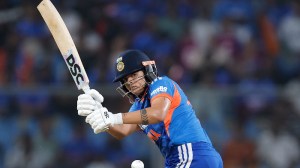
As the referee whistled to signal start of play,the hosts,after the customary toe poke inside the center circle,hoofed the ball out,over to the left flank. Captain Sunil Chhetri braced himself to bring the ball down,but the header that met the ball,thumping it whence it came,was provided by a Syrian defender. Wim Koevermans spell as the coach of the Indian team began in such fashion.
If the Indians had taken a shine to the coachs philosophy of keeping possession of the ball,and keeping the ball on the grass,it wouldnt show instantly. A sustained aerial barrage by the Syrians early in the first half,and the rain that sheeted down minutes later,ensured not much of the pass-and-move style the Indian coach has set his sights on would be on display. But still,India did enough to nick a 2-1 win,and in the end it was a case of the ends justifying the means.
The seventh minute saw the Indian team for the first time bring on to the field what was until that point perhaps just an idea in the coachs head. From deep inside Indias own half the ball was rolled out to Fransisco Fernandes,who played in the hole behind the lone striker Chhetri. Fernandes farmed the ball out wide and when it was swept back in for Chhetri,the striker couldnt turn around or get the shot away. The moment was memorable mainly because there would be few such over the course of the evening.
Early advantage
Mardek Mardikan and Alaa Alshbbli,like most traditional exponents of their position,were tall and sturdy target men. The focal point of most of Syrias early thrust,they chested balls down for midfielders to run on to,or flashed headers goalwards with fair regularity. The defence wasnt always ready or equipped to deal with the physicality of the attacks,but managed,often after protracted scrambles in the box,to boot the ball out with some desperation. The question of working the ball out from the back,therefore,did not arise,nor make much sense for India. At the end of 37 minutes,Syria had five shots on goal,and several that were headed not too far wide,to Indias one effort on target.
It was when the skies opened up,and after a few minutes of feckless running about,the referee decided to call play to a stop until conditions were more suitable. Even after the supersopper did its work,the ball only grudgingly came off the surface and the play,which was scrappy until then devolved into individual skirmishes. Defenders flew into tackles,sometimes misjudging interceptions completely,going down instead in a glorious spray of sludge.
It was one such miscalculation that played a part in the first goal of the match. A ball was squirted from the center to Clifford Miranda on the left and the Syrian right back went in on an all or nothing lunge,getting neither ball nor player,both having slushed to a stand still a few inches away. Miranda skipped past the prone defender and lofted the ball past the backtracking center backs for Chhetri to nod home on the stroke of half-time.
The goal under their belt,India reverted to type,dumping the ball out at the first opportunity,a play that was willingly adopted,according to Koevermans.
Change of strategy
The half-time called for a change of strategy. We had the goal and the rain meant there was no point trying to pass the ball around. We had to chip it around, he said. It was effective,in that India did not concede until the last kick of the game,but it also left them without any serious threats. It would take the entire the second half for Indias second goal to arrive. With minutes left,Fernandes pushed the ball to the right of the penalty area,where after a few seconds of slipping and sliding,substitute Anthony Pereira nutmegged Mohammed Zubaida to curl a left-footer into the top corner. Syria struck back deep into injury time,when one of Alshbblis powerful headers eventually went in,but it wasnt enough,as Koevermans began his stint with a win.