


Tags:


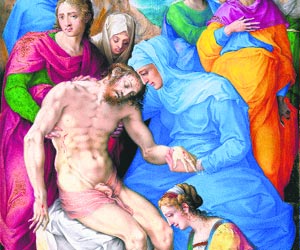
The Lamentation by Giulio Clovio hides a precious secret
The Lamentation is not a decoration. And it is more than a depiction of Mary,clad in Heavens blue,kneeling at a tomb-like stone mourning her dead son. Its a machine for silent prayer.
Purchased in 2006 by Americas National Gallery of Art,The Lamentation is on view in the Heaven on Earth exhibition in the East Building.
Protestants who knocked heads off holy statues and hurled stones through stained-glass windows would have hated it,but The Lamentation wasnt for them. Giulio Clovio 1498-1578,who painted it in Rome about 1550 and flecked it with gold,did so for the cardinal who employed him,the powerful and learned Alessandro Farnese,grandson of a pope.
Clovio,a Croat,moved in high circles. He was a friend of Michelangelos as you might guess from Christs musculature,but while mighty Michelangelo carved marble as big as giants and painted entire ceilings,Clovio worked tiny,with the smallest brushes and the sharpest sight. The Lamentation is 8 1/2 inches wide.


The picture is in gouache. Its not on paper,its on vellum,which was made from the scraped-and-bleached skin of a calf,kid or lamb.
Clovio was the last master of an old preprint tradition,the illuminator of sacred books. The Lamentation isnt an embellishment for a Bible or a hymnal. Its a separate object with another function.
At Jesus feet is Mary Magdalene. You can tell by the elaborateness of her hair and the opulence of her raiment. At the centre of the picture is the Virgin Mary,who not only gets pride of place in Clovios composition but exceptional blueness. Blue,from lapis lazuli,a stone brought from Afghanistan,was the most precious of Renaissance colours. Shes crying. You can see her tears. Her head leans against that of her son. Christs brow drips blood.
He doesnt wear his crown of thorns.
Although its in the painting,almost nobody will find it who doesnt know its there. Its that subtle.
It would be easier to see if you could pick the picture up and turn it in the light,but,of course,you cant do that in the East Building,where The Lamentation hangs on the wall,behind glass,under electric illumination.
The crown of thorns has fallen.
It has landed on the earth,wherepainted white-on-white in the lower left-hand cornerit leans against the stone in the foreground of the picture,almost within reach.
The crown of thorns that Jesus wore while hanging on the cross was prickly,dark and woody,but not anymore. Now its half halo. Cleansed and dematerialised,its been turned into light.
_Paul Richard,LATWP


