Journalism of Courage
 5 min read



Floods, contrary to popular and perhaps television perception, are not unmitigated bad news because they are symbols and substance of water regeneration 8212; a big plus in a country that has low water table in some parts and will be a big water consumer globally in the near future. But of course, floods, such as those caused by the Kosi river in north Bihar, also challenge the administration8217;s capacity to protect lives, livelihoods and homes. Two million people are reportedly homeless because of the Kosi floods and the official count for the dead has already reached three figures.
The Kosi breached its embankment at Kushala, about 13 km upstream of the Kosi barrage on the Nepalese side on August 18. That was the day Prachanda was taking oath as Nepal8217;s new PM. Nothing was done then and the blame game has begun now.
New Delhi is blaming Kathmandu for not allowing Bihar government engineers to reinforce the embankment once the river started attacking its spurs around August 15-16. The Bihar government is cross with the Centre as the latter did not take up the matter seriously enough with Nepal. And Kathmandu is angry with New Delhi for not maintaining the Kosi barrage and its embankment, given to New Delhi on 199 years lease, during the dry season.
The facts are as follows: Bihar government engineers were late in starting embankment enforcement operations; Nepalese customs took its sweet time letting the material through; the breach was within the Kosi-Tapu sanctuary, restricting operations; and the Nepalese workforce weren8217;t willing to work as an emergency demands.
Damage done, where were the forces of national disaster management? A 235-strong force landed 48 hours after the breach and flooding on August 18. But warnings had been sounded around Independence Day.
In another emergency earlier, a national disaster management force took four hours to reach Kullu, Himachal Pradesh; the stampede in the Naina Devi temple had claimed 141 lives by then. Yes, India8217;s response to the 2004 tsunami or even the 2000 Bhuj earthquake was credible. But, in general, something8217;s very rotten in disaster management administration.
Rats have a major presence in the headquarters of the National Disaster Management Authority NDMA at Centaur Hotel, Delhi. NDMA was set up in December 2005 and has the prime minister as its chairman. Its executive head is General Retd N.C. Vij, former Indian army chief. NDMA has 10 members, and Vij holds ex-officio rank of minister of state.
In terrorism-related incidents, NDMA doesn8217;t come in directly. These are handled by the disaster management cell under the home ministry which liaises with the concerned state. NDMA is supposed to have control of an eight-unit paramilitary force, called the National Disaster Response Force NDRF. Four units are trained to handle nuclear, biological and chemical disasters. These battalions, divided into 18 teams, have been raised via personnel from CISF, ITBP, BSF and CRPF. The eighth battalion is still being raised. The teams are stationed in Pune, Kolkata, Delhi, Vadodara, Mindli, Gauwhati, Chandigarh and Patna. This is the theory. But there are no dedicated airlift capabilities or equipment. That8217;s why the response team to Naina Devi, travelling via road, was at least four hours late.
The national disaster management policy has been with the UPA government since December 20, 2007 but it has not yet been cleared. Three years after the setting up of NDMA, the government has only now in principle approved the post of the director general, NDRF. Fourteen ministries have been sent policy papers but as of now only one ministry appears to have had the time to respond to NDMA.
Little wonder then that General Vij told Prime Minister Manmohan Singh last year that he would rather quit than be blamed for NDMA8217;s incompetence at a later date. The home ministry is tasked to service NDMA. But it still believes in the old thesis of district magistrates being nodal actors.
NDMA initiated a dialogue with the health ministry for better medical and ambulance services and extending civil defence facilities to all the districts, as opposed to only 100 towns now. That exercise is still a work-in-progress. By the way, we still don8217;t know the epidemiological roots of the 1994 Surat plague virus.
That most construction in India happens without a disaster audit is another scary anomaly that apparently scares no one. Statistics like these will be taken seriously only when NDMA is fully autonomous, has a separate budget, and is considered powerful enough to receive ministry cooperation.
shishir.guptaexpressindia.com

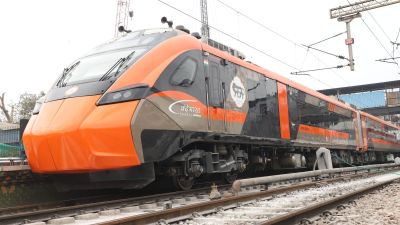
Railway Minister Ashwini Vaishnaw on Saturday said Vande Bharat Sleeper trains will be introduced across all states, including Kerala. He made the comments during a press briefing at New Delhi railway station after inspecting the Howrah–Guwahati–Howrah Vande Bharat Sleeper rake, which is set to be launched this month.