5 min read

Journalism of Courage




Pakistan President Pervez Musharraf imposed emergency rule on Saturday in a bid to reassert his flagging authority against challenges from Islamist militants, a hostile judiciary and political rivals.
The United States called the move 8220;very disappointing8221;.
General Musharraf said in a television address he decided to impose an emergency in response to a rise in extremism and what he called the paralysis of government by judicial interference.
Nuclear-armed Pakistan8217;s internal security has deteriorated sharply in recent months with a wave of suicide attacks by al Qaeda-inspired militants, including one that killed 139 people.
There had been increasing speculation that Musharraf, who seized power in a 1999 coup, might declare an emergency rather than run the risk the Supreme Court would rule against his re-election as president.
Television channels said that Supreme Court Chief Justice Iftikhar Chaudhry, whose earlier suspension in March marked the beginning of a slide in Musharraf8217;s popularity, had been told that his services were 8220;no longer required8221;.
Chaudhry had been reinstated in July, but was escorted home by police on Saturday from the Supreme Court where he and other judges had refused to endorse the emergency order.
Witnesses said troops were deployed at Pakistan Television and radio stations, and most phone lines were down. Most private television channels were taken off the air. Other troops sealed off the thoroughfare where the presidency building, the National Assembly and the Supreme Court are located.
Shots were heard in several neighbourhoods of Karachi, where there is strong support for former prime minister and opposition leader Benazir Bhutto. Bhutto, who had gone to Dubai on Thursday on a personal visit, flew back to Pakistan on Saturday.
The United States, which sees Musharraf as a crucial ally against al Qaeda in Pakistan and neighbouring Afghanistan, had earlier urged Musharraf to avoid taking authoritarian measures.
8220;This action is very disappointing,8221; White House National Security Council spokesman Gordon Johndroe said. 8220;President Musharraf needs to stand by his pledges to have free and fair elections in January and step down as chief of army staff before retaking the presidential oath of office,8221; he added.
Pakistan had been due to hold parliamentary elections in January as part of a transition to civilian democracy.
Musharraf had been awaiting a Supreme Court ruling on whether he was eligible to run for re-election last month while still army chief. He had promised to quit as army chief if he was given a second term. The court had said on Friday it would reconvene on Monday and try to finish the case quickly.
Aitzaz Ahsan, president of the Supreme Court Bar Association, told reporters at his home he was being arrested.
8220;One man has taken the entire nation hostage 8230; Time has come for General Musharraf to go,8221; he said. Fellow lawyers shouted 8220;Go Musharraf Go8221; as Ahsan was taken away by police.
Farzana Shaikh, a Pakistan expert at London8217;s Chatham House thinktank said the declaration of emergency by Musharraf was 8220;clearly a pre-emptive move on his part that was designed to act before the Supreme Court issued a ruling that might have invalidated his very controversial re-election as president8221;.
Musharraf8217;s troubles began in March when he suspended Supreme Court Justice Chaudhry on allegations of misconduct.
Then in July, after a week-long siege, Musharraf ordered troops to storm the Red Mosque in Islamabad to crush a Taliban-style movement based there.
At least 105 people were killed in the raid and a wave of deadly militant attacks and suicide bombings followed.
Musharraf also faced a strong political challenge from Bhutto, who was greeted by thousands of supporters when she returned to Karachi in October from eight years of self-imposed exile. At least 139 people were killed in a suicide bombing during a procession held to mark her return.
When she landed in Pakistan on Saturday, Bhutto went straight from Karachi8217;s airport terminal to her bullet-proof Landcruiser smiling and waving to hundreds of supporters who chanted: 8220;Long live Bhutto8221;.
Before the declaration of emergency, there had been widespread speculation that Bhutto would strike a deal with Musharraf to share power after the elections 8212; an alliance that had been encouraged by the United States.
Exiled former Prime Minister Nawaz Sharif, deposed by Musharraf in the 1999 coup, described his decision to invoke emergency powers as a form of martial law.
8220;We are heading towards a chaotic situation, heading towards anarchy,8221; Sharif told Indian news channel CNN-IBN.
Britain said it was 8220;gravely concerned8221; and urged Musharraf to hold elections. India8217;s Ministry of External Affairs also urged a return to democracy.
Husain Haqqani, director at the Center for International Relations at Boston University in Massachusetts, said that Musharraf had overplayed his hand.
8220;He risks dividing an already polarized nation further. In the past, generals have suspended the constitution to remove from power unpopular rulers. This is the first time an unpopular ruler has suspended the constitution to save his position.8221;

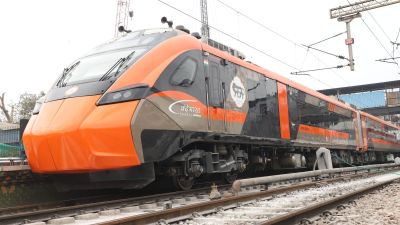
Railway Minister Ashwini Vaishnaw on Saturday said Vande Bharat Sleeper trains will be introduced across all states, including Kerala. He made the comments during a press briefing at New Delhi railway station after inspecting the Howrah–Guwahati–Howrah Vande Bharat Sleeper rake, which is set to be launched this month.