Journalism of Courage
 4 min read



For Jayant Khare, history is a passion. And his canvas and box of paints the medium for its expression. Testimony are the 300 paintings pertaining to the Peshwas and their times that adorn the walls of the Peshwa Sanghralaya on the Parvati temple premises. His brushes have created another 100 miniatures depicting life two centuries ago, compiled for a personal exhibition to be held soon.
8220;I am no historian,8221; he clarifies right in the beginning. A double graduate from the J.J. School of Art, Mumbai, Khare has also been the recipient of a year8217;s scholarship from UNESCO to study modern techniques in illustration in 1957. Going on to work with the same institution, he quit work after a tenure at a school in Pune, with the textbook bureau as an illustrator and then as the curator at the Aga Khan Palace.
Throughout he had been working on an assignment that culminated in the Peshwa Sanghralaya at the Parvati temple. Having met the Parvati sarpanch at a luncheon party, Khare had voiced his suggestion for having a more permanent tribute to the Peshwas in their land, Pune. 8220;Their power, when they were at the zenith of their regime, was enormous, ruling over a major portion of the country. I requested the panch committee to have some kind of museum that would underline the prestige they enjoyed,8221; says Khare.
And the idea took root. Receiving full support for his idea, Khare started working towards that end. What he envisaged was to recreate the glorious days of the Peshwai, to give Puneites a glimpse into all that was there when the Peshwas held supreme 8211; a museum of artefacts, paintings, clothes and weapons from that era.
Accordingly, Khare and his team of volunteers and connoisseurs spent time touring the places the Peshwas had spread their hold over. 8220;We met the sardar military commander families that had settled in and around Pune, who had inherited some such heirlooms. Other antiquarians who had such curios in their possession were also approached. We literally went around like bhikshukhs, requesting such people to part with their goodies!8221; he laughs at the memory.
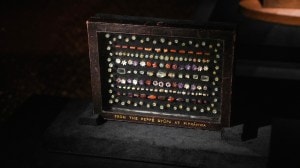
From the Juna Bazaar in our very city to the Jumme Raat Bazaar in Hyderabad to Burhanpur 8211; they scourged through different places to get whatever they could. Hyderabad proved to be a treasure house of different kinds of swords and paintings. 8220;I could procure 80 locks of different sizes dating to over two centuries ago at the Jumme Bazaar. We got them cleaned and there is a separate section at the museum for their display8221;.
Searching for Wadas built in Pune on the lines of the Shaniwar Wada, they succeeded in getting some authentic woodwork done even in sagwan that was re-installed at the museum. Statues, carpets, chandeliers, toys, puja material, pillars, cannons, coins 8211; the hoard accumulated.
All along, Khare also worked on the paintings that would also be part of the display. This was to enable the visitor to know how the Peshwas looked, what they wore. 8220;They themselves had got artists from Jaipur to do their portraits 8211; in miniature style. We were able to locate some of these, and from them I made bigger portraits. Each of the Peshwa and his deputies. There are also some showing their social life 8211; their hobbies like hunting, boat-riding, some others depicting celebration of festivals then8221;.
Referring to documents at the Peshwa Daftar, they got charts made and the museum was pieced together. 8220;It is still growing, with every addition that comes our way8221;.
Whilst this work was in progress, the decade-long research equipped him with enough reference material. Khare got to see many old pictures, and that got him fascinated. The thought came to mind to do a personal collection of paintings, and he got cracking. 8220;The cut-off date was 200 years ago, and till now, 100 pictures miniature are ready.8221; The Peacock Bazaar in Mumbai, the scene of a typical Maharashtrian house, marriage processions, the 1857 revolt, bullock carts, post coaches, costumes of British sepoys 8211; his canvas holds a mirror to life in Pune, 200 years ago.