Journalism of Courage
 6 min read



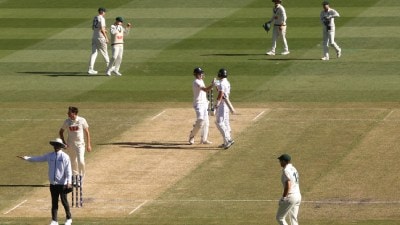
The Wanderers Cricket Gro-und in Johannesburg has a capacity of 32,000 seats. On Sunday, the stadium was fully sold out: 32,000 privileged people had a date with destiny. They came prepared for a grand finale in an Australia vs South Africa ODI series tantalisingly tied at 2-2. Little did they realise on that gloriously sunny morning that they would witness a cricketing tsunami, which would blow away the ODI record book, and experience a match that will never 8212; ever 8212; be replicated.
I still cannot believe that I was one of those spectators. As part of the ICC inquiry into the allegations of racial abuse of South African players by Australian spectators in the recent Test and ODI series in December 2005/February 2006, I had to go down to interview the players since by the time I reached Australia, the South African players had returned home. I was also required to attend two ODIs in Durban and Johannesburg to study crowd behaviour and the security measures undertaken by the South African cricket administrators.
Many hoped that South Africa would wrap up the series in Durban itself on Friday. That did not happen. So the focus shifted to Jo8217;burg. From the very beginning the atmosphere was vibrant. Standard Bank, the main sponsors, gave away 10,000 South African caps. Flags were flying in the cool breeze. Aussie supporters were sprinkled all over. The South African fans were charged up but behaved impeccably. And then, the roller coaster ride began.
The Australians clearly operate to a set and skilful pattern. Gilchrist and Katich started at a brisk pace, and built an impressive base on which the rest of the players quickly build a score that seemed impossible to chase. In the process, the bowlers got demoralised and the fielders became listless. Ponting came in at 97. It was impossible to contain him. As the partnerships consolidated, people started inquiring about the world record for the highest ODI score. It was Sri Lanka8217;s 398 against Kenya in the 1996 World Cup. When the third wicket fell at 374, it was clear the Lankan record would be a thing of the past. Now it was only a question of seeing what total the Aussies would build up. It turned out to be 434 for four!
During the lunch break, Ray Mali, president of the United Cricket Board for South Africa, was invited to speak in the Long Room. The amiable Ray said that he was happy that he was not in the South African dressing room at that point. And then he said, 8220;Do not give up hope! We have got them out for 93 in this series and we can beat this score today.8221; The audience clapped politely but clearly there were no takers for such optimism. When Ray returned to the president8217;s table, a senior South African minister told him, 8220;Ray, I must compliment you on your great imagination.8221; To this I gently responded, 8220;I think Ray must be thinking of a political career when his term gets over!8221;
By this time the game had started. Dippenaar was out for one and the score was 3/1. That8217;s when Gibbs came in. Before he could open his account, Ray remarked, 8220;You know, if Hersch gets going, he can win this match for us.8221; But it was only Ray who was optimistic. In fact, by now, scepticism had grown considerably and, believe me, several people were already talking of going home. And then something happened. Smith, a huge man, decided that if he had to go down, he would do so with all guns blazing. There was something in the way he took his stance. He crouched like a predator 8212; 8220;come and get me, or I will get you,8221; he seemed to say. The air became electrified. I told the couple sitting next to me that we were perhaps going to see history.
Gibbs took over from Smith and the famous Australian attack apart from Bracken fell apart. It was like the unfolding of a dream. As the runs piled up, the target got closer. Tension built up. People were no longer able to sit in their own seats. Every six and every four were met with roars of, 8220;Yes, yes, yes!8221;
After Gibbs got out for 175, Telemarcus and Van Der Wath gave vital support to Boucher. It was the last over. Seven to win in six balls. When Hall got out, two runs were needed with three balls left. There were huge groans when Ntini came on. Given the endearing Ntini8217;s lack of batting talent, several there were ready to settle for a tie. A single was taken and there was a palpable sigh of relief from the crowd: 8220;Now we cannot lose.8221; Then Boucher hit a four on the second last ball, and it was 438/9. There was one ball left but it was all over.
The crowd erupted like a volcano. I have never seen such emotions and such expressions. The legendary Pollock one of the all-time greats stood silently with tears in his eyes. The Australians could not believe what had happened to them, but Ponting and his team were gracious in their reaction. Ponting showed his greatness when he declined to share the 8216;Man of the Match8217; with Gibbs, because he felt Gibbs deserved it fully.
The 32,000 people who saw history being made at that stadium will be able to tell their children, 8220;We were there. We saw history being made.8221;
The writer is solicitor-general of India