Journalism of Courage
 5 min read



WHEN the weatherman predicted more rain for Gujarat in the coming days, BS Rathwa, the mamlatdar of Talaja taluka in Bhavnagar district, couldn8217;t brush off a feeling of complacence. He took off in his jeep to witness a rare sight in these otherwise parched parts 8212; check dams brimming over under a still promising grey sky.
One though played over and over: 8220;Now, we don8217;t have to worry about rationing water to the people of Talaja. Thanks to these check dams, we have enough drinking water till the next monsoon. We may also provide for irrigation later on,8221; he says, pointing to one of the three check dams on the Shetrunji river.
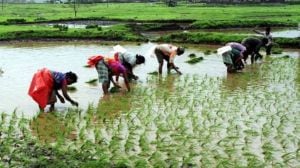
Dhoraji taluka of neighbouring Rajkot district is witnessing another rarity. After a gap of 22 years, farmers are ready to plant a sugarcane crop. Until last year, they planted only less water-intensive crops. Then, a 200-m long check dam on the Bhadar river near Supedi village came up. Now, the taluka has enough to irrigate sugarcane plantations and better still, groundwater levels in a 5-sq km area have been recharged.
Supedi8217;s Sarpanch Subashbhai Patel says this year, they will have sugarcane across 200 acres in the village. Villagers do spare a thought for Surat and Anand that have borne the brunt of the heavy rain but point out their happiness has been long in coming too. All 50,810 check dams in the state are overflowing, recharging some 71 major and minor rivers besides numerous rivulets and streams on which they are built. About 6,000 of these in the scarcity-prone districts of north Gujarat and Saurashtra came up only after the last monsoon.
Economist and Professor Emeritus, Sardar Patel Institute of Economic and Social Research, Dr Yoginder K Alagh, says the check dams, along with the Sardar Sarovar Project SSP on the Narmada, will have a widespread impact on Gujarat8217;s agriculture and economy.
8220;First, cotton, which did badly till 2005 will hold out this year. The crop in China is not doing well so with a bumper crop, we may even export cotton as we did in the 90s. Revival of grains in kharif is evident and rice will do well due to availability of water in plenty,8221; says Alagh. 8220;With water tables recharged, all wells, ponds and tanks will be full and the moisture content will be high which means a good rabi crop too. I think, combined with SSP, increase in availability of water means bumper crops and therefore, a 4 to 5 per cent economic growth in Gujarat.8221;
If that sounds like the ideal story, take a worst-case scenario. Dhrol in Jamnagar district faces water shortage throughout the year. With five check dams on the Und river, this year, it is expecting regular drinking water supply throughout.
Minister of State for Water Supply Harjivanbhai Patel says good rainfall combined with the enhanced storage capacity of the check dams has eased the drinking water situation. 8220;We withdrew water tankers from many villages in Banaskantha and the tribal areas of Sabarkantha. The groundwater tables have been thoroughly recharged due to the check dams,8221; says Patel. 8220;In fact, where check dams were not possible, bori bunds sandbag have been put up to temporarily halt water flow to allow percolation. It is making a lot of impact on the water tables.8221;
The Irrigation Department says the water storage capacity of Gujarat8217;s check dams is about 24,000 million cubic feet. Since 2002, the government has been constructing checkdams across the state with public participation. 8220;The state government earlier provided 60 per cent of the cost of a check dam while the panchayats or nagarpalikas bore 40 per cent expenditure.
Last year, the government increased its share to 80 per cent,8221; says Agriculture Minister Bhupendrasinh Chudasma.
8220;We have irreversibly lost the rainwater that had flown so far but now, these check dams are doing wonders to the water table. The water supply and irrigation will improve very much this year,8221; says the minister.
Besides, the state is counting the long-term benefits8212; thousands of farmers from Amreli and Bhavnagar who migrated to Surat and Mumbai to work as diamond polish workers are either returning home or making sure the next generation stays put in the villages.
The check dams too have a diamond connection. Most check dams in parched Saurashtra have been constructed by the Saurashtra Jaldhara Trust headed by millionaire diamond merchant Mathurbhai Savani, who had once left Saurashtra for Surat. 8220;All the trust members belong to Saurashtra too,8221; says Vipulbhai, chief engineer of the trust. 8220;Many farmers migrated earlier as their crops failed and they fell into heavy debt but they are also returning now. Now we want to prevent migration of the second generation.8221;
With water for at least another year secure in check dams, that8217;s a new prayer too for Saurashtra.