11 min read


© The Indian Express Pvt Ltd



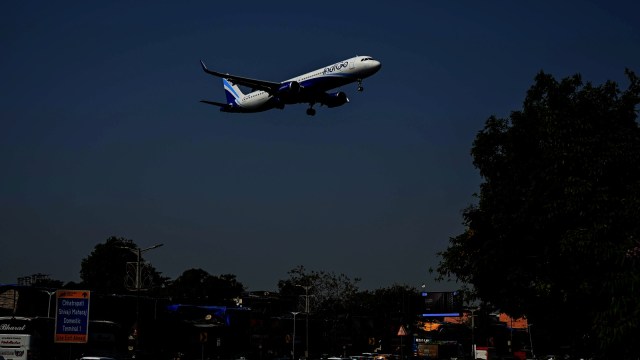 An IndiGo aircraft prepares to land in Mumbai. (Photo: Sankhadeep Banerjee)
After a harrowing start to December, when the operations of India’s biggest airlines unravelled over a new set of crew rest-and-duty duration rules, for now, a sense of calm has descended on the Indian skies. Riding on a temporary exemption granted to it by aviation regulator Directorate General of Civil Aviation (DGCA), IndiGo has over the past week managed to stabilise its operations and steadily ramp up its daily flights — up from around 700 at the peak of the chaos to over 2,050 since Saturday, December 13.
Without the temporary exemption related to night operations in the new rules, IndiGo could not have staged such a rapid recovery. The answer to why IndiGo sought these specific exemptions, which will be in place till February 10, and why the regulator yielded, lies in the airline’s dominance of the night skies.
Between midnight and 6 am — the new definition of ‘night’ in the revised Flight Duty Time Limitation (FDTL) rules — IndiGo has more domestic arrivals and departures than any other airline by a huge margin. Which is why, when the DGCA capped at two the maximum number of landings for a pilot operating a flight — landing or taking off — in this six-hour window, the impact on IndiGo was disproportionately higher.
IndiGo’s dominance of the night sky
The new FDTL norms define night duty as any duty period “encroaching upon any portion of the time period between 0000 hrs and 0600 hrs in the time zone to which the crew is acclimatised”. The earlier definition of night duty was midnight to 5 am. Listing the operational limits for pilots in a 24-hour period, the new norms say that for “operations encroaching night duty”, the maximum number of landings allowed are two. In the earlier norms, up to six landings were permitted.
With a far more widespread network than any of its competitors, IndiGo is the sole operator on over 60 per cent of its domestic routes. The size, scale, and expanse of IndiGo’s network makes it a lot more complicated for the airline to manage crew rostering for flights. The cap on landings for pilots operating in any part of the 12-6 am window hit IndiGo the hardest since they were flying night hours more than any other airline.
An analysis by The Indian Express of schedule data sourced from aviation analytics firm Cirium shows that IndiGo has more domestic arrivals and departures during the 12-6 am ‘night’ period than that of all other airlines put together.
Data related to IndiGo’s domestic schedule for Mondays in November shows that the airline had 155 flight arrivals and 166 departures in the new six-hour night window. These accounted for 59.2 per cent of all domestic arrivals and 62.2 per cent of departures across the five major Indian airlines — IndiGo, Air India, Air India Express, Akasa Air, and SpiceJet. Which means, of every 10 airlines taking off or landing between midnight and 6 am anywhere in the country, six would be IndiGo.
In terms of the total 529 domestic aircraft movements (a departure and an arrival are counted as one movement) across major airlines during these six hours, IndiGo’s share was 60.7 per cent.
Unsurprisingly, IndiGo is also the dominant carrier in the 5-6 am window — the additional hour in the new night duty definition. At 89 departures and 18 arrivals, IndiGo has the highest number of domestic aircraft movements in this window. The airline accounts for 58 per cent of all 5-6 am departures across the five major airlines, while in arrivals, its share is a staggering 95 per cent. Barring Air India Express, which has one arrival, none of the others — Air India, Air India Express, and SpiceJet — have any domestic flight arrival listed in this particular hour. In terms of aircraft movements in this one hour, IndiGo’s share is almost 62 per cent.
Yet, given the scale of IndiGo’s network, the night operations are only 8 per cent of its overall daily flights, a share comparable to, or even lower than, that of other airlines. But in absolute numbers, the gulf between IndiGo and other carriers is hard to miss.
Airline schedules for Mondays in November show IndiGo operated 1,994 domestic flights, significantly higher than Air India’s 544, Air India Express’s 382, SpiceJet’s 154, and Akasa Air’s 134.
Although the airline faced little disruption in the first month of the new night duty rules, which kicked in November 1, by early December, its roster resilience caved in, with some external factors like technical glitches, adverse weather, and increased congestion at key airports compounding the impact.
Because IndiGo’s operations are spread across far more airports, pilot rostering becomes more complex: the airline needs to maintain a larger number of crew bases, each with enough standby pilots to absorb disruptions.
Data shows that Air India, Akasa Air, and SpiceJet have around 80 per cent of their 12-6 am domestic aircraft movements concentrated at the top six metro airports — Delhi, Mumbai, Bengaluru, Hyderabad, Chennai, and Kolkata — while it’s notably lower, at around 60 per cent, for IndiGo and the much smaller Air India Express.
While IndiGo spread its wings faster and farther than any other airline, including in the 12-6 am window, it did so without proportionately expanding its pilot workforce. The change in the night duty norms was primarily prompted by concerns of pilot fatigue, a key risk to aviation safety. One of the key objectives of the night flying-related changes in the rules was to reduce the pilots’ workload in the Window of Circadian Low (WOCL) — 2 am to 6 am — when the human body is susceptible to a fall in alertness and cognitive function, and an increase in fatigue levels. Reforming the FDTL regime had been a long-standing demand of pilot associations.
As per data shared by the airline with the regulator in review meetings during the peak of the disruption, the airline was short by 65 captains for its workhorse Airbus A320 fleet to maintain its schedule as per the new FDTL rules. While it had sufficient first officers for the new rules, even there, there wasn’t much of a buffer. The new crew rest and duty norms required IndiGo to have 2,422 captains and 2,153 first officers; the airline had 2,357 captains and 2,194 first officers.
Yet, the airline expanded its domestic flight schedule, and more so, its night flying. IndiGo’s schedule data from Cirium also shows that on Mondays in November, its domestic aircraft movements in the six-hour period were almost 13 per cent higher than in November last year, and around 6 per cent higher than June this year. Its total daily domestic flights for the day were 8.3 per cent higher year-on-year and 1.6 per cent higher vis-à-vis June.
Queries sent by The Indian Express to IndiGo remained unanswered at the time of publication.
IndiGo’s competitors appear to have approached the new rules with better preparation, particularly in terms of network adjustments and pilot availability. They also benefited from having a strong bench strength of pilots relative to the size of their aircraft fleets and networks, which provided them with sufficient pilot buffers.
The long night and its cascading impact
Airlines are now required to put more pilots on the roster not just for the six-hour night window, but across the entire day, given the cascading impact of the crew landing cap. Known for its lean and efficient staffing model, IndiGo did not have a sufficiently large buffer to fill the gap.
The new rules meant that for pilots operating flights that were landing or departing in the six-hour night window, the maximum number of sectors (one takeoff + one landing) they could operate during their entire shift for that day would be two, and not the usual four or five that they would operate earlier.
Say, two pilots operate an 11 pm Delhi-Mumbai flight and land in Mumbai post midnight. The two would be allowed to operate just one more flight in their shift that day, and that too if this was their first flight of the shift. If it was their second flight of the shift, which means it would be their second landing, they cannot operate another flight after landing in Mumbai. And if they had already done two flights in that duty shift before this flight, operating this one would be a violation of the new FDTL norms, say experts.
Similarly, if a set of pilots operate a 5 am Delhi-Mumbai flight as their first flight of the day, they would be permitted to operate just one more flight during that duty period, even though the FDTL-defined night hours would have ended before their next flight’s departure. Under the earlier norms, the airline could have, theoretically, asked them to fly four more sectors within their duty shift.
While the new FDTL rules were stipulated nearly two years ago, giving the airline enough time to prepare its rosters by either adjusting its schedule to comply with the new norms or increasing pilot strength, IndiGo fell woefully short on both counts. The airline, in fact, ended up increasing flights — including night flights — and went slow on pilot hiring.
According to the DGCA, IndiGo admitted that it was short on pilots vis-à-vis the requirement under the new FDTL norms and that the disruptions arose “primarily from misjudgement and planning gaps in implementing” the rules. The result was for all to see — thousands of flights cancelled and tens of thousands of passengers stranded at airports across the country as India’s aviation system went down on its knees.
The DGCA is probing the disruption, and the airline is conducting its own internal investigation. The regulator has also ordered IndiGo to curtail its domestic flight schedule by 10 per cent.
According to sources close to IndiGo, the airline is likely to gradually scale up its operations over the coming days to around 2,200 daily flights — 1,900 domestic and roughly 300 international — down from the 2,300 flights it operated before the crisis. This truncated schedule is expected to last until March 28, 2026.
The sources said pilot hiring at the airline is in full swing and that they expect sufficient numbers to be added by early- to mid-February. Also, command upgrades — promotions of first officers to captains — are being expedited, a move that is expected to increase the airline’s bench strength.
If these measures don’t add up before the DGCA’s February 10 exemption deadline, IndiGo may be forced to make adjustments to its network, particularly by rationalising night flights.
While IndiGo has managed to pull back from the brink, industry experts say questions will continue to be raised about its lack of preparedness. At least in this instance, India’s biggest airline may have dominated the night — but also seemed to be flying in the dark.
The cap on landings for pilots operating in any part of the 12-6 am window hit IndiGo the hardest since they were flying night hours more than any other airline
Other airlines appear to have approached the new rules with better preparation, particularly in terms of network adjustments and pilot availability.