Premium
This is an archive article published on June 5, 2015

Identity Crisis

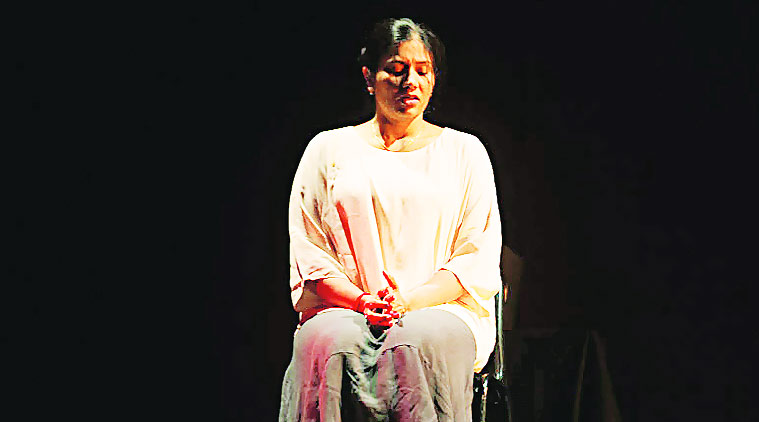
‘What happens when a stranger takes over your online identity?’ asks UK-based dancer Divya Kasturi in her new production, Forgot Your Password

talk, delhi talk, art, dancer Divya Kasturi, UK dancer, Forget your Password, lifestyle, Indian Express Forgot Your Password is a western contemporary dance performance with elements of theatre (Pictures Courtesy Simon Richardson)

It is being called the first South Asian dance theatre piece to use holograms but UK-based Bharatanatyam and Kathak dancer Divya Kasturi’s new production, Forgot Your Password (FYP), reaches even farther into technology. The solo is set in the deepest matrices of the Web where hackers with nimble fingers peep into the secrets of their victims. Even human action becomes an algorithm and there is a binary code to break it. Three years in the making and with funding from the Arts Council England, the piece is having its world premiere in London. Before today’s performance at Harlow Playhouse in the UK, Kasturi, who has worked with artistes of international acclaim such as Paul McCartney, spoke to us about dance, danger and the digital world. Excerpts:

Did a real-life experience trigger the narrative of FYP?
I would say that the trigger for the creation of FYP was in 2011, when I was in the middle of submitting my postgraduate dissertation in South Asian Dance Studies at Roehampton University in London. I submitted a website to stand in for the conventional written dissertation. In the process of creating the website, I encountered a situation in which every window I was opening on the internet was prompting me to create a user name and password. This triggered the seed of an idea since user names and passwords represent another version of ourselves. How we choose the letters and characters, create a pattern, rehearse it carefully and type it into the space for a virtual audience, is very similar to how I would create choreography. I would create a movement, then a sequence or a pattern, rehearse it and present it in front of an audience.
In the middle of researching this idea, my email account got hacked. I was in India, getting ready for a performance, when my phone started to ring non-stop, with friends, well-wishers asking me if I was okay. The interesting thing with all these real-life experiences, which underpin FYP is that there is a lot of human emotion involved. There was the trauma in losing many years of accumulated information. The other human touch that appealed to me was that some of my friends actually believed the hacking email to be true. They replied to the hacker, offering to send the money demanded, and what they got as a response was the fact that the hacker actually knew every detail about me. It struck me that there was, somewhere amid the digital media, a human quality, and of course my personal trauma of not knowing how to begin recalling the contacts I had stocked up all these years.

How did you translate your experience into a fictional storyline?
FYP spins from my own experience, with the main character getting a hacked email. The fact that the hacking happened slowly unfolds through the 50-minute piece. It is interjected with holographic projections, some of which are to do with the protagonist multiplying so there are many avatars of her. In one instance, there are about seven of her on stage. How the protagonist gets affected emotionally is interspersed with the emotional arc of trust and starting all over again.

You are an engineer. Did this make it easier to perform with hologram technology?
I had to be 200 per cent alert while designing the whole piece. I had to imagine that there was a virtual hologram standing next to me and avatars of me were dancing alongside. Musion is the company that has done the holographic projections. They had realised Narendra Modi’s 3D holographic projections as well as Michael Jackson’s. I wanted to integrate it with performance in a theatre space, so that was how I envisaged the piece. We also tried a game for the audience to guess the most common passwords and winners would get free tickets to the performance. To add up to the experience, we designed a pre-show installation wherein people could try a dance move and watch their 2D avatar perform it in the foyer space before entering the theatre.

Dipanita Nath is a Senior Assistant Editor at The Indian Express, based in Pune. She is a versatile journalist with a deep interest in the intersection of culture, sustainability, and urban life. Professional Background Experience: Before joining The Indian Express, she worked with other major news organizations including Hindustan Times, The Times of India, and Mint. Core Specializations: She is widely recognized for her coverage of the climate crisis, theatre and performing arts, heritage conservation, and the startup ecosystem (often through her "Pune Inc" series). Storytelling Focus: Her work often unearths "hidden stories" of Pune—focusing on historical institutes, local traditions, and the personal journeys of social innovators. Recent Notable Articles (December 2025) Her recent reporting highlights Pune’s cultural pulse and the environmental challenges facing the city during the winter season: 1. Climate & Environment "Pune shivers on coldest morning of the season; minimum temperature plunges to 6.9°C" (Dec 20, 2025): Reporting on the record-breaking cold wave in Pune and the IMD's forecast for the week. "How a heritage tree-mapping event at Ganeshkhind Garden highlights rising interest in Pune’s green legacy" (Dec 20, 2025): Covering a citizen-led initiative where Gen Z and millennials gathered to document and protect ancient trees at a Biodiversity Heritage Site. "Right to breathe: Landmark NGT order directs PMC to frame norms for pollution from construction sites" (Dec 8, 2025): Reporting on a significant legal victory for residents fighting dust and air pollution in urban neighborhoods like Baner. 2. "Hidden Stories" & Heritage "Inside Pune library that’s nourished minds of entrepreneurs for 17 years" (Dec 21, 2025): A feature on the Venture Center Library, detailing how a collection of 3,500 specialized books helps tech startups navigate the product life cycle. "Before he died, Ram Sutar gave Pune a lasting gift" (Dec 18, 2025): A tribute to the legendary sculptor Ram Sutar (creator of the Statue of Unity), focusing on his local works like the Chhatrapati Shivaji statue at Pune airport. "The Pune institute where MA Jinnah was once chief guest" (Dec 6, 2025): An archival exploration of the College of Agriculture, established in 1907, and its historical role in India's freedom struggle. 3. Arts, Theatre & "Pune Inc" "Satyajit Ray, Ritwik Ghatak were not rivals but close friends, says veteran filmmaker" (Dec 17, 2025): A deep-dive interview ahead of the Pune International Film Festival (PIFF) exploring the camaraderie between legends of Indian cinema. "Meet the Pune entrepreneur helping women build and scale businesses" (Dec 16, 2025): Part of her "Pune Inc" series, profiling Nikita Vora’s efforts to empower female-led startups. "How women drone pilots in rural Maharashtra are cultivating a green habit" (Dec 12, 2025): Exploring how technology is being used by women in agriculture to reduce chemical use and labor. Signature Style Dipanita Nath is known for intellectual curiosity and a narrative-driven approach. Whether she is writing about a 110-year-old eatery or the intricacies of the climate crisis, she focuses on the human element and the historical context. Her columns are often a blend of reportage and cultural commentary, making them a staple for readers interested in the "soul" of Pune. X (Twitter): @dipanitanath ... Read More


📣 For more lifestyle news, click here to join our WhatsApp Channel and also follow us on Instagram


Latest Comment
Post Comment
Read Comments
Advertisement
Advertisement
Advertisement
Advertisement