Journalism of Courage



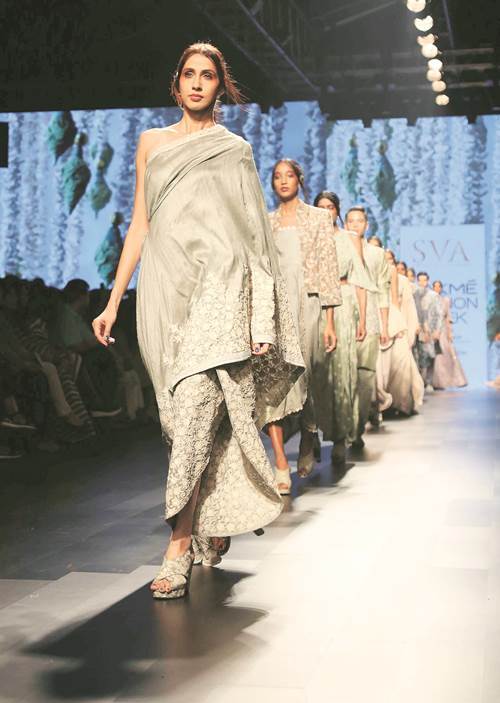 Photo by Dilip Kagda.
JUST when fashion watchers were beginning to tire of the endless parade of boxy dresses, the sameness of sack-like silhouettes and a surfeit of earthy textile hues that walked the runway on the first two days of Lakme Fashion Week (LFW) Summer/Resort 2017, courtesy designers championing the cause of sustainable fashion, there was a marked change in pace and presentation on Day Three. Friday saw a parade of lehenga skirts, dhoti pants, kedia tops and cape blouses take over, subverting the narrative and presenting the flipside of the coin that constitutes contemporary Indian fashion. Gone were the unfinished hems, unadorned textiles, coarse cottons and gauche detailing, replaced instead by beaded tunics, luxurious lace and zardozi embroidery.
More from the lifestyle world:
They may have been unceremoniously tagged as the “commercial crowd”, but this crop of designers are the ones pushing the — oft-abused and seldom actualised — ‘Indo-Western’ ideology. Designer Payal Singhal, for one, calls her creations “global fusion Indian clothes” and has no qualms about being called a “commercially successful” designer.
And she subscribed to same style sentiment on Friday evening with her glamourous line “Lady M”, inspired by Agatha Christie’s dark romantic murder mystery Death on the Nile. While it ticked off all the boxes in the Indianwear category, she lent a resolutely modern touch to the collection with the retro Gatsby-esque flair of fringed beaded tunics and jazzy dresses. Art Deco embroidery laden lehenga skirts were teamed with silken blouses and asymmetric skirts were worn over cancans.
Low crotch dhoti pants were paired with beaded kaftans and slinky camisoles and scalloped edges lined tops and jackets. The colour palette was decidedly unconventional with midnight blue, gunmetal, navy, blush and emerald meeting champagne, pale rose and blue hues, ideal for Singhal’s large NRI clientele and the destination wedding-hopping crowd.
Designers Monica Shah and Karishma Swali also experimented with fusion silhouettes for their luxury pret label Amoh by Jade. There were Victorian lace edged angarkha-style kurtas, blouses paired with tailored dhoti pants and coquettish corset tops worn with scarlet palazzos. We especially loved a plain rose gold lehenga that was offset by a classic ivory blouse and a ruby red cape.
Hints of ivory added a Victorian appeal to SVA’s spring-summer collection “Noor” too. Sonam and Paras Modi steered clear of their recent preoccupation with brocade weaves and instead presented a British Raj-influenced collection primarily playing with embroidery and drapes. Cape sleeves on off-shoulder blouses, peplum jackets teamed with dhoti-style tulip pants and asymmetrical sari drape tunics were embellished with intricate zardozi and pita work, giving the appearance of delicate lace. Again, a muted palette of greys, burnt rose, green tea and ecru kept the collection from looking singularly Indian in sensibility.
In contrast, Delhi label Madsam Tinzin introduced a native sensibility rarely seen on Indian runways — that of the Brok-Pa tribe from Ladakh. While surface ornamentation was used to replicate the texture details of Brok-Pa fabrics and materials like cotton-chanderi, kota, modal-linen and matka silk were used for their earthy appeal, the silhouettes remained breezy, contemporary and imminently wearable.
And in many ways, the work of Madsam Tinzin, the amalgamation of the design experiences of friends and NIFT graduates Madhurita, Saumya, Tina and Stanzin, is pretty much a representation of the Indo-western wave that’s sweeping contemporary Indian fashion, straddling the chasm between commercial concerns and aesthetic appeal. May their tribe grow.

 4 min read