5 min read


© IE Online Media Services Pvt Ltd



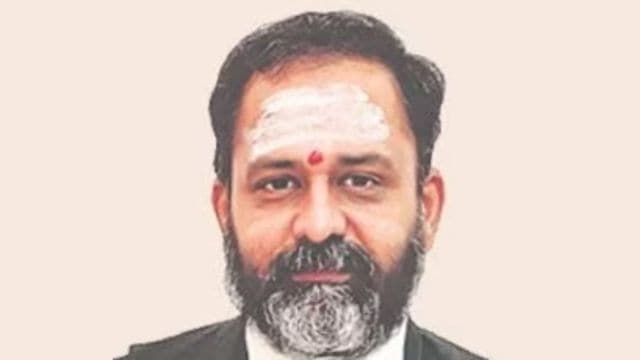 Justice Swaminathan had released a self-appraisal card on completion of two years of his service.
The ruling of Madras High Court’s Justice G R Swaminathan has triggered a political storm with the ruling DMK exploring options for his removal.
The judge has often made headlines for his orders and public utterances in the past, most recently being the legal tussle over the lighting of the Karthigai Deepam lamp atop the Thiruparankundram hill in Madurai.
On December 1, the judge allowed devotees to light the ceremonial lamp at the Deepathoon — a stone pillar located near the Ucchi Pillaiyar shrine and close to a dargah complex – prompting a legal and political tussle.
Justice Swaminathan, who is a first generation lawyer, was born in 1968. He practised for over thirteen years at Chennai. After the establishment of the Bench of Madurai, he shifted his practice.
He was the standing counsel for several public sector undertakings. He became the Assistant Solicitor General of India for Madurai Bench in the year 2014. He was elevated as Additional Judge of the Madras High Court in June 2017 and later made permanent.
Justice Swaminathan has authored several landmark judgments covering free speech, prisoners’ rights, animal rights and the rights of differently-abled. According to the Madras High Court website, Swaminathan has so far authored 52,094 judgments and orders.
Swaminathan surprised many by releasing a self-appraisal card, along with a confession that he was releasing 75 cases from his board, in which he reserved orders but failed to deliver final orders. He said in a letter that he had decided to release the performance card on his own work as he believes “in judicial accountability”.
Contempt warning: Justice Swaminathan issued a contempt warning to Advocate S Vanchinathan while presiding over a case in which Justice Swaminathan was the subject of a complaint sent by the same lawyer to the Chief Justice of India, alleging caste bias and ideological misconduct.
Vedas: While speaking at the 17th Annual Talent Parade of Vedic Scholars, the judge recounted how he once helped acquit a man who confessed to a fatal accident, and saw it as proof that “the Vedas protect those who protect them.”
Sivakasi statue case: Coming down heavily on the local authority in Sivakasi, his bench allowed the installation of a freedom fighter’s statue at a local community hall after ordering its release from the tehsildar’s custody. Swaminathan pointed out that while a statue may have “symbolic value”, it is also “property in the legal meaning of the term”.
Constitution: While speaking at a book launch event in Chennai, Justice Swaminathan said that the Constitution of India will cease to exist if the country’s “demographic profile” that existed when the document was formed is altered. He also said that the Constitution will continue to exist as long as the people “who are under the Indian tradition and dharma” remain so.
Annadhanam: A litigant was allowed to hold Annadhanam (distribution of food) in an open public ground. It was held that if a particular section is excluded from using a public ground on the sole ground of religion, it would offend Article 15 of the Constitution. Justice Swaminathan held that the right to hold Annadhanam can even be brought within the scope of one’s fundamental right under Article 25, reported Verdictum.
Privacy: In a significant judgment, it was observed that privacy as a fundamental right includes spousal privacy and also declared that evidence obtained by invading a spouse’s right is inadmissible in court, reported lawbeat.
Aadhaar: It was held that Aadhaar correction is not a discretionary privilege but a statutory and fundamental right flowing from Section 31 of the Aadhaar Act, 2016, reported Verdictum.
Adoption: It was held that adoption under the Juvenile Justice Act, 2015, confers complete parental rights equivalent to those of natural parentage, stating that the Act will prevail over Muslim Personal Law in such matters, reported Verdictum.
Former Madras High Court judge Justice K Chandru recently launched a scathing attack on the judge for his purported anti-Constitution remarks during an event organised by the Viduthalai Chiruthaigal Katchi (VCK) Advocates’ Wing and Samathuva Vazkarinyar Sangam, reported lawchakra.com.
According to the report, “Justice Chandru did not mince words” and described Justice Swaminathan “as a strange person for making statements at Rashtriya Swayamsevak Sangh (RSS) events” that, “strike at the heart of India’s constitutional values”. “Speaking at an event in Haryana, Justice Swaminathan reportedly described the Indian Constitution as a ‘copied’ document derived from the Government of India Act, 1935, claiming it lacked originality,” the report added.