Journalism of Courage



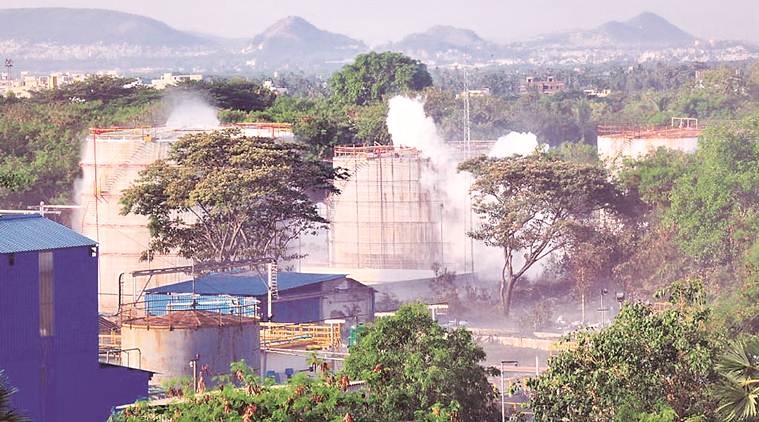 After the gas leak at LG Polymers in R R Venkatapuram village of Visakhapatnam Thursday. (PTI)
The gas leak at the L G Polymers plant in Visakhapatnam on Thursday puts under the spotlight gaps in the legal framework in dealing with such accidents.
A decade ago, the issue was raised even during discussions on the Civil Nuclear Liability Act, 2010. The 2010 Act deals with instituting civil liability for nuclear damage and granting prompt compensation to victims of a nuclear incident.
While participating in a debate on the Act on August 30, 2010, then Leader of the Opposition in Rajya Sabha Arun Jaitley had said, “We have a sad and unfortunate experience of the Bhopal gas leak. This law deals only with nuclear incidents. I think, two lessons still remain. If there are incidents and accidents which are not on account of a nuclear incident but because of which a large number of casualty and damage does take place, our legal regime even today is only the conventional legal regime that the victims go to a civil court, and then have their remedies adjudicated, and we are all conscious of the limitations of our legal system that it almost takes decades, not years, in order to compensate the victims…”
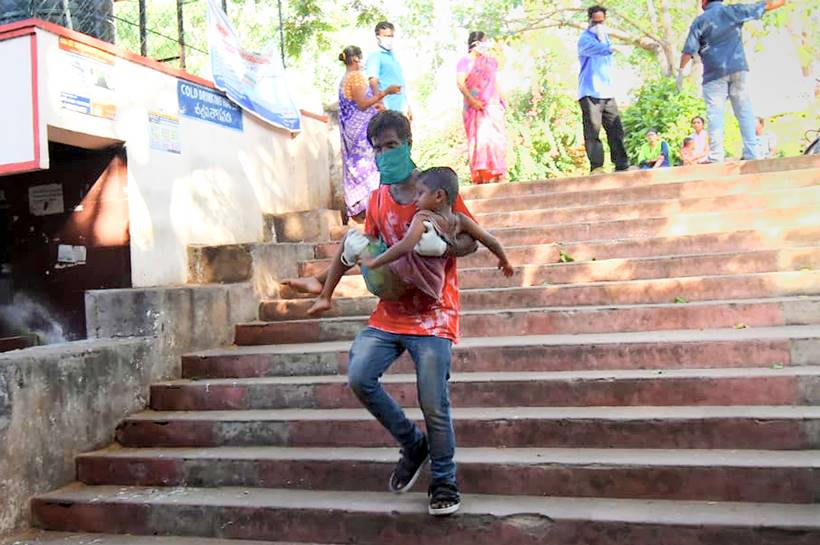 A father rushes to take his child for treatment at King George Hospital. (PTI Photo)
“So, I would urge the Government while dealing with this expeditious legal remedy machinery for victims of a nuclear incident to also consider that other incidents of this kind, which are not caused on account of a nuclear leakage, also there ought to be a similar law which would deal with it.”
While the civil nuclear law does not deal with criminal remedies, he said criminal remedies are going to be the same, whether it is a nuclear leak or a gas leak or a chemical leak, and argued that the legal architecture regarding them needs to be strengthened. “…when you store or utilise the hazardous material and it is utilised in a manner, the fact that there is a leakage itself is a proof that you did not handle it properly, and, therefore, you must be taken to task for this,” Jaitley said.
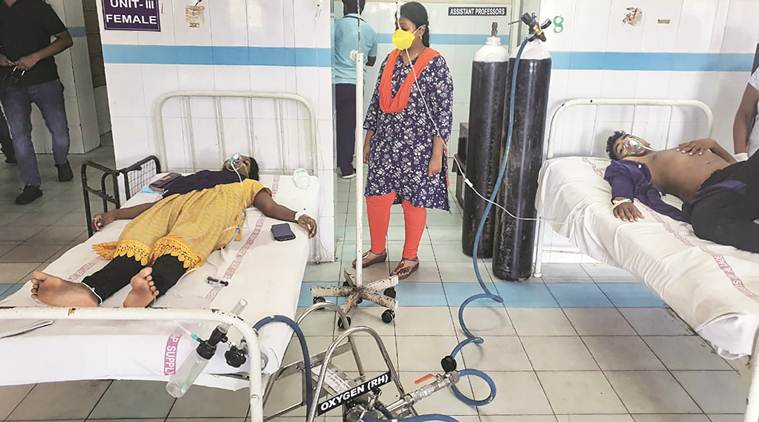 Victims of the Visakhapatnam gas leak at a hospital. (PTI)
This principle of strict liability was evolved by the Supreme Court in the 1987 Oleum Gas leak case to fix civil liability on companies and compensate the victims.
The Environment Relief Fund (ERF), a central fund under the Public Liability Insurance Act, 1991, was set up to provide immediate relief to victims of accidents in chemical industries. In March, a study by Vidhi Centre for Legal Policy found that a corpus of Rs 810 crore with ERF has remained unutilised for nearly three decades.
The other provision for fixing liability can be found in the Environment Protection Act, 1987, brought in the aftermath of Bhopal Gas Tragedy. Under this, the Centre has notified Manufacture, Storage and Import of Hazardous Chemicals Rules, 1989 and the Hazardous Wastes (Management, Handling and Transboundary Movement) Rules, 2008 for regulating hazardous substances.
Violation of these regulations or failure to comply with standards would constitute an offence. The Act also has provisions against government officials found violating the law. The accused are booked under Section 304A of the IPC, pertaining to causing death by negligence and with a provision of jail term of maximum two years.

 4 min read