Journalism of Courage



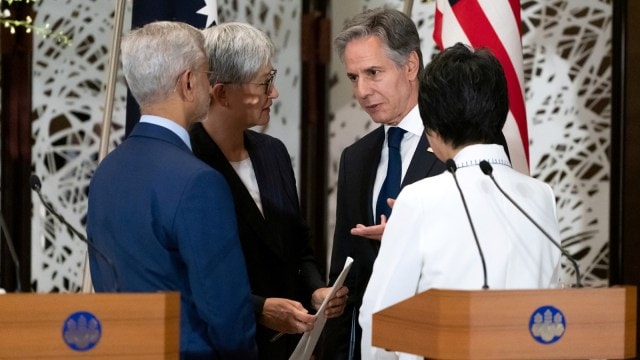 External Affairs Minister S Jaishankar with US Secretary of State Antony Blinken, Australia’s Foreign Minister Penny Wong and Japan’s Yoko Kamikawa in Tokyo, Monday. (Reuters)
THREE weeks after Prime Minister Narendra Modi visited Russian President Vladimir Putin in Moscow, India joined the US, Australia and Japan in the Quad grouping Monday to express its “deepest concern” over the “war raging in Ukraine”, and flagged “respect for sovereignty and territorial integrity” — a clear reference to Russian invasion of Ukraine.
As External Affairs Minister S Jaishankar met with US Secretary of State Antony J Blinken, Japanese Foreign Minister Yoko Kamikawa and Australia’s Penny Wong in Tokyo, the Quad reaffirmed its “steadfast commitment to a free and open Indo-Pacific, vowing to work towards a region where no country dominates others and each state is free from coercion in all its forms”. This was a veiled reference to China’s aggressive behaviour in the region.
After the Quad foreign ministers’ meeting, Jaishankar said: “The overall messaging is that our four countries — all democratic polities, pluralistic societies and market economies — are working together for a free and open Indo-Pacific, for a rules-based order and for global good. That by itself is a powerful stabilising factor in an uncertain and volatile world.”
The reference to “democracies” is important, since the US administration, under President Joe Biden, has sought to frame the debate vis-a-vis China and Russia as a contest between “autocracies” and “democracies”.
Modi visited Russia and embraced Putin during his July 8-9 visit in which he also made it clear, in public with Putin next to him, that solutions cannot be found on the battlefield. And expressed concern over the killing of children in a Russian attack on a hospital in Kyiv.
The Quad foreign ministers also said that they looked forward to India hosting the next Quad Leaders’ Summit later this year and to the US hosting the next Quad Foreign Ministers’ meeting in 2025. Biden was expected to travel to India early this year for the Quad leaders’ summit but that did not happen due to scheduling issues.
On the Russia-Ukraine war, the joint statement of the Quad foreign ministers said: “We express our deepest concern over the war raging in Ukraine including its terrible and tragic humanitarian consequences. We reiterate the need for a comprehensive, just, and lasting peace in line with international law, consistent with the purposes and principles of the UN Charter, including respect for sovereignty and territorial integrity.”
Significantly, this formulation of “respect for sovereignty and territorial integrity” is not used by India in its national statements on the Russia-Ukraine war.
“We also note the negative impacts of the war in Ukraine with regard to global food and energy security, especially for developing and least developed countries. In the context of this war, we share the view that the use, or threat of use, of nuclear weapons is unacceptable. We underscore the importance of upholding international law, and in line with the UN Charter, reiterate that all states must refrain from the threat of or use of force against the territorial integrity and sovereignty or political independence of any state,” it said.
Divergences between India and the remaining Quad members US, Japan and Australia over Russia and bilateral differences over the Pannun assassination plot have cast a shadow on the grouping. With Beijing as the principal challenge, Quad is trying to paper over the differences and make a case for cooperation.
On China’s aggressive behaviour, the joint statement said, “We reaffirm the Quad’s steadfast commitment to a free and open Indo-Pacific, which is inclusive and resilient, and are united in our commitment to upholding the free and open rules-based international order, with its strong support for the principle of freedom, human rights, rule of law, democratic values, sovereignty and territorial integrity, and peaceful settlement of disputes and prohibition on the threat or use of force in accordance with the UN Charter.”
“All countries have a role in contributing to regional peace, stability, and prosperity, while seeking a region in which no country dominates and no country is dominated, competition is managed responsibly, and each country is free from coercion in all its forms and can exercise its agency to determine its own future,” it said.
Later, while responding to questions about the role of a third party in India’s border dispute with China, Jaishankar said that the two neighbours have an issue and it is for them to find a way out.
“We are not looking to other countries to sort out what is really an issue between India and China,” Jaishankar said while responding to a series of questions at a press conference in Tokyo.
“We have a problem, or, I would say, an issue between India and China…I think it is for two of us to talk it over and to find a way,” he said.
“Obviously, other countries in the world would have an interest in the matter, because we are two big countries and the state of our relationship has an impact on the rest of the world. But we are not looking to other countries to sort out what is really an issue between us,” he said, recalling his meeting with Chinese Foreign Minister Wang Yi twice this month.
Jaishankar and Wang met last week in Laos capital Vientiane where they participated in the meeting of the Association of Southeast Asian Nations (ASEAN). At the meeting, they agreed on the need to give strong guidance to complete the disengagement process following the military standoff in eastern Ladakh in May 2020.
Jaishankar also listed the outcomes from the Quad meeting including: the Indo-Pacific Maritime Domain Awareness initiative that links information fusion centres; the Open-RAN (Radio Access Network) deployed in Palau; a space-based climate warning system to be launched in Mauritius, and off-grid solar projects in the Indo-Pacific.

 6 min read