Journalism of Courage



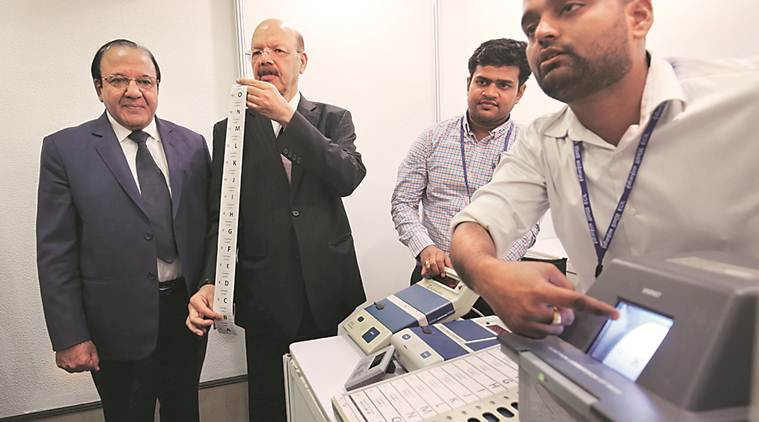 CEC Zaidi announces the challenge at Vigyan Bhawan in New Delhi on Saturday. Renuka Puri
The Election Commission’s (EC) open challenge to political parties to prove allegations of EVM tampering will begin from June 3, poll panel chief Nasim Zaidi announced on Saturday. The challenge, which the EC expects could go on for five days, will be open to a maximum of three nominees from each political party that contested the Assembly elections in Punjab, Uttar Pradesh, Uttarakhand, Goa and Manipur.
National and state parties have time till May 26 to nominate representatives for the challenge, failing which they will forfeit the opportunity to prove their allegations of EVM tampering. Zaidi clarified that only Indians can participate, which effectively rules out the possibility of parties nominating foreign experts.
To prove their allegations, the naysayers would have to demonstrate that results could be doctored by either pressing a combination of keys on the Control Unit or Ballot Unit of the EVM or both, or by communicating with the EVM through an external wireless device or bluetooth or mobile phone, over four hours. The EC may grant more time to parties to prove their charges if the parties seek it in writing.
The parties would be deemed to have failed the challenge if the EVM shuts down after their tampering attempts, if the voting results remain unchanged, if the challenger violates the EC’s guidelines, and the expert withdraws.
Zaidi refused to say what the EC would do in case a tampering attempt was successful.
The Chief Election Commissioner (CEC) rejected the demand that the technical experts be allowed to take the EVMs back with them or to tamper with the mother board of the machine.
“This is like saying that they should be permitted to manufacture a new machine and introduce their new EVMs in our system. Further, it is common knowledge that changing the ‘internal circuit’ of any electronic device is like changing the whole device itself, after which it is no longer the same device. As any person with common sense will be able to appreciate, a non-ECI EVM or an EVM with a different ‘internal circuit’ is simply a different machine or lookalike of ECI EVM, hence can never be guaranteed by the ECI to give correct results. Such a scenario is completely ruled out within our administrative safeguards and that’s why it is not proposed in the challenge,” Zaidi said at the press conference.
The EC’s announcement of the EVM challenge comes a week after it held an all-party meeting to allay apprehensions regarding the electronic voting machines, which have been in use since 2000. Over the last 17 years, EVMs have been deployed for conducting 107 Assembly elections and three Lok Sabha polls.
The machines were also at the centre of a controversy in 2004, after the BJP was shocked by the Congress in that year’s general elections.
The controversy has been revived by the opposition parties that were routed in the recent Assembly elections in five states. The BSP was the first to complain, with Mayawati alleging that largescale EVM tampering was behind the BJP sweep in UP. Later, Delhi Chief Minister Arvind Kejriwal challenged the EC to make EVMs available to the party for 72 hours and claimed that “we will read the code and rewrite it too”.
Experts of political parties, however, will not have 72 hours but a challenge slot of four hours should they want to prove essentially two allegations that have been made — first, that the EVMs used in the five Assembly polls were tampered after polling was over to favour a particular candidate/political party; and, second, that the EVMs could be altered before or on voting day even within the technical and administrative safeguards adopted by the EC.
As first reported by The Indian Express on May 10, parties can select a maximum of four EVMs from any four polling station in the five states that went to polls, to demonstrate tampering. The identified EVMs, however, should not be from polling stations where results have been challenged recently in court. Parties have time till May 26 to indicate their chosen polling stations, and will be permitted to accompany these selected EVMs from the strong room to the EC headquarters in the Capital.
Zaidi ruled out the possibility of providing EVMs used in the Bhind (Madhya Pradesh) and Dholpur (Rajasthan) by-elections for the challenge as the period for filing poll petitions against results on the two seats would not have expired by June 3. Doubts had been raised over the EVMs used in the two seats, though an EC inquiry had found the machines were working fine.
The EVM challenge will be conducted under the supervision of the EC’s technical expert committee, headed by Professor D T Sahani of IIT Delhi.

 5 min read