Journalism of Courage



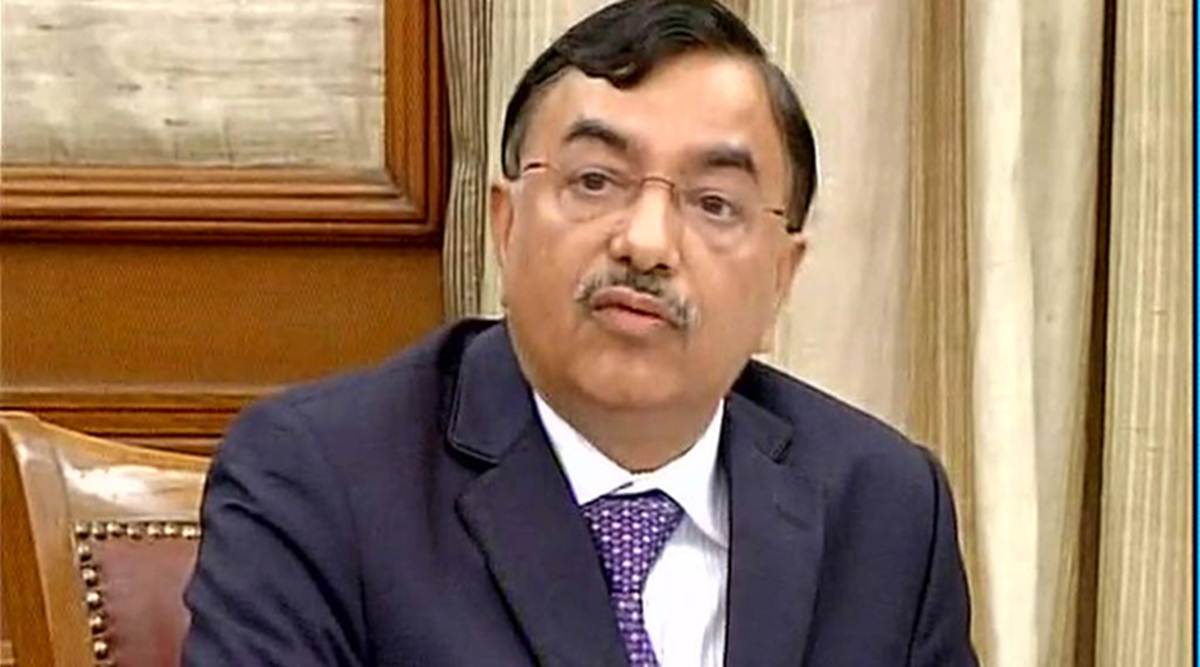 Election Commissioner Sushil Chandra. (File Photo)
The Election Laws (Amendment Bill), 2021 passed in Rajya Sabha on Tuesday will help make the electoral roll “very clean”, as it will eliminate duplication of names in voter list, Chief Election Commissioner Sushil Chandra said on Wednesday.
The Bill, he said, enables “linking of electoral roll data with the Aadhaar ecosystem”.
Addressing the media in Panaji, Chandra said: “This is a very useful Bill…the reason for this particular linkage (with Aadhaar) is that in our electoral rolls…(many) persons (are listed) in two or three places. So that will help us in eliminating double voters — double names of same persons in one constituency…so the electoral roll will be very, very clean.”
Asserting that no name will be deleted “without full verification”, he said, “You will be given choices. Suppose you are a voter at two places and we come to know that, the natural process is I should ask you whether you would like to be a voter in Panaji or at the other place. So, safeguards are there. This will ensure a very clean vote.”
The Bill was passed by Rajya Sabha on Tuesday amid a walkout by the Opposition.
In Parliament, Law Minister Kiren Rijiju had said linking Aadhaar with voter ID card “is voluntary”, and that the government held “many meetings” with the Election Commission before the Bill was brought.
Chandra also said that in the upcoming elections, political parties will have to state reasons for fielding a candidate with criminal antecedents, “so that the public is well-informed about antecedents of candidates”. The record of a candidate’s criminal antecedents will have to be published in newspapers and TV at least thrice, and parties will have to publish them on their websites as well, he said.
“They will have to give reasons for choosing a person with criminal antecedents, and why they could not find a clean candidate and what was so specific about this person that they have chosen so that there is full knowledge about the candidate. Ultimately, it is the elector who will choose.”
He said the Election Commission of India (ECI) will be stricter about this in the upcoming elections. “This has happened earlier also but it was not happening very strictly, and we have seen the reasons. In certain cases the Commission monitored and found they (political parties) had said that they (candidates) have done a lot of social work in that area, that is why we have put them (up as candidates). The Supreme Court has asked to give reasons so that the elector can understand the reason why he (candidate) has been chosen. Ultimately, the party chooses the candidate and the final decision lies in the hand of the voter.”
He said the EC will later launch an app with these details.
The ECI officials were on a two-day visit to poll-bound Goa to review poll preparedness in the state.
For the first time, he said, there will be webcasting data analytics in Goa, for which IIT-Goa has also lent its expertise. “There will be real-time monitoring of polling stations that will ensure booths will be absolutely impartial, queue management can be done through it, and if there are unwanted people in the polling booth they can be removed,” said Chandra.
While summary revision of electoral rolls in Goa will be concluded on January 5, 2022, Chandra said the number of voters in Goa is expected to be 11.56 lakh. So far, 30,598 new voters have been added to the electoral roll, of whom 16,807 are first-time voters, Chandra said.
The CEC said the elections will be held in a Covid-compliant manner and 60 additional polling booths have been added to ensure there are no more than 1,000 voters at each polling station. The number was brought down from 1,500 to 1,000 in view of social distancing norms necessitated by Covid-19.
For the state Assembly polls, there will be 1,722 polling stations in Goa and they will all be on the ground floor, he said. Of these, 100 will be manned completely by women and about 60 by people with disabilities.

 5 min read