






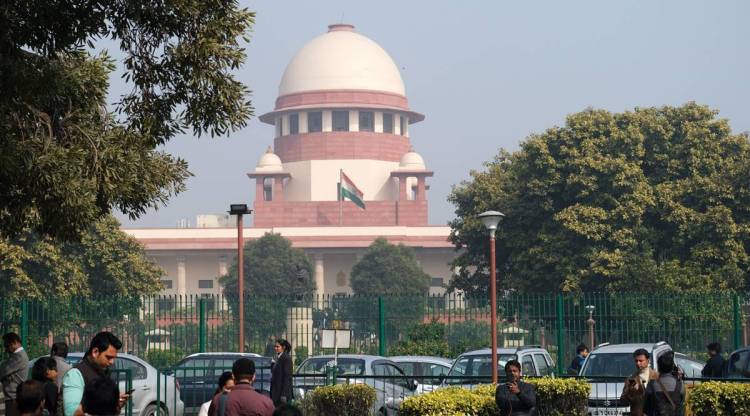
 Supreme Court (File)
Sedition Law Supreme Court Hearing Live Updates: The Supreme Court on Wednesday stayed all proceedings in sedition cases and directed the Centre and states to not register any fresh FIR invoking sedition charges until the government re-examines the colonial era penal law.
“We expect that till re-examination of S 124A is complete, it will be appropriate not to continue its usage by governments. We expect that the state and central governments will restrain from registering any FIR, continuing any probe or taking any coercive measure by invoking it till then,” the top court said.

A bench headed by Chief Justice N V Ramana said all pending cases, appeals and proceedings with respect to charges framed for sedition should be kept in abeyance. Reliefs granted to the accused by courts would continue, it said and fixed the third week of July for hearing pleas challenging the validity of the provision; by then, the Centre would have the time to undertake the exercise to re-examine the provision.


? The court “hopes and expects that central and state governments will restrain from registering any FIR, continuing any investigation or taking any coercive measure by invoking it till the review happens.”
? If any fresh case is registered under Section 124A, affected parties are at liberty to approach concerned courts for relief. “The Courts are requested to examine the reliefs taking into account the present order as well as the clear stand taken by Union of India,” a three-judge bench presided by Chief Justice of India N V Ramana ruled.
? The reliefs granted by courts to accused under the provisions of the law will continue.
? Those already booked under Section 124A of the IPC section and are in jail can approach the courts for bail. (Read more)
Although Thomas Macaulay, who drafted the Indian Penal Code, had included the law on sedition, it was not added in the code enacted in 1860. Legal experts believe this omission was accidental. In 1890, sedition was included as an offence under section 124A IPC through the Special Act XVII.
The punishment prescribed then, transportation “beyond the seas for the term of his or her natural life”, was amended to life imprisonment in 1955. (Read here)
Section 124A defines sedition as: “Whoever, by words, either spoken or written, or by signs, or by visible representation, or otherwise, brings or attempts to bring into hatred or contempt, or excites or attempts to excite disaffection towards, the Government established by law shall be punished with imprisonment for life, to which fine may be added…”
The provision also contains three explanations: 1- The expression “disaffection” includes disloyalty and all feelings of enmity; 2- Comments expressing disapprobation of the measures of the Government with a view to obtain their alteration by lawful means, without exciting or attempting to excite hatred, contempt or disaffection, do not constitute an offence under this section; 3- Comments expressing disapprobation of the administrative or other action of the Government without exciting or attempting to excite hatred, contempt or disaffection, do not constitute an offence under this section. (Read here)
In 2021, while hearing a petition filed by Major General (retired) SG Vombatkere who has challenged Section 124A of the IPC which deals with the offence of sedition, Chief Justice of India N V Ramana observed that the “colonial law” was used by the British to silence Mahatma Gandhi and Bal Gangadhar Tilak.
According to the LOC blog, the first known instance of the application of the law was the trial of newspaper editor Jogendra Chandra Bose in 1891. Other prominent examples of the application of the law include the trials of Tilak and Gandhi. Apart from this, Jawaharlal Nehru, Abul Kalam Azad and Vinayak Damodar Savarkar were also charged with sedition. Read more.
The Supreme Court Wednesday observed that it will not be appropriate to continue using the sedition law until the reexamination of Section 124A dealing with the offence of sedition is complete.
The apex court stated that it expects the Centre and states to not register any FIRs, continue any probe or take coercive measures by invoking the provisions of Section 124A till then. This came after the central government informed the court that staying provisions of sedition, upheld by the Constitution, may not be the “correct approach”. (Read more)
FROM AN editorial linked to a government hoarding to remarks against the Prime Minister in a pre-poll speech, from a video clip with disputed audio to a message on a housing society WhatsApp group — all of these have been booked for sedition under the draconian IPC section 124A for offences punishable with imprisonment upto three years and a fine, or imprisonment for life and a fine.
An analysis by The Indian Express of 14 key sedition cases lodged over the past year show that governments across the country, in states ruled by both BJP and Congress, have wielded the charge seemingly at the drop of a hat against a sweeping range of alleged offences. Read here.
The Centre on Wednesday told the Supreme Court that a superintendent of police rank officer can be made responsible for monitoring registration of FIRs for the offence of sedition.
A bench headed by Chief Justice N V Ramana was told by Solicitor General Tushar Mehta, appearing for the Centre, that however, the registration of FIRs for the offence of sedition cannot be prevented as the provision dealt with a cognisable offence and was upheld by a Constitution bench in 1962.
With regard to pending sedition cases, the Centre suggested that hearing on bail pleas in such matters may be expedited as the government did not know the gravity of offence in each case and they may have terror or money laundering angles.