Journalism of Courage



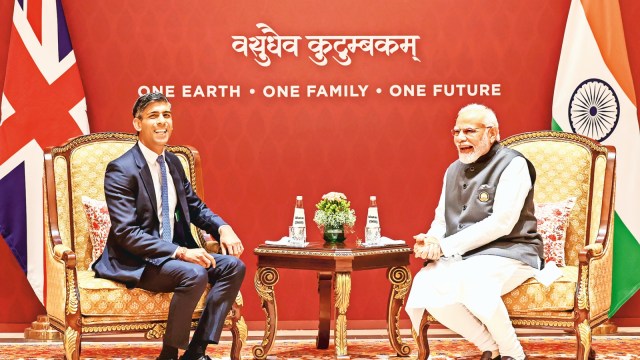 PM Narendra Modi with UK counterpart Rishi Sunak. Both countries have made headway on service sector work permits in FTA talks, which began formally in Jan 2022. File
 The signing of the India-UK free trade agreement, originally slated for Diwali last year, is set to miss this year’s festival too as negotiators are still working on contentious issues including chapters pertaining to rules of origin and intellectual property rights (IPR), two officials aware of the development said.
While the talks have gathered momentum — 21 out of 26 chapters have been finalised and negotiations are happening in weekly rounds — there is an urgency to wrap up the deal as India heads for elections early next year. General elections in the UK, meanwhile, will take place latest by January 2025.
A government official said India has been able to secure “limited” short-term work permits for its service sector workforce under the movement of natural persons (mode 4) category. Mode 4 refers to services traded by individuals of one WTO member through their presence in the territory of another. It covers employees of services firms and self-employed service suppliers.
The degree of mode 4 market access is “very limited” as it deals with commitments that provide a right of entry and stay only to highly skilled individuals and those transferred from an affiliate of a company with a commercial presence in the UK. The discussion on rules of origin that ensures that products from third countries do not receive FTA benefits unless they undergo “significant transformation” in the exporting country, has been one of the most contentious.
After the US, the UK is the largest importer of India’s services making up 17% of India’s total services exports including travel, transportation, insurance, software and financial services. Services are among India’s fastest growing exports, registering a jump of nearly 30% to $267.79 billion from April to January in FY23 compared to $206.27 billion during the comparable period in FY22.
“(The) rules of origin (issue) is a crucial concern for India in various categories of products. For instance, there is fear that products from Europe, especially alcoholic drinks such as gin, vodka and Irish whiskey, could make their way into India via the UK. They are dominant in these areas so discussions regarding the same are going on in great detail,” a person aware of the negotiations said.
After opening its high tariff market for Australian wines in the India-Australia early-harvest deal that came into effect in December last year, India is expected to bring down tariffs for UK’s Scotch whisky after the initiation of the UK FTA. London is pushing New Delhi to slash the whisky import tariff to 30 per cent from the current 150 per cent over three years.
India tends to weigh in favour of more conservative rules of origin compared to most developed countries, leading to extended discussions and negotiations in its FTA talks, including with the UK, said Global Trade Research Initiative (GTRI) co-founder Ajay Srivastava. However, India may need to be more flexible in its rules of origin framework, especially as its firms in sectors like chemicals, electronics, and synthetic textiles are increasingly using imported inputs, he added.
Talks on IPR are crucial as India is the world’s largest producer and exporter of generic drugs and affordable generic drugs constitute 70-80 per cent of consumption in the domestic market. The UK, as a leader in life science innovation, is seeking strong IPR protection. But its state-run health system, National Health Service (NHS), also relies on Indian generics to keep costs down.
“As a major innovator and manufacturer in the field of pharmaceuticals, the UK has strong offensive interests as regards tightening India’s intellectual property (IP) regime, which has helped to make that country a leading exporter of generic (non-branded/off patent) medicines. At the same time, though, the NHS, like other healthcare providers around the world, draws significant financial benefit from making extensive use of cheaper generic drugs manufactured in India,” the UK House of Commons’ International Trade Committee report said.
The UK has also asked India to reduce duty on car imports to gain access to one of the largest automobile markets in the world. Bloomberg had reported earlier this week that New Delhi is considering a concessional tariff of 30 per cent on 2,500 electric vehicles imported annually from the UK priced above $80,000. India currently levies taxes between 70 per cent and 100 per cent on cars imported as completely built units, depending on their value.
India and the UK are also looking to sign a bilateral investment treaty (BIT) alongside the FTA that could improve UK’s investments into India. To resolve investor-state disputes under the new BIT faster, India is moving away from its 2016 model BIT approach that stressed on exhaustion of local remedies.
Before 2015, India signed BITs with 83 countries or regions. It suspended BITs with 68 countries and regions with a request to renegotiate based on the model 2016 BIT while six BITs are still in force. However, it found few takers, curbing foreign investments.
In FY2023, India’s merchandise exports to the UK were valued at $11.41 billion while imports stood at $8.96 billion.

 5 min read