This is an archive article published on December 14, 2024
Remote village in Chhattisgarh’s Sukma district gets reason to cheer – its first TV
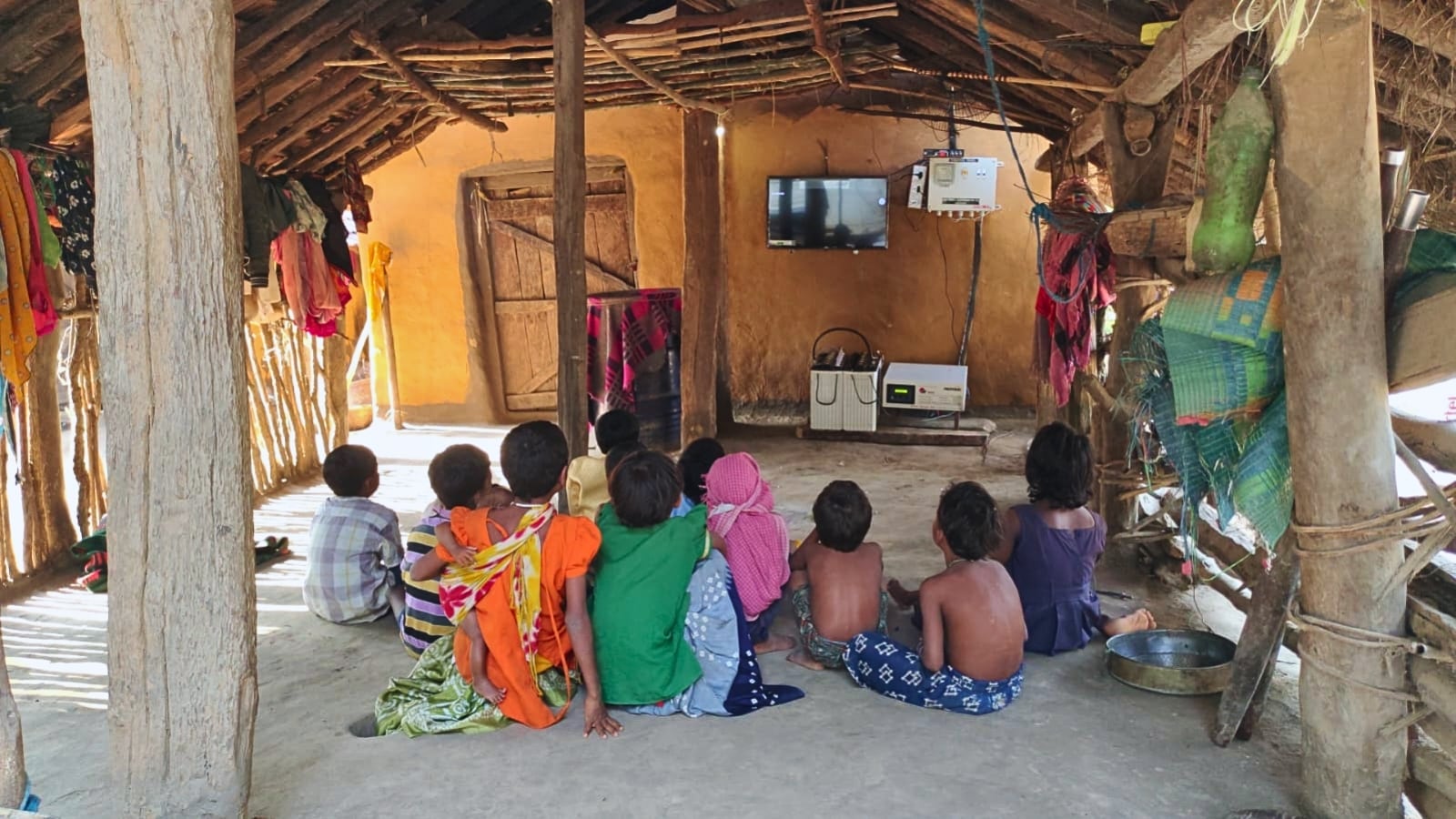
Solar-powered appliances, including a 32-inch television and lights and fans, were distributed in Chhattisgarh’s Puvarti earlier this week.
Written by Jayprakash S Naidu
Raipur | Updated: December 14, 2024 09:33 PM IST
2 min read
Whatsapp
twitter
Facebook
Reddit
Apart from the 32-inch television with a set-top box that gives access to 100 channels, solar-powered appliances such as lights and fans were also distributed to families in Puvarti through the Chhattisgarh State Renewable Energy Development Agency. (Express Photo by Jayprakash S Naidu)
Infamous for being the home of top Maoist leaders Barse Deva and Madvi Hidma, Puvarti village in Chhattisgarh’s Sukma district had reason to cheer this week – the remote village in the state’s Bastar region got its first television, powered by solar energy, on December 11.
“For the first time since India’s independence, the residents of this village watched national and international news, serials, and local films on Doordarshan. Children, women, and elderly villagers from Puvarti eagerly gathered around TV sets to watch programmes for hours,” a government official said.
Apart from the 32-inch television with a set-top box that gives access to 100 channels, solar-powered appliances such as lights and fans were also distributed to families in Puvarti through the Chhattisgarh State Renewable Energy Development Agency (CREDA).
“Children watched educational programmes and cartoons with visible joy and excitement. Their faces reflected curiosity and a thirst for learning. This initiative is a major stride toward rural development,” the official added.
Earlier this year, similar appliances were delivered to Silger and Tekalgudem villages too in a bid to address the issue of power shortage in the core Naxal area. The initiative is a part of the Chhattisgarh government’s Niyad Nellanar Yojana to ensure 100 per cent implementation of central and state government schemes in these areas.
“Our efforts are not only meeting the basic needs of villagers but also promoting sustainable energy and environmental conservation,” District Collector Devesh Kumar Dhruv said. “Our district being a tribal-dominated district had always been committed to forest and environment protection. The distribution of solar-powered appliances is not only reducing dependency on conventional electricity but also encouraging environmental conservation. The use of renewable energy is a step toward reducing pollution and setting an example for sustainable development,” he added.
Silger, Tekalgudem and Puvarti lie near the Sukma-Bijapur border in one of the most affected Naxal belts in the area. In January this year, three Central Reserve Police Force jawans, including two from the elite Commando Battalion for Resolute Action, died battling a battalion of the People’s Liberation Guerrilla Army, an armed wing of the banned Communist Party of India (Maoist) in Tekalgudem.
Jayprakash S Naidu is a Principal Correspondent for The Indian Express, currently serving as the state correspondent for Chhattisgarh. With an extensive career in frontline journalism, he reports on the political, security, and humanitarian landscape of Central India.
Expertise and Experience
Specialized Conflict Reporting: Jayprakash is a leading voice on the Maoist/Naxalite conflict in the Bastar region. His reporting provides a critical, ground-level view of:
Internal Security: Tracking high-stakes encounters, surrender programs for senior Maoist leaders, and the establishment of security camps in formerly inaccessible "heartland" villages.
Tribal Rights & Displacement: Investigative reporting on the identity and land struggles of thousands of displaced tribals fleeing conflict zones for neighboring states.
Governance & Bureaucratic Analysis: He consistently monitors the evolution of Chhattisgarh as it marks 25 years of statehood, covering:
Electoral Politics: Analyzing the shift in power between the BJP and Congress and the impact of regional tribal movements.
Public Policy: Reporting on landmark infrastructure projects (e.g., mobile connectivity in remote zones) and judicial interventions, such as High Court rulings on civil and family law.
Diverse Investigative Background: Prior to his current focus on Chhattisgarh, Jayprakash held reported from Maharashtra, where he specialized in:
Crisis & Disaster Management: Notable for his extensive coverage of the Cyclone Tauktae barge tragedy (P-305) and the COVID-19 pandemic’s impact on frontline personnel.
Legal & Human Rights: Investigative pieces for platforms like Article-14, focusing on police accountability and custodial deaths across India.
Environmental & Social Justice: Authoritative reporting on the Hasdeo Aranya forest protests and the approval of major tiger reserves, highlighting the tension between industrial mining and environmental preservation. ... Read More


 2 min read