Journalism of Courage



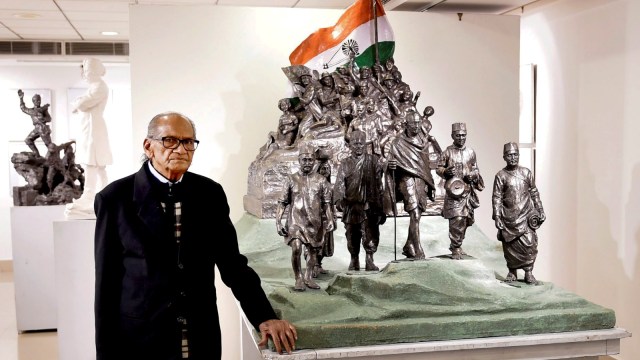 From Statue of Unity to Statue of Prosperity, Ram Vanji Sutar’s works redefined the landscape of monumental sculptures in India
From the 522-foot Statue of Unity, the tallest statue in the world towering over the Narmada and the quiet meditating statue of Mahatma Gandhi outside the old Parliament building in New Delhi to the 45-foot-tall Chambal monument and the 108-foot bronze Statue of Prosperity at Kempegowda International Airport, Bengaluru, Ram Vanji Sutar’s work redefined the landscape of monumental sculptures in India. Sutar, one of India’s most influential sculptors, passed away early Thursday morning at his Noida residence.
He was 100 and had been ailing due to age-related illnesses. Born on February 19, 1925, in Maharashtra’s Dhule district, Sutar dreamt of building the world’s biggest statue when he saw pictures of the Statue of Liberty as a child. His talent took him to the Sir JJ School of Art in Mumbai, from where he graduated as a gold medallist.
He was appointed a modeller at the Department of Archeology in 1954, where he helped restore several sculptures at the Ajanta-Ellora cave complex. Sutar who believed in creating “larger than life sculptures” (as said on his official website) left his job at the Ministry of Information and Broadcasting in 1959 to pursue his passion for sculpting full-time.
Along with his son, Anil Ram Sutar, with whom he had been working since 1994, he built the 91-foot bronze statue of Chhatrapati Shivaji Maharaj in Rajkot Fort in Maharashtra, which was unveiled earlier this year.
Prime Minister Narendra Modi took to X to pay his tribute and called Sutar a remarkable sculptor whose mastery gave India some of its most iconic landmarks. He added that Sutar’s works would “always vividly showcase India’s history, culture and collective consciousness”.
Sutar’s engagement with institutions nurturing Indian art was equally significant. Dr Nand Lal Thakur, Vice-Chairman of the Lalit Kala Akademi, recalled a visit to the sculptor’s studio: “It was like how a small child shows his toys. He would show each of his works with great enthusiasm and narrate his entire journey – from childhood to how he entered the art field.” That bond led a major retrospective exhibition at Lalit Kala Akademi during Sutar’s centenary, earlier this year. “He would come every day throughout the exhibition, sit there, and converse very warmly with students and artists,” Thakur said.
Manesar-based sculptor Naresh Kumar Kumavat, who built the 369-foot Statue of Lord Shiva in Nathdwara (Rajasthan) said Sutar’s death is an irreparable loss to the world of art and sculpture. “With him, an entire era of Indian monument art comes to a dignified close,” he said.
He recalled a memory that he holds close to his heart, “During 1996–97, at the T-Series Studio, he had come to meet my father, Shri Matu Ram ji, who was then engaged in creating a massive sculpture. Though Shri Sutar ji was nearly 20-22 years senior to my father, when my father moved to touch his feet in reverence, Sutar ji immediately reciprocated by touching my father’s feet and said, “It is best when an artist is honoured by another artist. That single gesture reflected the depth of his character and the dignity with which he lived his art.”
Twenty six-year-old artist Mohit Jangra, recalled meeting Sutar last year, when the veteran artist was already 100. “I had invited him for my exhibition and because of his health, I wasn’t sure if he would come. To my surprise, he came, saw the paintings peacefully and chatted with me for nearly half an hour.” What stayed with Jangra was the man’s humility. “He was always eager to share his knowledge with youngsters like me,” he added.
Sutar was awarded Padma Shri in 1999 and the Padma Bhushan in 2016. In October 2018, he was honoured with the Tagore Award for Cultural Harmony, and in November 2025, he was conferred with the Maharashtra Bhushan, the state’s highest civilian honour, in recognition of his lifetime of artistic achievement.

 4 min read