Journalism of Courage



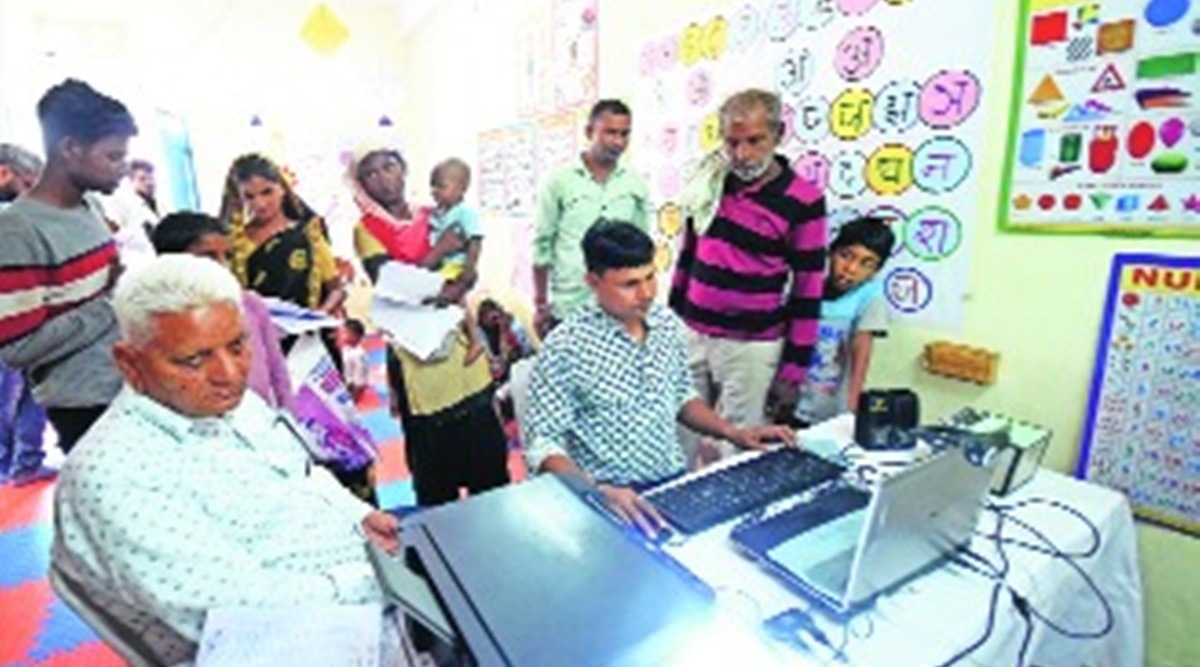 Parents get their children registered for an Aadhaar card in Prem Nagar, Jaipur, on Friday. (Express Photo)
 Twenty-six-year-old Monu, a resident of Prem Nagar slum that is about half a kilometre off the Jaipur-Agra highway, polishes shoes for a living.
Going by the general profile of children in Prem Nagar, chances are that Monu’s children, Mayra (4) and 8-month-old Kana will follow in his footsteps and take up similar jobs here: be a kabadi-wallah (one who trades junk and rags), pick garbage, drive an e-rickshaw, do seasonal jobs, or even beg.
As per a register maintained by Chetna, an NGO working in the slum, there are quite a few children already doing these jobs. “My father polishes shoes and mother does jeera-bartan. I sometimes find scrap in garbage and sell it for Rs 10-20 per kilo. If I beg, they either give me food or I get up to Rs 50-60 per day,” says an eight-year-old who has nine siblings.
‘Jeera-bartan’ is a barter system where a person goes around collecting hair from homes and gives cumin (jeera/zeera) and utensils in exchange for hair. In Prem Nagar, quite a few women are engaged in ‘jeera bartan’, including Heena Devi, who then sells the hair for money.
While Devi has absolutely no documents of her children, Hemraj, 8, and Hanisi, 9, Monu and his wife Sanjana have the hospital certificate of their son Kana.
Like some other parents in Prem Nagar, Heena, Monu and Sanjana hope to change that by educating their children, but a lack of Aadhaar means no access to a government school three kilometres away. For several reasons not limited to lack of money and awareness, many residents of Prem Nagar, especially children, don’t have Aadhaar cards.
This May, this was raised by some children associated with Childhood Enhancement through Training and Action (Chetna), an NGO, at a stakeholder’s consultation organised by the National Action and Coordination Group for Ending Violence against Children (NACG EVAC) in Jaipur.
“When we go to schools, we are turned down; when we go again, they ask for Jan Aadhaar card; when we go with the Jan Aadhaar card, they tell us to reduce the age of the child. Now how can we reduce the age?” said Mohammad Shabir Sha, 13, at the consultation.
This prompted Sangeeta Beniwal, Chairperson of Rajasthan State Commission for Protection of Child Rights (RSCPCR) and who was present at the consultation, to try and bridge the gap through special camps for Aadhaar enrolment through the Department of Information Technology and Communication. Three such camps — in Prem Nagar, Kali ka Bhatta and Jaisinghpura Khor — were set up for three days between June 14 and 16.
The Prem Nagar camp was inaugurated by Beniwal on June 14, who said: “Children here as old as 13-14 years haven’t been enrolled in a school due to lack of Aadhaar. They can’t avail flagship schemes of the government due to lack of Aadhaar card, hence I gave instructions for setting up camps in the respective localities. Getting an identity card is a fundamental right of a person.”
In Prem Nagar, the registration camp was held out of a centre run by Chetna; the registration was limited to children between the ages of 0-18. Deepesh Sain, project coordinator with Chetna, says mainly the aim of the exercise is to help students enrol in government school and avail benefit of government schemes.
Although Aadhaar service is free, service providers often charge a “hefty” fee. Khema, 33, state educator with Chetna, says: “So many people here are in debt that they can’t even spare a few hundred. And it also means that they have to skip the day’s work.”
Asaram Gurjar, 26, also an educator with Chetna, says that most people in the slum don’t have any document, which also prevents them from accessing several government schemes.
But things are changing. Pari Singhwal, 9, who has an Aadhaar, has been going to a school for a month now, attending class 2. Standing next to her, Deepika, 14, hopes to join Pari soon. “It is perhaps for the first time that RSCPCR went out of its way to set up these camps. If there are other places where people don’t have Aadhaar card, RSCPCR will set up camps through NGOs and government organisations,” Beniwal added.

 4 min read