South African cheetahs Prabhash and Pavak get new home, 250 km from Kuno
The two male cheetahs, originally brought from South Africa’s Waterberg Biosphere Reserve to Kuno in February 2023, were chosen for the move to Gandhi Sagar due to their wild traits, hunting record and age, wildlife officials said.
The Chief Minister said the release of the two cheetahs was a matter of great joy and a major step in the state’s ambitious Cheetah Project.
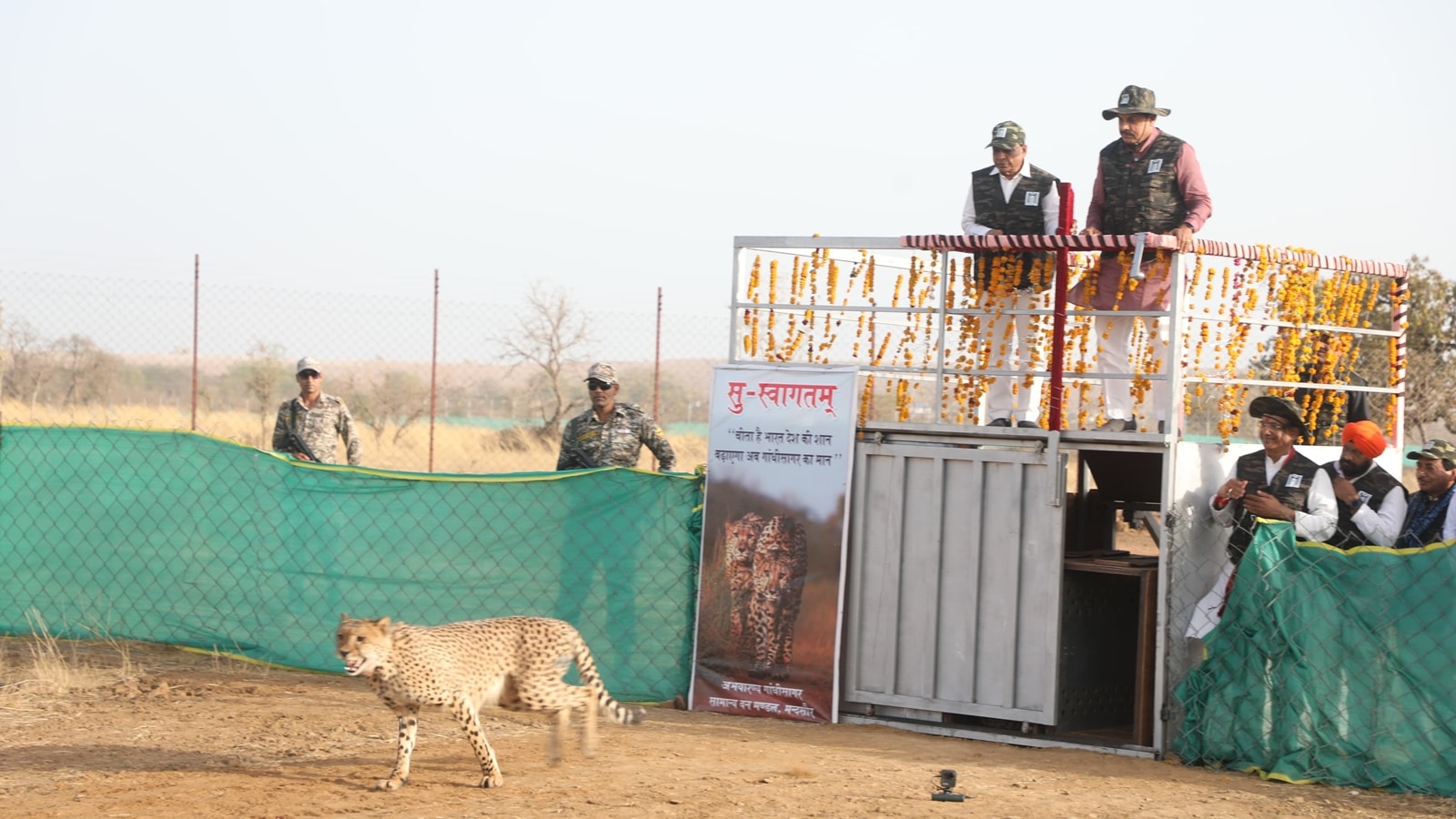
After spending two years at Kuno National Park (KNP) in Madhya Pradesh’s Sheopur district, six-year-old cheetahs Prabhash and Pavak were relocated to the Gandhi Sagar Wildlife Sanctuary, 250 km away, on Sunday evening, according to officials overseeing the translocation.
The two male cheetahs, originally brought from South Africa’s Waterberg Biosphere Reserve to Kuno in February 2023, were chosen for the move to Gandhi Sagar due to their wild traits, hunting record and age, wildlife officials said. The two have successfully hunted several chitals – the most common prey at KNP.
Additional Principal Chief Conservator of Forests Uttam Kumar Sharma said the animals were transported by road to their new home in a journey that took around eight hours. Chief Minister Mohan Yadav released them into the sanctuary in the evening.
The Chief Minister said the release of the two cheetahs was a matter of great joy and a major step in the state’s ambitious Cheetah Project.
He said the project, aimed at increasing the population of cheetahs and preserving the species, is showing signs of success. “Gandhi Sagar Sanctuary has now become the second site in the state, after Kuno National Park, where cheetahs are being reintroduced. From the perspective of wildlife tourism, today marks a historic day,” he said. The Chief Minister emphasised that India’s cheetah reintroduction efforts have shown better survival rates than those seen in other countries and attributed this to the state’s forests and conducive climate. He pointed out that Madhya Pradesh’s forests now host 26 cheetahs, including 14 cubs born in India.
He also said that cheetahs are being brought from countries like South Africa, Kenya, and Botswana to be settled in Madhya Pradesh’s forests. On Friday, National Tiger Conservation Authority officials in Bhopal had announced that eight more cheetahs would be brought from Botswana in two phases, with four expected to arrive by May.
Spread across a vast 2,500-square-km landscape straddling Madhya Pradesh and Rajasthan, the Gandhi Sagar Wildlife Sanctuary’s mix of grasslands, dry deciduous forests, and riverine evergreen patches is meant to offer an ideal habitat for the cheetahs to thrive. The sanctuary currently has a carrying capacity of 10 cheetahs. “In order to sustain six-eight cheetahs inside the predator-proof fenced area, there is an annual requirement of 1,560-2,080 prey animals, or 26-35 prey animals per square km. The current prey availability inside the fenced area is 475 animals and that is being augmented with 1,500 more, such as chital, blackbuck and nilgai,” the action plan says.
Story continues below this ad
However, the sanctuary’s robust leopard population presents a formidable challenge. According to the action plan, the sanctuary has an estimated population of 70 leopards in the West Range, and they pose a significant threat to cheetahs, particularly cubs and juveniles, and compete for similar prey.
To mitigate this risk, all “leopards within the fenced area will be captured and relocated before the cheetahs are brought to Gandhi Sagar WLS”, the plan says.
Yadav said the Gandhi Sagar Sanctuary, which spans Mandsaur and Neemuch districts in Ujjain division, may have been home to cheetahs hundreds of years ago, and that their return is also a promising sign for the revival of wildlife tourism. He further noted the historical and cultural significance of the sanctuary, which includes the Chaturbhuj Nala area, known for its prehistoric rock paintings.
Anand Mohan J is an award-winning Senior Correspondent for The Indian Express, currently leading the bureau’s coverage of Madhya Pradesh. With a career spanning over eight years, he has established himself as a trusted voice at the intersection of law, internal security, and public policy.
Based in Bhopal, Anand is widely recognized for his authoritative reporting on Maoist insurgency in Central India. In late 2025, he provided exclusive, ground-level coverage of the historic surrender of the final Maoist cadres in Madhya Pradesh, detailing the backchannel negotiations and the "vacuum of command" that led to the state being declared Maoist-free.
Expertise and Reporting Beats
Anand’s investigative work is characterized by a "Journalism of Courage" approach, holding institutions accountable through deep-dive analysis of several key sectors:
National Security & Counter-Insurgency: He is a primary chronicler of the decline of Naxalism in the Central Indian corridor, documenting the tactical shifts of security forces and the rehabilitation of surrendered cadres.
Judiciary & Legal Accountability: Drawing on over four years of experience covering Delhi’s trial courts and the Madhya Pradesh High Court, Anand deconstructs complex legal rulings. He has exposed critical institutional lapses, including custodial safety violations and the misuse of the National Security Act (NSA).
Wildlife Conservation (Project Cheetah): Anand is a leading reporter on Project Cheetah at Kuno National Park. He has provided extensive coverage of the biological and administrative hurdles of rewilding Namibian and South African cheetahs, as well as high-profile cases of wildlife trafficking.
Public Health & Social Safety: His recent investigative work has uncovered systemic negligence in public services, such as contaminated blood transfusions causing HIV infections in thalassemia patients and the human cost of the fertilizer crisis affecting rural farmers.
Professional Background
Tenure: Joined The Indian Express in 2017.
Locations: Transitioned from the high-pressure Delhi City beat (covering courts, police, and labor issues) to his current role as a regional lead in Madhya Pradesh.
Notable Investigations: * Exposed the "digital arrest" scams targeting entrepreneurs.
Investigated the Bandhavgarh elephant deaths and the impact of kodo millet fungus on local wildlife.
Documented the transition of power and welfare schemes (like Ladli Behna) in Madhya Pradesh governance.
Digital & Professional Presence
Author Profile: Anand Mohan J at Indian Express
Twitter handle: @mohanreports ... Read More


 4 min read