

Journalism of Courage

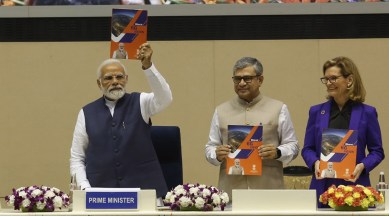
India is gearing up to roll out high-speed 6G communication services by 2030 and has set up a Bharat 6G project to identify and fund research and deployment of the next-generation technology in the country, according to a vision document unveiled by Prime Minister Narendra Modi on Wednesday.
India’s 6G project will be implemented in two phases, and the government has also appointed an apex council to oversee the project and focus on issues such as standardisation, identification of the spectrum for 6G usage, create an ecosystem for devices and systems, and figure out finances for research and development, among other things.

While, technically, 6G does not exist today, it has been conceived as a far superior technology promising internet speeds up to 100 times faster than 5G.
The apex council will facilitate and finance research and development, design and development of 6G technologies by Indian startups, companies, research bodies and universities. It will aim to enable India to become a leading global supplier of intellectual property, products and solutions of affordable 6G telecom solutions and identify priority areas for 6G research based on India’s competitive advantages.
A key focus of the council will be on new technologies such as Terahertz communication, radio interfaces, tactile internet, artificial intelligence for connected intelligence, new encoding methods and waveforms chipsets for 6G devices.
“Within 6 months of the rollout of 5G technology we are talking about 6G,” the prime minister said. This, he said, shows the confidence of the country. “Before 4G, India was only a user of telecom technology, but now India is moving fast to become a big exporter of telecom technology,” he added.
Modi formally launched 5G services in October 2022 and said at the time that India should be ready to launch 6G services in the next 10 years. As opposed to 5G, which at its peak can offer internet speeds up to 10 Gbps, 6G promises to offer ultra-low latency with speeds up to 1 Tbps.
As per the vision document, 6G use cases will include remote-controlled factories, constantly communicating self-driven cars and smart wearables taking inputs directly from human senses. However, while 6G promises growth, it will simultaneously have to be balanced with sustainability since most 6G supporting communication devices will be battery-powered and can have a significant carbon footprint, the document said.
As part of its 6G mission, India will identify priority areas for research by involving all stakeholders including industry, academia and service providers spanning theoretical and simulation studies, proof-of-concept prototypes and demonstrations and early market interventions through startups.
The project will be implemented in two phases: the first one from 2023 to 2025 and the second one from 2025 to 2030. In phase one, support will be provided to explorative ideas, risky pathways and proof-of-concept tests. Ideas and concepts that show promise and potential for acceptance by the global peer community will be adequately supported to develop them to completion, establish their use cases and benefits, and create implementational IPs and testbeds leading to commercialisation as part of phase two.


