Journalism of Courage



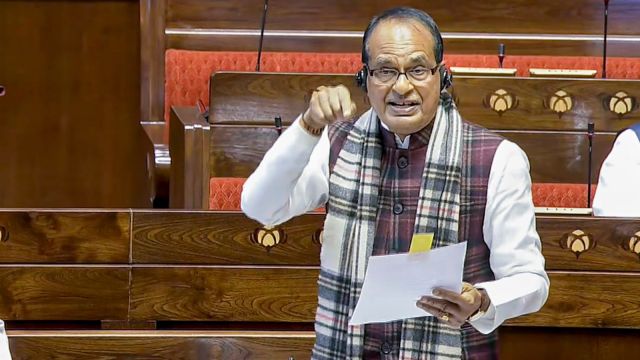 Union Minister Shivraj Singh Chouhan speaks in the Rajya Sabha during the Winter session of Parliament, in New Delhi (PTI)
The Centre is looking at April 1, 2026, as the date for the rollout of its new rural job guarantee scheme, Viksit Bharat-Guarantee for Rozgar and Ajeevika Mission (Gramin) or VB-G Ram G, Union Rural Development Minister Shivraj Singh Chouhan said Tuesday.
Chouhan, who is piloting VB-G Ram G, which will replace the Mahatma Gandhi National Rural Employment Guarantee Scheme (MNREGS), said the new initiative will ensure ample employment opportunities while providing all basic amenities in villages to make the country a developed nation.
Chouhan said, despite taking several steps to check irregularities, there have been many complaints in the MGNREGS.
PM Modi ‘reveres’ Mahatma Gandhi
Chouhan rejected the Opposition’s allegation of removing “Gandhi from our country’s psyche” by changing the MGNREGA to the VB-G Ram G scheme.
“Mahatma Gandhi ke prati sampoorn shraddha hum logon ke mann mein hai, aur hum to unke jeevan se hee prerana lekar kaam kar ke Bapu ke aadarshon par yeh sarkaar chal rahein hain. Pradhaan Mantri svayam bhee Bapu kee pooja karte hain. Ek tarah se maine, jo bhakti ka bhaav unke mann mein dekha hai. (We have complete reverence for Mahatma Gandhi, and we are working by drawing inspiration from his life. This government is running on Bapu’s ideals. The Prime Minister himself reveres Bapu. In a way, I have seen the devotion he has for him),” Chouhan said.
“There used to be Jawahar Rozgar Yojana. After the Jawahar Rozgar Yojana, they [UPA] brought in NREGA, and then named it Mahatma Gandhi NREGA,” he pointed out.
“When schemes are launched, they are given names. This is a new scheme, and its name is this. There is no question of disrespect here. Reverence is not expressed only through names. Reverence is expressed through actions, through conduct,” Chouhan said.
“Now, we respect Gandhi, but we should also follow Gandhi’s teachings. We should follow Gandhi’s principles. We are engaged in serving the poor, considering them as God. And they [Opposition] are talking about the name of Ram,” he added.
60:40 ratio of VB-G Ram G Bill funding
Asked whether the Centre’s move to share the burden of funding the VB-G Ram G Bill will put additional pressure on the states’ exchequers, Chouhan said that states, too, have a responsibility towards the development of villages in a federal structure.
“Revenue collection is now increasing continuously. States also receive a share of the GST. This money is being used to develop villages. The work described in the four categories is something the states would be doing anyway, one way or another. With this large sum of money, these projects will be completed. This is also a responsibility of the states. We have a federal structure,” Chouhan said.
When asked how the Centre would devise “objective parameters” to determine state-wise normative allocation under the VB-G Ram G Bill, Chouhan said that the NITI Aayog will devise a “formula based on scientific principles.”

 3 min read