Journalism of Courage



 The government also suggested that the time for filing claims and objections regarding inclusion of names in the draft NRC be extended from the one month proposed initially to two months.
The Centre proposes to include Indian citizens who are not from Bangladesh and who moved to Assam from other parts of the country before or after March 24, 1971 in the National Register of Citizens (NRC) if their citizenship is proved beyond reasonable doubt.
This is part of the Standard Operating Procedure (SOP) drawn up by the Centre to deal with claims and objections of those who have been left out of the draft NRC which is being prepared on the directions of the apex court.
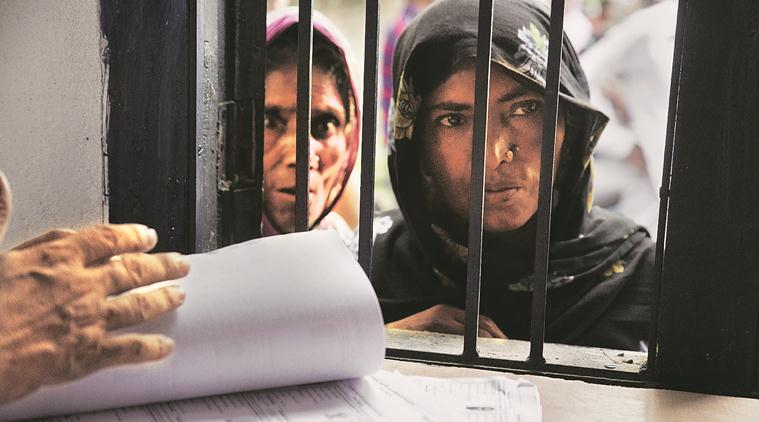
The SOP, filed in the Supreme Court Tuesday, will be considered on August 16. The government also suggested that the time for filing claims and objections regarding inclusion of names in the draft NRC be extended from the one month proposed initially to two months.
The document pointed out that the Supreme Court, in its July 21, 2015 order, had said “…Indian citizens including their children and descendants, who may have moved to the State of Assam subsequent to 24th March, 1971 would be eligible for inclusion in the NRC on adducing satisfactory proof of residence in any part of the country (outside Assam) as on 24th March 1971”.
The government, however, said that in some cases, people have not been able to provide documents to prove their residence in any part of the country. For such people, it proposed to make provisions “similar to Rule 4 of the Citizenship (Registration of Citizens and Issue of National Identity Cards) Rules, 2003 and Clause 3(3) of the Schedule”.
Accordingly, “citizens of India who originate from other states in India and who do not have any origin in specified territory (Bangladesh) and have moved to State of Assam prior to 24th March 1971 or after will be included in the NRC if the citizenship of such persons is ascertained beyond reasonable doubt to the satisfaction of the authorities disposing of claims and objections”.
“Cases of all such persons whether ordered for inclusion by the authority (disposing claims and objections), or for exclusion, will be examined first by the CRCR (Circle Registrar of Citizen Registration) and then by the DRCR (District Registrar of Citizen Registration). The final decision of inclusion or exclusion will be taken by the DRCR, who will issue a speaking order issued under his deal and signature” the SOP stated, adding that “authorities examining the claim and the DRCR will exercise great caution to ensure that no illegal person’s name is included taking recourse to the above provisions”.
The government also submitted that claims involving children of 14 years who have been left out from the draft NRC and whose parents have included in it “will be segregated and pre-claim verification undertaken by CRCR to ascertain the shortcomings in linkage documents or any inconsistencies thereof.” It said the DRCR concerned will ensure specific hearings for the composite family in respect of these children and oral and written evidences from parents will be available.
This “special consideration” was needed, the government said, because adequate documentary evidence may not be available for children below age 14.
“Claims where only married women are involved and have no linkage document other than Gaon Panchayat Secretary Certificate issued prior to August 2015 will be examined separately in accordance with the guidelines issued in its compliance to Hon’ble Supreme Court orders on the verification of Gaon Panchayat Secretary Certificate for married women,” it said.
The Local Registrar of Citizen Registration (LRCR) will issue notices for hearing the objections raised to inclusion of any names including to the person against whom the objection is raised.
To “ensure fairness and objectivity”, the government said, “it is considered necessary that the officers who have decided the applications at the stage of draft NRC (LRCR) are not the decision-making authority at the stage of disposal of claims and objections”.
The state had informed that it will be able to make available 1,500 to 2,500 Class I officers for this, the Centre stated. The exact requirement will, however, depend on the number of claims and objections that are filed, the SOP said, adding it was also proposed to appoint senior state government officers as observers to oversee the process of disposal of claims and objections.
During the hearings, the state, in collaboration with UIDAI, will undertake biometric enrolment of applicants. Once the final NRC is published, those included in it will be given Aadhaar numbers.
The SOP also provides a timeline for completing tasks. Accordingly, the period for receiving claims and objections will be from August 30 to October 28. The hearings will start from December 15 onward. On July 31, a bench of Justices Ranjan Gogoi and R F Nariman, while allowing the government to draw up the SOP, had said it would approve the same if the procedure adopted was fair, else it would correct it.


 5 min read