Journalism of Courage



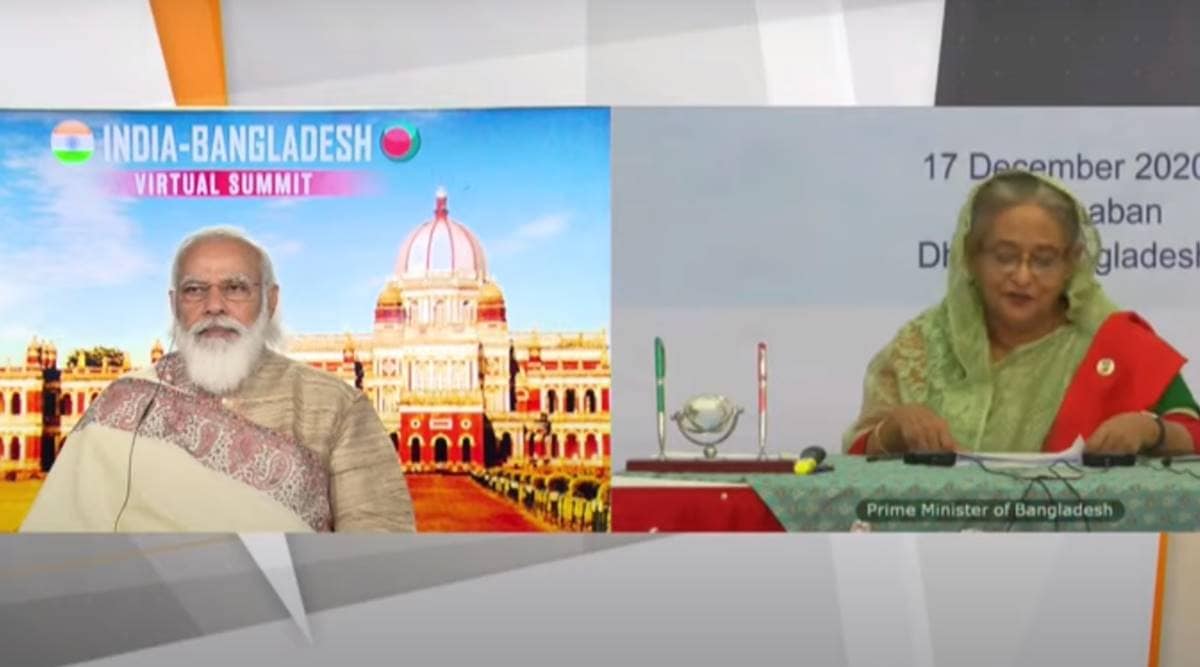 The two leaders jointly inaugurated a Bangabandhu-Bapu digital exhibition (Source: Screengrab)
A year after the CAA-NRC issue adversely impacted the bilateral ties between New Delhi and Dhaka, India and Bangladesh on Thursday sought to bring it back on track as Prime Minister Narendra Modi and Bangladesh Prime Minister Sheikh Hasina met through video-conferencing and discussed a broad range of issues — from loss of lives on the border, Teesta water-sharing agreement and ease of travel to a more ambitious trade pact, vaccines against Covid-19 and Rohingya refugees.
Hasina invited Modi to visit Bangladesh for celebrations on the occasion of the 50th anniversary of Bangladesh’s Independence and 50 years of Bangladesh-India diplomatic relations in March next year, which he accepted.
“Bangladesh is a major pillar of our ‘Neighborhood First’ policy. From the very first day, strengthening and development of relations with Bangladesh has been a special priority for me,” Modi said, after the bilateral meeting.
“It’s a fact that this year has been challenging due to the global pandemic. But it is a matter of gratification that India and Bangladesh had good cooperation in this difficult time.Whether it be medicines or medical equipment, or working with health professionals. We are also having good cooperation in the field of vaccine. We will also take special care of your needs in this regard,” he said.
Hasina said, “I believe both our countries can move up the global and regional value chains by further integrating our economies taking advantage of available synergies…we happily recognise the growing mutual dependency of the economies of Bangladesh and India. A good number of Indian nationals are employed in the manufacturing and service sector of Bangladesh and are remittance earners for India. On the other hand, India receives its highest number of tourists and medical patients from Bangladesh.”
Other than health, Modi said, “This year our special partnership has been steadily advancing in other areas as well. We reduced hurdles in land border trade, expanded connectivity between the two countries, and added new means. All this reflects our intentions to further strengthen our relationship.”
According to a joint statement, both sides emphasised simplifying people to people movement between the two countries. “Bangladesh side requested for early implementation of India’s commitment to remove remaining restrictions on entry/exit from land ports in India for Bangladeshis travelling on valid documents in a phased manner, beginning with checkpoints at Akhaura (Tripura) and Ghojadanga (West Bengal),” it said.
The two leaders also agreed to facilitate completion of border fencing at all pending sectors at the international border between both the countries at the earliest beginning from the Tripura (India)- Bangladesh sector.
“Both leaders also agreed that loss of civilian lives at the border is a matter of concern and directed the border forces concerned to enhance coordinate measures to work towards bringing such border incidents to zero,” it said.
Recognizing the “immense potential” of bilateral economic and commercial ties, both Prime Ministers “directed the officials to expeditiously conclude the ongoing joint study on the prospects of entering into a bilateral Comprehensive Economic Partnership Agreement (CEPA)”, it said.
The joint statement also said that the “Bangladesh PM highlighted the need for early signing of (an) interim agreement for sharing of the Teesta waters, as agreed upon by both the governments in 2011. Prime Minister Modi reiterated India’s sincere commitment and continued efforts of the Government of India in that regard.”
Bangladesh Prime Minister expressed keen interest in the ongoing India-Myanmar-Thailand trilateral highway project and sought India’s support for enabling Bangladesh to connect with this project with a view to enhance connectivity between the regions of South and Southeast Asia. In the same spirit, the Indian side requested Bangladesh to allow connectivity from West Bengal (Hilli) to Meghalaya (Mahendraganj) via Bangladesh, the joint statement said.
Modi “appreciated the generosity of Bangladesh in sheltering and providing humanitarian assistance to the 1.1 million forcibly displaced persons from the Rakhine State of Myanmar”. Both Prime Ministers reiterated the importance of their safe, speedy and sustainable return, it said.
Hasina congratulated India on its election as a member of the United Nations Security Council and “expressed Bangladesh’s expectation to see India assist in the repatriation of the forcibly displaced Rohingyas back to Myanmar”.
At the virtual summit, India and Bangladesh also sealed seven agreements to expand cooperation in diverse areas — hydrocarbons, elephant conservation, sanitation, and agriculture, and restored a cross-border rail link which was in operation till 1965. They also jointly inaugurated a digital exhibition on Mahatma Gandhi and Bangladesh’s founder, Sheikh Mujibur Rehman.

 5 min read