Journalism of Courage



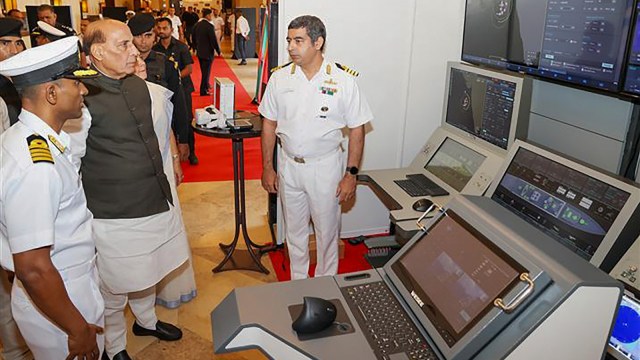 Union Minister for Defence Rajnath Singh visits the Make in India exhibition at the fourth edition of Goa Maritime Conclave, in Goa, Monday, Oct. 30, 2023. (PTI Photo)
 Stressing the need for establishing multi-national collaborative frameworks to effectively tackle common maritime challenges in the Indian Ocean Region, Defence Minister Rajnath Singh Monday said ‘might is right’ has no place in a ‘free, open and rule-based’ maritime order.
In his keynote address at the fourth edition of the Goa Maritime Conclave, being held from October 29-31, Singh said a free, open and rule-based maritime order is a priority for all of us. “ ‘Might is right’ has no place in such a maritime order. Adherence to international maritime laws, as enunciated in the United Nations Convention on the Law of the Sea (UNCLOS) 1982, must be our lodestar,” he said. The conclave is being attended by senior representatives, chiefs of navy and heads of maritime forces of 12 Indian Ocean nations.
Singh said narrow immediate interests may tempt us to flout or disregard the well-established international law, but doing so would lead to the breakdown of our civilised maritime relations.
“Our common security and prosperity cannot be preserved without all of us committing to cooperatively adhering to the legitimate maritime rules of engagement. Fair rules of engagement are crucial for fostering collaboration and ensuring that no single country dominates others in a hegemonic manner,” he said.
Singh’s remarks come amidst growing concerns about China expanding its footprint in the Indian Ocean Region in recent times.
Singh called for a multi-national collaborative effort for compilation and sharing of surveillance data to tackle Illegal, Unreported and Unregulated (IUU) fishing, an issue which was also flagged by Indian Navy chief Admiral R Hari Kumar.
“It will help in identifying actors with irregular or threatening behaviour, which will have to be countered resolutely. IUU fishing endangers ocean ecosystems and sustainable fisheries. It also threatens our economic security and regional and global food security,” he said.
On climate change, he said the collaborative mitigation framework can involve the countries working together to reduce carbon emissions and transition to sustainable practices.
“When you talk of IUU… it is the biggest problem. It does not happen in our exclusive economic zone or only to a very low extent. We can track them and take action, but the area which is in international waters, beyond the exclusive economic zone… IUU fishing problem exists there largely and there is no framework for this in the Indian Ocean region,” Kumar said.
“During the last edition in 2021, we arrived at common maritime priorities, which could be viewed as a much needed starting point. This year, the aim is to formulate collaborative mitigation frameworks to address these priorities… Our problems are common. We call them problems without a passport. Piracy, drug trafficking, terrorism, arms smuggling…to tackle such problems, we need cooperation and collaboration,” he said.
The Navy chief said the government is making every effort to secure the release of eight former Indian Navy personnel, who were sentenced to death in Qatar, last week.
“I am yet to see the transcript of the court hearing… it was supposed to have been transcribed and provided to us on Sunday… when we get back, we will have a look at it.”
He said the Goa Maritime Conclave has evolved from a small congregation of principles of maritime security agencies to a functional construct that deals with transnational challenges in the Indian Ocean region. “The aim of the forum is to find regional solutions to regional problems. While there are larger constructs such as the Indian Ocean Naval Symposium (IONS), BIMSTEC…sometimes at larger constructs, it is difficult to reach a consensus. When the numbers are smaller, it is easier to arrive at a workable solution in a smaller time frame,” he said.

 4 min read