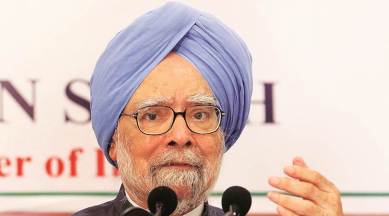
Former Prime Minister Manmohan Singh in Mumbai on Thursday. (Express Photo: Ganesh Shirsekar)
Advertisement
With Maharashtra and Haryana voting for new assemblies in four days, former Prime Minister Manmohan Singh Thursday nuanced the Congress position on the removal of J&K’s special status, saying the party believes that Article 370 was a “temporary measure” under the Constitution. This is the first time a Congress leader of Singh’s stature has articulated such a view.
Underlining that the “party had voted in favour of the dilution of Article 370 in Parliament”, Singh told reporters in Mumbai that the Congress was “opposed to the high-handed manner” in which it was done.
You’ve Read Your Free Stories For Now
Sign up and keep reading more stories that matter to you.
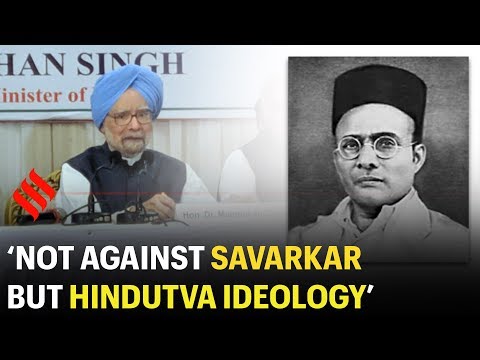
He also balanced the aggressive Congress view on Vinayak Damodar Savarkar — days after his party had slammed the Maharashtra BJP for pledging in its manifesto a Bharat Ratna for Savarkar — saying it was not against him.
While he skirted the Bharat Ratna issue, saying it will be settled by the government when it comes before the committee which looks into these matters, Singh said: “As far as Savarkarji is concerned, you would recall that Indiraji had issued a postal stamp commemorating Savarkarji. So we are not against Savarkarji… we are not in favour of the Hindutva ideology that Savarkarji patronised and stood for. As far as the case of (the Bharat Ratna) being referred to the government… the issue will be settled by the government when his case comes before the committee which looks into these matters,” he said.
He targeted the government over the Citizenship Amendment Bill: “The BJP government is trying a Citizenship Amendment Bill to ensure that Hindus, Sikhs, Jains, Christians can enter our country if they are persecuted or harassed… we are having a legislation in Parliament which discriminates against Muslims. This is for the first time that a national legislation is going to discriminate on the basis of religion.”
On NRC, he said: “I am not against the legislation for NRC but it most not lose sight of the human problems that arise in the process of investigating and finding effective means to ensure that only people who deserve to be excluded are excluded.”
On Article 370, the Congress has been a divided house. A large section within the Congress has been questioning the party’s opposition to the move. Prime Minister Narendra Modi, on the other hand, has made abrogation of Article 370 his main campaign theme in the assembly elections. Campaigning in Haryana and Maharashtra, Modi has been attacking the Congress over its stance on Article 370, even daring it to declare that it will bring back the provision in its manifesto.
Story continues below this ad
Explained
Push for a more pragmatic line
Manmohan Singh’s remarks nudge the party’s position away from the hardline on two hot-button issues on which the BJP has pushed it against the wall. His view on Article 370 echoes that of a section within that argued for a more pragmatic stand. This is also meant to steal the thunder from the BJP which has dared the party to come clean on the issue.
Sources in the Congress said Singh’s nuancing of the Congress’s position on both Article 370 and Savarkar was strategic. “There is sentiment in Maharashtra in favour of Savarkar… we have to admit that,” a senior party leader said. On Article 370, Singh’s articulation more or less now reflects the position taken by several Congress leaders like Lok Sabha MP Shashi Tharoor.
“Congress party… jab yeh Bill Parliament ke saamne aaya toh Article 370 ki upar jo baatcheet hui, Congress party ne iske haq main vote diya, iske khilaf vote nahin diya. Congress party ka yeh vichar hai ki Article 370 is a temporary measure. But if it has to be changed… the change has to be brought with the goodwill of the people of Jammu and Kashmir. The manner in which it was implemented, the high-handedness with which it was implemented is what we opposed. We were not opposed to the enactment of Article 370’s abrogation,” Singh said.
While the statutory resolution to amend Article 370 was passed by a voice vote in Rajya Sabha on August 5 with little opposition, there was division in Lok Sabha the next day and the Congress had voted against the resolution — contrary to what Singh said.
On August 6, the Congress Working Committee met to discuss the issue. The resolution adopted by the CWC did not mention that Article 370 was a temporary measure. But there was some nuancing then too. The CWC did not question the government move but slammed the “unilateral, brazen and totally undemocratic manner” in which it was done. “It deserved to be honoured until it was amended, after consultation with all sections of the people, and strictly in accordance with the Constitution of India,” the CWC said.
Story continues below this ad
Several leaders, including Janardan Dwivedi, Jyotiraditya Scindia and Deepender Hooda, had publicly backed the government move. In an interview to The Indian Express in September, Tharoor said the Congress was not defending Article 370 “for all time” because it was “never intended to be forever” but was questioning the manner in which the special status was revoked as it was “undoubtedly violative of the spirit” of the Constitution.
Singh also said he was not against a legislation for NRC but it must not lose sight of the human problems that arise: “The problem is that we do not like foreigners to come and take the jobs that our people face. Or therefore, foreigners or some entity who are not to the liking of many of us. But it is a human problem. If you find people who have come and they do not have the requisite documents, one has to look at that problem sympathetically. Because even many people in my family… we are an educated family, if you ask us to produce documents for proving our citizenship, I think many of them, even educated people, would find it a problem… I think it is necessary to ensure that any action that is taken in this regard takes into account the human problem… in dealing with this investigation, we should not create problems for the poorest people regardless of whether they are foreigners or they are not foreigners.”
“In Assam, 19 lakh people have been declared foreigners. Now the BJP had said that they would all be Muslims. Instead it turns that out of these 19 lakh, 12 lakh people are Bengali Hindus… I am not against the legislation for NRC, but it most not lose sight of the human problems that arise in the process of investigating and finding effective means to ensure that only the people who deserve to be excluded are excluded,” he said.
Manoj C G currently serves as the Chief of National Political Bureau at The Indian Express. A veteran journalist with a career spanning nearly two decades, he plays a pivotal role in shaping the publication's coverage of India's political landscape.
Experience & Career: Manoj has built a robust career in political journalism, marked by a transition from wire service reporting to in-depth newspaper analysis.
The Indian Express (2008 – Present): He joined the organization in 2008 and has risen to lead the National Political Bureau, overseeing key political coverage.
Press Trust of India (PTI): Prior to his tenure at The Indian Express, Manoj worked with India’s premier news agency, PTI, honing his skills in breaking news and accurate reporting.
Expertise & Focus Areas: As a seasoned political observer, Manoj focuses on the nuances of governance and party dynamics.
National Politics: extensive reporting on the central government, parliamentary affairs, and national elections.
Political Strategy: Deep analysis of party structures, coalition politics, and the shifting ideologies within the Indian political spectrum.
Bureau Leadership: directing a team of reporters to cover the most critical developments in the nation's capital.
Authoritativeness & Trust: Manoj’s authoritativeness is grounded in his nearly 20 years of field experience and his leadership role at a legacy newspaper. His long-standing association with The Indian Express underscores a reputation for consistency, editorial integrity, and rigorous reporting standards required of a Bureau Chief.
Find all stories by Manoj C G here. ... Read More