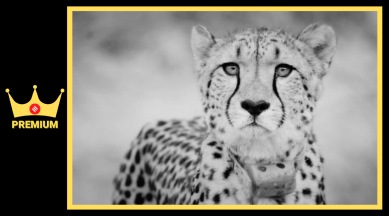
Radio collar goes silent, Kuno officials try old-school ways to track female cheetah
This is part of an exercise being carried out by wildlife officials to track down free-ranging cheetahs and bring them back to their enclosures so their radio collars can be removed and the animals can be checked for possible signs of infection caused due to wet weather conditions.
Cheetahs are being brought back to enclosures for their collars to be removed. (Twitter/@KunoNationalPark)
Advertisement
Listen to this articleYour browser does not support the audio element.
Relying on elephants, ground teams, CCTVs and local villagers, Madhya Pradesh wildlife officials and Namibian experts are trying to track two female cheetahs at Kuno National Park, including one that has been untraceable since its collar stopped transmitting signals a few days ago.
The team of experts are now relying on traditional modes of tracking as they traverse the Kuno landscape looking for pug marks and other signs of the cheetahs, Nirva and Dhatri, who they want to check for possible infection. While Dhatri’s radio collar is working, Nirva’s is not.
You’ve Read Your Free Stories For Now
Sign up and keep reading more stories that matter to you.
This is part of an exercise being carried out by wildlife officials to track down free-ranging cheetahs and bring them back to their enclosures so their radio collarscan be removed and the animals can be checked for possible signs of infection caused due to wet weather conditions. This comes after two male cheetahs died within a span of three days in July.
Principal chief conservator of forests (PCCF-wildlife) Aseem Shrivastava told The Indian Express, “We have a dedicated team made up of wildlife officials and Namibian cheetah experts who are trying to track down the two remaining cheetahs. These two are skittish and avoid human interaction, which is making it very difficult to track them down. In African countries, some of these cheetahs are used to human interaction so it makes it easier to medically examine them.”
Wildlife officials said they are employing elephants and taking the help of local villagers to track the two big cats.
“Elephants are tracking them; we have ground teams working 24×7. We have cameras to trace their movements by their pug marks so we increase the chances of sighting and collecting evidence of their presence and can track them down,” Shrivastav said.
Asked why Nirva’s radio collar had stopped transmitting the signal, Shrivastav said, “This is a technical issue and it can happen. Sometimes, these collars may have a battery life of a year and you may need to recharge the battery in six months. It is normal in these cases.”
Story continues below this ad
Officials said Dhatri will soon be tranquilised and brought back to the enclosure.
Wildlife officials have managed to bring back nine free-ranging cheetahs from the Kuno National Park to their respective enclosures. Officials examined the cheetahs and a coalition of Namibian brothers, Gaurav and Shaurya, also known as The Rockstars, reported serious infection, which has been treated. Wildlife authorities said that all cheetahs back at the enclosure are healthy.
At least five of the 20 cheetahs translocated from Namibia and South Africa to Kuno since September last have died due to various reasons.
The first, on March 27, was a Namibian cheetah named Sasha, who died of a kidney ailment. Officials believe Sasha had the problem before its arrival at Kuno.
Story continues below this ad
On May 9, female cheetah Daksha, brought from South Africa, died following a “violent interaction” with two male cheetahs during mating. Daksha’s death came close on the heels of the death of Uday, who had taken ill in April.
On July 14, male cheetah Suraj died, and on July 11, male cheetah Tajas was found dead. Both had injuries on the neck and multiple organ failure. South African experts and wildlife officials suspected that an infection broke out due to wet weather conditions and abrasions caused by radio collars resulting in septicemia.
On July 17, the Madhya Pradesh government removed J S Chauhan from his position as the state’s chief wildlife warden, days after he said he was considering removing the radio collars. The Ministry of Environment, Forest and Climate Change had meanwhile said that reports of cheetah deaths due to radio collars were not based on scientific evidence, and that “all mortalities are due to natural causes”.
Anand Mohan J is an award-winning Senior Correspondent for The Indian Express, currently leading the bureau’s coverage of Madhya Pradesh. With a career spanning over eight years, he has established himself as a trusted voice at the intersection of law, internal security, and public policy.
Based in Bhopal, Anand is widely recognized for his authoritative reporting on Maoist insurgency in Central India. In late 2025, he provided exclusive, ground-level coverage of the historic surrender of the final Maoist cadres in Madhya Pradesh, detailing the backchannel negotiations and the "vacuum of command" that led to the state being declared Maoist-free.
Expertise and Reporting Beats
Anand’s investigative work is characterized by a "Journalism of Courage" approach, holding institutions accountable through deep-dive analysis of several key sectors:
National Security & Counter-Insurgency: He is a primary chronicler of the decline of Naxalism in the Central Indian corridor, documenting the tactical shifts of security forces and the rehabilitation of surrendered cadres.
Judiciary & Legal Accountability: Drawing on over four years of experience covering Delhi’s trial courts and the Madhya Pradesh High Court, Anand deconstructs complex legal rulings. He has exposed critical institutional lapses, including custodial safety violations and the misuse of the National Security Act (NSA).
Wildlife Conservation (Project Cheetah): Anand is a leading reporter on Project Cheetah at Kuno National Park. He has provided extensive coverage of the biological and administrative hurdles of rewilding Namibian and South African cheetahs, as well as high-profile cases of wildlife trafficking.
Public Health & Social Safety: His recent investigative work has uncovered systemic negligence in public services, such as contaminated blood transfusions causing HIV infections in thalassemia patients and the human cost of the fertilizer crisis affecting rural farmers.
Professional Background
Tenure: Joined The Indian Express in 2017.
Locations: Transitioned from the high-pressure Delhi City beat (covering courts, police, and labor issues) to his current role as a regional lead in Madhya Pradesh.
Notable Investigations: * Exposed the "digital arrest" scams targeting entrepreneurs.
Investigated the Bandhavgarh elephant deaths and the impact of kodo millet fungus on local wildlife.
Documented the transition of power and welfare schemes (like Ladli Behna) in Madhya Pradesh governance.
Digital & Professional Presence
Author Profile: Anand Mohan J at Indian Express
Twitter handle: @mohanreports ... Read More