4 min read
Stay updated with the latest - Click here to follow us on Instagram
© IE Online Media Services Pvt Ltd



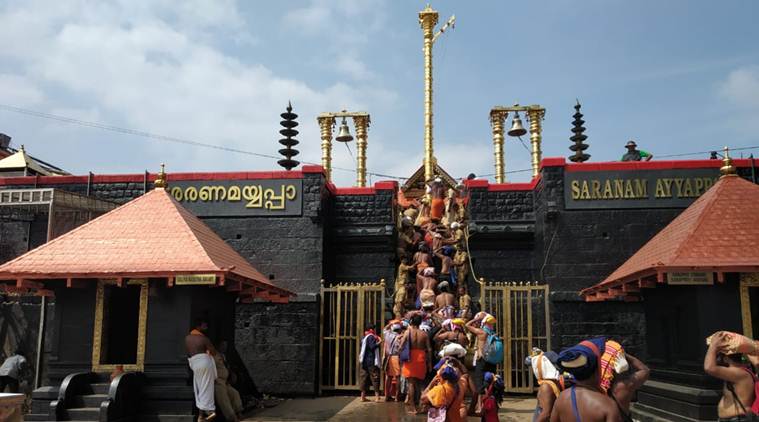 The court also said that a larger bench will decide on religious issues relating to Sabarimala, entry of women into mosques and practice of female genital mutilation
The Supreme Court Thursday referred petitions seeking a review of its 2018 decision to allow the entry of women of all ages in Kerala’s Sabarimala Temple to a larger seven-judge bench.
In a majority verdict of 3:2, Justices R F Nariman and D Y Chandrachud gave a dissenting view by dismissing all the review pleas and directing compliance of its last year order.
The majority verdict — written by Chief Justice of India Ranjan Gogoi, Justice A M Khanwilkar and Justice Indu Malhotra — said the ban on women’s entry in religious places, is not restricted to Sabarimala alone but was part of a larger debate that also includes other religions.
Reading out some portions of the majority view, Chief Justice Gogoi said the petitioners were endeavouring to revive the debate on religion and faith.
He added that the apex court should evolve a common policy on religious places like Sabarimala and added that the larger bench will decide the issues relating to Sabarimala, entry of women into mosques and practice of female genital mutilation.
Stating that pleas relating to Sabarimala, entry of women into mosques and practice of female genital mutilation in the Bohra community may require adjudication by a larger bench, the court decided to keep pending the pleas seeking a review of its 2018 order.
However, the majority verdict did not say anything adverse against the apex court’s September 28, 2018 decision allowing women to enter the shrine nor did it stay the earlier judgement.
Explained | Supreme Court’s Sabarimala order and the ‘essentiality’ test in religious practice
Welcoming the apex court’s verdict, Kandararu Rajeevaru, chief priest of the Sabarimala temple said religion and law must not be mixed, “We accept it. Referring the decision to a larger bench gives us more hope. It will extend greater strength to the faithful. It’s a good thing that the verdict considers Ayyappa devotees as a separate community.”
The decision was also welcomed by the Congress and the BJP in Kerala. Senior Congress leader Shashi Tharoor said issues involved have implications for the practice of all faiths. The BJP, currently without a state chief after PS Sreedharan Pillai was promoted as Mizoram Governor, also welcomed the ruling. Senior leader Kummanam Rajasekharan said that all existing customs and practices at the Ayyappa temple must continue and demanded a harmonious pilgrimage season.
The verdict comes just days before the Sabarimala temple opens for the annual ‘mandalam-makaravilakku’ festival stretching from November 16 to mid-January, a period witnessing heavy rush of devotees at the hilltop shrine.
In 2018, a five-judge Constitution Bench headed by then CJI Dipak Misra had ruled that banning entry of menstruating women is discriminatory and violates the right to equality. It said discrimination based on menstruation is akin to practising untouchability as both concepts are rooted in the idea of purity. Justice Malhotra, however, had given a dissenting verdict.
The split decision came on 65 petitions — 56 review petitions, four fresh writ petitions and five transfer pleas — which were filed after the apex court verdict of September 28, 2018 sparked violent protests in Kerala. Temple custodians argue that women of menstrual age are prohibited from offering prayers as the deity there, Ayyappa, is a celibate.
In February, the court had reserved its verdict after a day-long hearing of over 65 review petitions and fresh writ petitions.
Stay updated with the latest - Click here to follow us on Instagram