Journalism of Courage



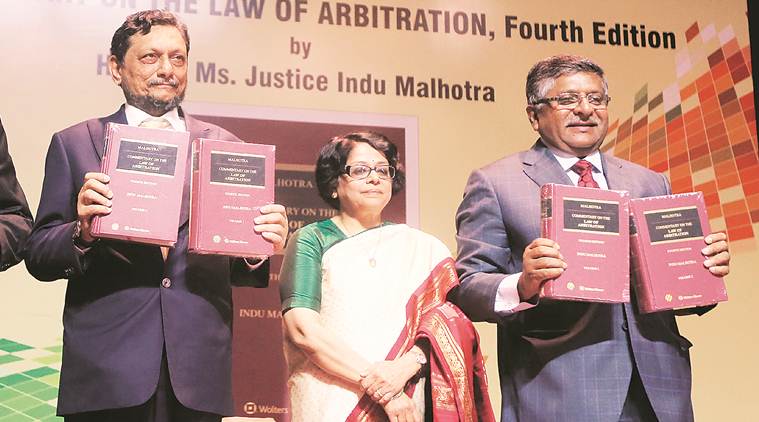 CJI S A Bobde with Union minister Ravi Shankar Prasad at the launch of a book on arbitration laws by Justice Indu Malhotra in New Delhi on Monday. (Express photo by Prem Nath Pandey)
At a time when two major legal decisions of the government, the presidential orders diluting Article 370 of the Constitution and the Citizenship (Amendment) Act are under challenge before the Supreme Court for being “arbitrary”, Union Minister for Law and Justice Ravi Shankar Prasad said on Monday that judges must first define the contours of “manifest arbitrariness” before striking down legislation.
“If manifestly arbitrary as a ground is used to nullify legislation, then it is important to define its contours in judicially manageable standards so that lawmakers can know it,” Prasad said.
He was speaking at the launch of the 4th edition of the treatise on arbitration laws The Law and Practice of Arbitration and Conciliation authored by Supreme Court judge Justice Indu Malhotra. Referring to a November 2019 judgment where a bench led by Justice Rohinton Nariman struck down the 2019 amendment to the Arbitration and Conciliation Act on the grounds that it was “manifestly arbitrary”, Prasad said the doctrine of manifest arbitrariness is not “an issue very free from difficulty.”
Even as he criticised application of the doctrine, the minister repeatedly said that the verdict must be respected.
While executive actions have been struck down for being ‘arbitrary’, the SC has extended this to legislation passed by Parliament since 2017. It was first used by Justice Nariman in the 2017 to set aside the practice of triple talaq.
In order to be described as arbitrary, it must be shown that the law was “not reasonable and manifestly arbitrary”, the court had said. Subsequently, the court used the doctrine in cases to decriminalise homosexuality and adultery.
In November 2018, referring to the doctrine of “constitutional morality,” Prasad remarked that “the nuances of the principle need to be defined more clearly.” The SC had invoked the doctrine of constitutional morality in many significant cases including the Sabarimala case in which the court lifted the traditional age bar on women entering the shrine in Kerala.
“We hear a lot of Constitutional morality.We appreciate these innovations.One respectful submission I would like to make is the nuances of Constitutional morality need to be defined with greater clarity. And it should not differ from Judge to Judge but there should be a consensus,” Prasad had said.
Incidentally, a 9-judge bench of the court is now set to define the contours of constitutional morality and its application to cases while reviewing the Sabarimala verdict.

 3 min read