Journalism of Courage



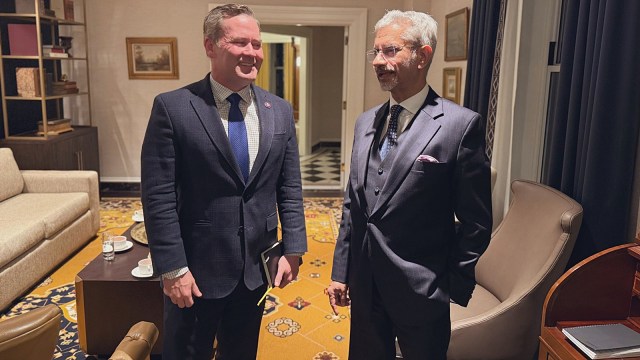 In the last week of December, Jaishankar had met Mike Waltz in the US. (Photo: X)
S Jaishankar will represent India at the January 20 inauguration of US President-elect Donald Trump.
Announcing the visit, the Ministry of External Affairs on Sunday said, “On the invitation of the Trump-Vance inaugural committee, External Affairs Minister Dr S Jaishankar will represent the Government of India at the swearing-in ceremony of President-elect Donald J Trump as the 47th President of the United States of America.”
During the visit, the MEA said, “The External Affairs Minister will also have meetings with representatives of the incoming administration, as also some other dignitaries visiting the US on that occasion.”
Jaishankar visited the US in the last week of December and met Mike Waltz, NSA-designate in the incoming Trump administration.
The new administration has maintained that strengthening Indo-US ties has been a bipartisan commitment and enjoys support on both sides of the aisle.
But Trump’s return brings challenges as well – he has spoken out against tariffs by the Indian government, even calling it the “tariff king” and “abuser of tariffs” in the past. So, the Indian side is expecting a tough challenge on the trade front, which has grown beyond USD 190 billion in 2023.
The other challenge that India expects is on the issue of illegal immigration, a political hot-button issue during the elections. In the last year, the Biden administration sent back about 1,100 people on flights who had entered the US illegally.
The Indian government maintains it does not support illegal immigration, and does not want the issue to cast a shadow on legal immigration. In recent weeks, there has been much debate over the H-1B visa issue as well, raised by far-right Republicans, and the Indian community has had to face the ire of the MAGA Republican base.
However, Trump has backed the H-1B programme, and acknowledged frequently using it for his own properties, calling it a “great programme”. His ally and backer, Elon Musk, owner of Tesla, X and SpaceX, had waded into the debate on hiring H-1B visa-holders with many in the right wing opposing it.
Musk said he “will go to war” on the issue and asked right-wingers to “take a big step back”.
The H-1B programme allows businesses in the US to employ skilled foreign nationals.
The Indian side maintains that Indian professionals contribute to the US economy as well, and the Indian American community is viewed as an influential, educated and wealthy “model minority” group in the US.
In the light of these issues, the Indian establishment has moved in early to engage with the incoming Trump administration. And Jaishankar’s two back-to-back visits are testament to that effort.
Delhi believes that the growing assertiveness of China has been a strategic glue for India and the US, including under Trump 1.0, and expects that to continue in his second term as well.
Trump championed the Quad grouping by reviving it, and is expected to continue with it. The Biden administration has started the Initiative on Critical and Emerging Technologies, and Delhi hopes it will continue with the Trump administration – since Beijing is the biggest competitor on these critical and emerging technologies as well.
During his visit in December, Jaishankar was said to have met senior members of the Trump team – other than those of the outgoing Biden administration.
The Biden administration sent NSA Jake Sullivan to India last week on a wrap-up visit, and Delhi is counting on a sense of continuity in the next term with Trump in the Oval Office.
There is a possibility of Prime Minister Narendra Modi visiting France for the Artificial Intelligence summit early February, for which French President Emmanuel Macron is also trying to bring Trump. If that works out, the two leaders will have their first opportunity for an in-person meeting on the sidelines of the AI summit.

 4 min read