Journalism of Courage



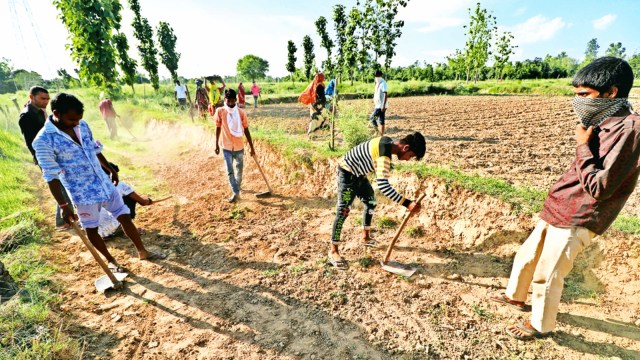 MGNREGA guarantees a minimum
100 days of unskilled manual work in
a financial year (April-March) to every rural household on demand. File
MGNREGA guarantees a minimum
100 days of unskilled manual work in
a financial year (April-March) to every rural household on demand. FileFINANCE MINISTER Nirmala Sitharaman has provided Rs 86,000 crore for the Mahatma Gandhi National Rural Employment Guarantee Act (MGNREGA) scheme in the Interim Budget for 2024-25, retaining it at the same level as provided for in the revised estimate for 2023-24.
While she had provided only Rs 60,000 crore for 2023-24 in her Budget presentation last February, the government had to increase the allocation during the year following continued robust demand for work under the scheme, despite the economy emerging fully from the Covid and Ukraine war-induced disruptions.
The two pandemic years of 2020-21 and 2021-22 saw all-time-high funding and job generation under MGNREGA, which guarantees a minimum 100 days of unskilled manual work in a financial year (April-March) to every rural household on demand. Even 2022-23, which unleashed Russia’s invasion of Ukraine, generated higher than average (pre-pandemic) person-days of employment.
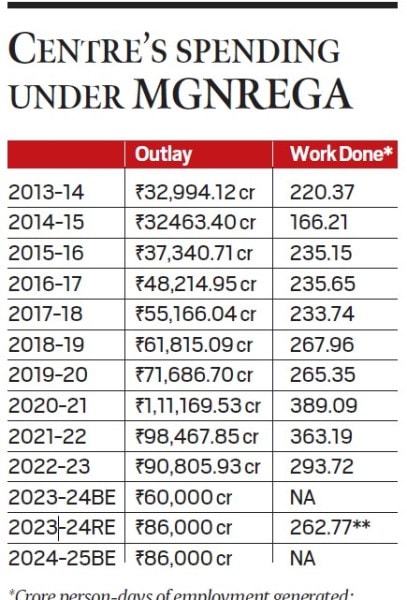
The current fiscal was expected to be the first normal year after the pandemic, which also accounted for the MGNREGA budget being slashed to the lowest-ever level since 2017-18 (see table). But as it turned out, work demand under the scheme — launched in February 2006 by the previous UPA government — remains high. If the trend of employment during April-January 2023-24 holds, the fiscal could end up with 300 crore-plus person-days getting generated. That would be the third highest, after the record 363-389 crore person-days of 2020-21 and 2022-23.
MGNREGA is supposedly a demand-driven scheme; the government can always meet additional funds requirements based on demand for works through supplementary demands for grants. The higher provision in the Interim Budget may, nevertheless, send positive signals to states for taking up MGNREGA works, ahead of Lok Sabha elections due in April-May, These are generally high-demand months before the southwest monsoon’s onset in June.
While MGNREGA was a UPA baby, the Pradhan Mantri Kisan Samman Nidhi (PM-Kisan) is a scheme that was started by the Modi government and became operational from December 1, 2018. The scheme’s beneficiaries — roughly 10 crore landholding farmer families, receiving an income support of Rs 6,000 per year – were paid two instalments of Rs 2,000 each before and during the last national elections in April-May 2019.
There were expectations that the Modi government would increase the annual payment under PM-Kisan as a pre-poll sop — from Rs 6,000 to about Rs 9,000 — in Thursday’s Interim Budget (the scheme was, in fact, officially announced in the last 2019-20 Interim Budget of Piyush Goyal). But this did not happen. The outlay for the scheme in 2024-25 has been retained at the current fiscal’s budget and revised estimate of Rs 60,000 crore.
Later, addressing a press conference, Sitharaman said, “MGNREGA allocation is not done on the basis of a trend. It is based on the demand coming from the ground.” In response to a query about the states’ cooperation in the implementation of the scheme, Sitharaman said the CAG has commented on the way MGNREGA is operating in some states.
In a separate announcement, the Finance Minister said it has been decided to enhance target for Lakhpati Didi from 2 crore to 3 crore.

 3 min read