Journalism of Courage



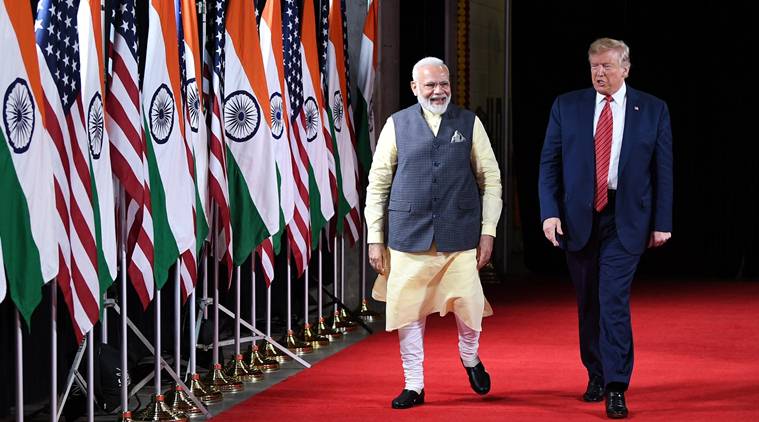 Prime Minister Narendra Modi with US President Donald Trump. (File)
INDIA AND the US were not able to finalise an “understanding” on trade and tariff-related issues, as Delhi was not willing to yield on the price control on medical devices, especially on coronary stents.
According to highly placed sources, Prime Minister Narendra Modi had instructed the Indian negotiators that, keeping the Ayushman Bharat Yojana in mind, the government cannot yield on lifting the price cap on coronary stents.
Sources said the price cap on coronary stents is “critical” to the success of Ayushman Bharat — the government’s flagship health coverage scheme. While Delhi wants to keep price control on knee implants as well, the issue of coronary stents was a “red line” for the Indian negotiators.
According to sources, cardiac surgery is among the most sought-after procedures, and government data shows that one- and two-stent angioplasty tops the list of packages offered under the scheme, followed by radiotherapy, knee replacement and hip replacement.
So, while Delhi and Washington bridged the gap on most of the trade and tariff-related issues, this became a key sticking point. While Commerce Minister Piyush Goyal and Commerce Secretary Anup Wadhawan came to New York for last-minute negotiations with US Trade Representative Robert Lighthizer, this issue could not be resolved.
Foreign Secretary Vijay Gokhale explained that the trade issues are “complex” since they “involve domestic industry on both the sides, jobs on both sides, and reconciling the gives-and-takes requires a certain amount of discussion, and certain amount of balance”. “We have made significant progress in the regard and are quite confident we will make further progress in the future,” he said.
“We expect it to be a fair and reasonable deal, and we have laid out our requirements, and so has the US side. It is now a matter of negotiating between the two sides on individual issues, to ensure that our requirement of access to the US markets, and for Indian companies and exporters to continue to do so, and also in new products, is secured. We also addressed the US side’s concerns regarding what they consider to be trade deficit,” he said.
The US government has been pushing India to lift the price caps on coronary stents and knee implants, at the behest of US medical device manufacturers. The medical device imports have jumped 24% to Rs 38,837 crore in FY19, according to the latest export-import data. The US is the largest exporter of medical devices to India, constituting one-fifth of the total, followed by Germany, China, Singapore and the Netherlands.
Gokhale said India and the US have made “significant progress in growing the trade in the last three-four years and also reducing the trade deficit”. He said both sides “felt optimistic of reaching some kind of a trade agreement in the near future, and the discussions will continue”.
In 2017, India slashed prices by 85% and capped the trade margins for coronary stents, following it up with a round of price controls on knee implants. The move hit many US companies.

 3 min read