Stay updated with the latest - Click here to follow us on Instagram

Journalism of Courage
 5 min read


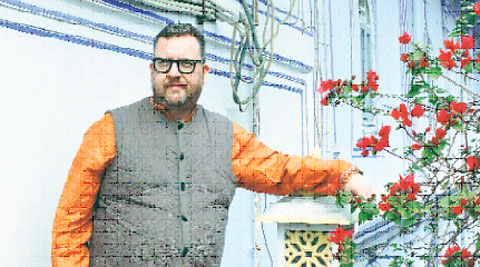 British writer Philip Hensher.
British writer Philip Hensher was a clerk at the House of Commons in 1996 when he opened his mouth to a gay magazine to say that he fancied Gordon Brown’s “shagged-out look”. Hensher, now 49, was promptly fired but that left him with the time in the world to write and travel to different worlds, between hard covers — The Mulberry Empire (2002) set in Afghanistan in the 1830s, The Northern Clemency (2008) which was shortlisted for the Man Booker Prize, and Scenes from Early Life (2012) about a Bangladeshi family during the war of 1971. He writes all his books longhand so it was no surprise that in 2012, Hensher wrote The Missing Ink, a book about the lost art of handwriting. Excerpts from an interview:
Would you say that losing your job was the “best” thing to have happened?
Oh it was fantastic. I think everybody ought to be sacked at some point in their lives. Because for most people that is the worst thing that could possibly happen. And when it happens, you think, oh well, that’s fine. That was 20 years ago, but since then, I’ve never been frightened of anybody. Apart from tigers, I’m quite frightened of tigers.
Your last book, Scenes from Early Life, is about your husband Zaved’s childhood. It’s been praised for its accurate portrayal of Dhaka of the 1970s. How did you manage that?
I’ve always felt that there was a real spiritual connection between the Bengali mind and the English mind and it’s about the place of humour. You don’t often see two Bengalis talking for long without one of them making a joke and the other one bursting out laughing. You can sit and watch two Swedish people for a long time before one of them will set out to make the other laugh. Bengalis and the English drive each other up the wall, but they get on in the end.
As a writer, do you feel you need to identify with the characters, especially if you’ve set them in a country and culture different from yours?
With Scenes, I don’t think readers cared if you’re actually Bengali or not, I can’t do anything about not being Bengali. But the writing needs to possess the quality of truth, it should appear to be true. I didn’t want to write the history of the Bangladesh war, I wanted to write the story about this family. I was quite a long way in when I realised that it was going to be about the war as well. Because everything was being shaped by the war. I wanted to give readers an interest into the war and go and read another book. I felt it wasn’t for an English writer to write a nationalist story.
In The Missing Ink, you wrote about how the pen is an extension of ourselves. You’ve also mentioned how cellphones are increasingly eclipsing writing instruments.
I love all the aspects of writing because of the instruments, you can chew the end of your pencil as you write. The pen feels very warm to us, like a part of ourselves. With the cellphone, there is a kind of bewildering intimacy. Till some years ago, people took out their cellphones to make calls. Now they hold it in their hands all the time, gazing at it like a small animal that might bite them if they don’t stare at it ceaselessly.
You’ve described Dan Brown as somebody who writes like a real estate agent. You’re not too fond of commercial fiction, are you?
I love commercial fiction, but Dan Brown is awful! Do you know who I love more than anybody? Elmore Leonard. A lot of the writers who we think of as great writers now, were very commercial in their times. Dickens, PG Wodehouse. But among the writers I admire, I admire Naipaul’s books more than anything. I don’t like him very much, but as a writer he’s unparalleled. Zadie Smith, she’s simply wonderful, especially her essays.
What are you working on now?
I’ve just finished a novel called The Emperor Waltz. It’s got three historical strands — one’s about the early Christians, one’s about German society in the 1920s, the rise of the Bauerhaus, the background of the rise of the Nazis, and the third one is about a radical bookshop in London in the 1980s. It’s been a great pleasure to write this novel, it’s a long one. I didn’t realise that I’d been thinking about this novel for decades. One of my best friends, when I sent him the novel, said to me, do you remember that when we were at Cambridge together in the late 1980s, we were walking down the street in London and we passed this radical bookshop and I’d said, at the time, (he remembered, I didn’t) that somebody ought to write a novel about that? So I’ve been thinking about this novel for at least 25 years. It came together very fluently, 620 pages, and I wrote it in 13 months. I’ve got to think of another one to write, but I’m having a little break now.
Stay updated with the latest - Click here to follow us on Instagram