Journalism of Courage



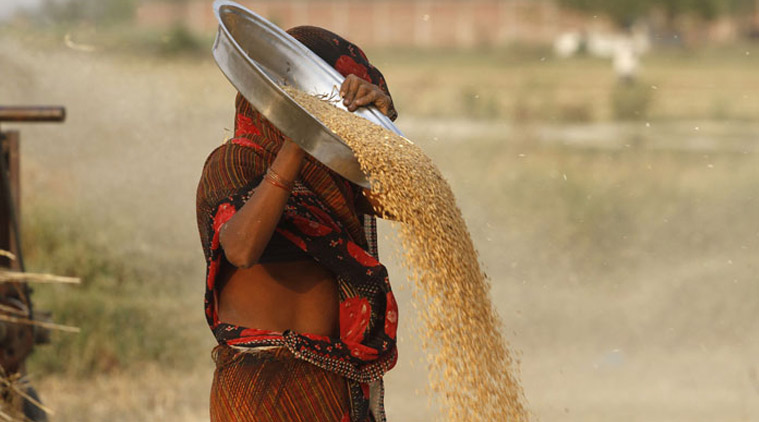 The Food Corporation of India (FCI) and state agencies have so far procured 26.14 million tonnes (mt) of the 2014-15 wheat crop being marketed from April, as against the 25.67 mt bought during this period last year.
The government has bought more wheat and paddy from farmers this time despite a dip in production due to the failure of the last monsoon and crop damage from unseasonal rain and hailstorms. This will also help blunt opposition criticism of the government being anti-farmer.
The Food Corporation of India (FCI) and state agencies have so far procured 26.14 million tonnes (mt) of the 2014-15 wheat crop being marketed from April, as against the 25.67 mt bought during this period last year.
The higher state purchases have happened despite the country’s wheat output falling to 90.78 mt, from the record 95.85 mt of 2013-14, and the government only marginally hiking its minimum support price (MSP) from Rs 1,400 to Rs 1,450 per quintal.
[related-post]
If the withdrawal of the additional Rs 150/quintal bonus paid last year by Madhya Pradesh and Rajasthan governments is also accounted for, farmers have effectively got a lower price for their wheat
this time.
A top official of the food ministry attributed the higher procurement to untimely rain and hailstorms in March, resulting in widespread crop damage and poor quality of the harvested grain. “Quality issues have meant very few private takers for this year’s wheat. All the surplus grain has, hence, flowed into government godowns,” the official said.
This is borne out by data comparing crop arrivals in mandis with official procurement volumes. While wheat arrivals have been lower this year, reflective of a smaller crop, overall governmental procurement has nevertheless gone up (see table). And that has been mainly courtesy the government relaxing quality specifications for wheat purchases to avoid distress sales by farmers.
For the current rabi marketing season, wheat with up to 10 per cent shrivelled and broken grains (against the existing 6 per cent limit) and 50 per cent luster loss content has been allowed to be procured at the official MSP of Rs 1,450 per quintal. “Farmers had little choice but to sell to state agencies, as private millers and traders wouldn’t have paid even Rs 1,100-1,200 per quintal for the quality of the grain on offer,” the official said.
 “FCI’s procurement invariably goes up whenever the crop quality is bad,” Tejinder Narang, a grain trade analyst, pointed out. But the willingness to buy every grain, irrespective of quality, at the MSP would also entail dispensing with the rule of offloading old stocks from warehouses first.
“The usual principle is FIFO (first-in, first-out). But this time, we will be following LIFO (last-in, first-out), since the wheat bought is prone to further quality deterioration and cannot be stored for too long. It has to be milled and consumed in the shortest possible time,” the official said.
The low availability of good quality domestic wheat, especially the rain-effected Lokwan and Sharbati varieties from Madhya Pradesh, has also led to flour millers resorting to bulk imports for the first time since 2007-08.
South-based mills have already contracted 3.5-4 lakh tonnes of Australian premium white wheat for delivery at Kochi, Tuticorin and Chennai ports. The first shipments of 25,000-30,000 tonnes each, imported through multinational traders like Louis Dreyfus and Noble Grain, are expected to arrive early this week.
“The landed cost of $255-270 per tonne works out below FCI’s open market sale price of Rs 18,500 even after adding port handling and bagging charges of Rs 1,000 per tonne. Russian and Ukrainian wheat would cost even lower at $210-220 per tonne, though the government will have to lift plant quarantine restrictions coming in the way of their imports now,” Narang said.
S Pramod Kumar, executive director of Belgaum Roller Flour Mills, said the imports currently being undertaken are basically for “quality and not price considerations”. Millers typically blend premium quality wheat from Madhya Pradesh (or, in its absence, Australia) with normal fair average quality grain to make atta, maida and sooji used in products from rotis, naan, biscuits and cookies to rava idli and upma.
But it’s not just wheat. The government has also bought more paddy from farmers this time compared to last year. As on Friday, total paddy purchases (in terms of rice) for the 2014-15 marketing season stood at 27.74 mt, up from last year’s corresponding procurement of 27.25 mt. This again, despite a fall in rice production (102.54 mt versus 106.65 mt for 2013-14), a marginal Rs 50/quintal increase in the paddy MSP, and no extra bonus from states such as Chhattisgarh.

 5 min read