Journalism of Courage



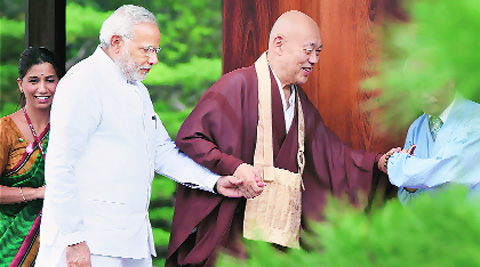 ‘I’m Modi and you are Mori’: This is how Prime Minister Narendra Modi charmed the 83-year-old head priest Yasu Nagamori (left) of Kinkakuji (Golden Pavilion) — an ancient 14th century Buddhist temple — in Kyoto on Sunday. (Source: PTI)
When Prime Minister Narendra Modi looked through the microscope at Kyoto University’s stem cell centre lab on Sunday, he saw “hot muscle cells” made by Shinya Yamanaka, Japan’s stem cell pioneer and a 2012 Nobel Prize winner.
Soon, he asked Yamanaka to help battle sickle cell anaemia in India. The Japanese scientist, who has been to India, agreed, and Tokyo and Delhi are now looking at an agreement to help fight the hereditary disorder in which the body’s red blood cells take on a sickle shape, and contain defective haemoglobin.
In India, the disease is found mostly commonly among tribals in some parts of Gujarat and Orissa, as well as in Maharashtra, Madhya Pradesh and Chhattigarh.
As Gujarat CM, Modi is understood to have met several tribals suffering from the disease.
After his visit to the lab on the second day of his Japan tour, the PM said: “I wanted to understand stem cell research because cultural heritage matters to me as much as scientific heritage. I want to integrate both to make India a developed country.”
Akemi Nakamura, a spokesperson for Yamanaka’s stem cell research institute, said, “The Indian Prime Minister and Dr Yamanaka had a conversation for about 30 minutes. It was indeed a proud moment for us.”
Officials said the prospect of cooperation on sickle cell anaemia is a “promising start” towards combating the disease.
Yamanaka won the Nobel Prize along with British scientist John Gurdon for his work in stem cell research. He made the groundbreaking discovery that “induced pluripotent stem cells” could be derived from adult cells and potentially substituted, in research and therapy, for embryonic stem cells.
That discovery was prompted by his reluctance to use live embryos for research purpose.

 2 min read