Stay updated with the latest - Click here to follow us on Instagram

Journalism of Courage
 7 min read


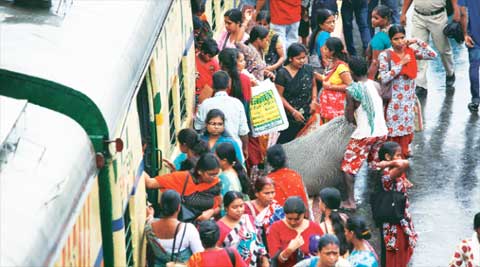 For women in Kolkata, commuting during rush-hour in trains and buses is as trying as in other cities.
Darkness sets in early in Kolkata. By 6 pm, awash with orange-hued streetlights, it becomes a different city. The mad rush of Dalhousie is still there, New Market is bustling with shoppers and hawkers, Coffee House is clogged with the smell of cigarette and coffee, and women still wash utensils under gushing water hydrants in the lanes of Shobhabazar. But the city shrinks imperceptibly for women. “By evening, my para is unrecognisable. Strangers take over the place.
Known corners take on sinister hues. I don’t feel safe,” says 28-year-old Anushree Bhatter, a freelance photographer based out of the city, about the upmarket neighbourhood of New Alipore, which saw a spate of molestation cases two years ago.
A mild sense of justified paranoia grips most women of the Indian subcontinent as soon as dusk descends, and Kolkata is no exception. There are empty roads to be negotiated, groping hands to be averted and stares to be ignored. For decades or more, however, Kolkata cushioned itself comfortably in the complacence of being a safe city. Delhi was where all the bad things happened. Mumbai partied late into the night and invited trouble. Bangalore with all its beer bars and call centres spelled trouble. While Kolkata sat contended as an island of peace and safety. Really? According to the National Crime Records Bureau, the incidence of crime against women was highest in West Bengal in 2011. More than 2,000 cases of rape were registered that year.
In the last few years, Kolkata’s reputation has been battered by many cases of violent crime: from the Park Street rape, the Kamdhuni gang rape and murder to the recent gang rape and alleged murder of a 16-year-old girl. Many people are not surprised at the figures or the number of women speaking out. Kakoli Bhattacharya of Kolkata-based women’s rights organisation, Swayam, believes that the “safe city” tag was illusory. “It will be foolhardy to presume that things were hunky dory once and they have changed now. Having worked in this field for decades, I have witnessed numerous incidents of rape, eve-teasing, and sexual harassment in the workplace,” says Bhattacharya. Over a decade ago, on New Year’s Eve, 2002, five young men had chased a woman riding pillion on a motorbike at Nirmal Chander Street and murdered the traffic constable, Bapi Sen, who had tried to intervene and protect her.
Fifty-year-old Reba Das, a domestic worker who commutes from the suburb of Santragachi to south Kolkata every day, observes that sexual violence has been relentless and rampant in the city for as long as she can remember. “When I was younger, I would get catcalls from louts on the road. This is why we would travel together in a huddle. Today, I feel ashamed to admit that I am groped in buses at times,” says Das. Last year, in a little talked-about incident, Reba’s friend was raped near the Satragachi flyover when she stepped out alone early in the morning to report for work.“She was accosted by an unidentified man. He tried to snatch her gold earrings. When she resisted, he forced himself upon her and raped her,” says Das.
The city’s women point to a greater hostility towards those who step out of conventional roles. “Nowhere will you find the slotting of good victim and bad victim more than in Kolkata. I was tagged a bad victim because I partied and boozed. Therefore, I asked for it,” says Suzette Jordan, who was raped in a taxi on Park Street in 2012. In many ways, the culture urges you to respect only a certain kind of woman. “You are expected to respect women who are like your mothers. Those who question that stereotype are looked at with suspicion,” says Jayeeta Biswas, a student of English at Jadavpur University.
Recently, Nila Sen (name changed on request), a working single mother of a 16-year-old son, put up a status message on Facebook, about how her son was being harassed by young men of her neigbourhood because his mother was a divorcee. “They would call me names in front of him and when he protested, he was beaten up. When I tried to intervene, I was manhandled too. These boys were hardly a few years older than my son. I didn’t know what to say,” says Sen. She was “advised” by the elders of her neighbourhood not to antogonise the men. “They said I have to live here alone and I shouldn’t take that risk,” she says.
For working women in Kolkata, commuting during rush-hour is a nightmare, like any other city. But many feel that you are more likely to be groped in a crowded metro in Kolkata than in a packed local train in Mumbai. “There is this passive aggression in some men that is very palpable. Recently, I was groped in a bus by a young man in a bus. When I confronted him, he hurled abuses at me and said he wouldn’t even look at a girl like me,” says Sweta Chatterjee, a student from Film and Television Institute of India.
Catie Buttner, a social worker from Philadelphia, who is working with sex workers of Sonagachi (Asia’s largest red-light district), observes a pattern in all this. “It’s funny how I am more comfortable walking down the streets of Sonagachi. Things are more sexually liberated there. I have faced more harassment in the middle-class pockets of the city,” she says. Catie recalls a number of incidents where she and her Indian male friend was accosted by the local police for being out late at night. A year ago, a French national was chased down by a gang of bikers in Ballygunge. “As a foreigner in a city, I am used to be stared at. I know that people stare at me because I look different and unusual. But there is a thin line between staring and leering. When I am travelling in the metro, I am usually leered at by middle-aged, office-going men,” she adds.
The city’s infrastructure has a major role to play in the way women of Kolkata feel about their wellbeing. The restriction on the operating hours of bars and restaurants in the city that started after the Park Street rape case in late 2012 has had an adverse effect on the city’s safety. “When I was younger, we could get cabs from Park Street way beyond midnight,” says Paromita Chakraborti, director, School of Women’s Studies, Jadavpur University. “Today, there are hardly any cabs available beyond 10.30 pm. Even autorickshaws and buses don’t ply on roads beyond 11pm. These things matter. It’s almost as if the authorities are asking us not to step out of our houses at night. A city that refuses to recognise the right of each and every citizen of the city to commute freely can never be a safe city,” says Chakraborti.
By Premankur Biswas
Stay updated with the latest - Click here to follow us on Instagram