Journalism of Courage



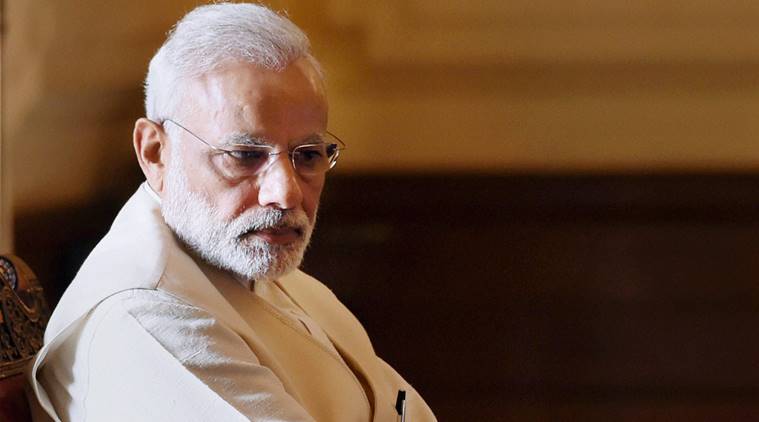 Prime Minister Narendra Modi at the release of Vice-President Hamid Ansaris book Citizen and Society at Rashtrapati Bhawan in New Delhi on Friday. PTI Photo by Subhav Shukla
Sending the strongest signal of deterioration in ties with Pakistan in the wake of the September 18 Uri attack, India Tuesday announced it will not attend the 19th SAARC summit in Islamabad in November. Official sources claimed Bangladesh, Afghanistan and Bhutan too have reservations on attending the summit.
The announcement was made by the Ministry of External Affairs (MEA) which said “increasing cross-border terrorist attacks in the region and growing interference in the internal affairs of member states by one country have created an environment that is not conducive to the successful holding of the 19th SAARC Summit in Islamabad”.
WATCH VIDEO: After India, Bangladesh, Bhutan, Afghanistan Boycott 19th SAARC Summit In Islamabad
MEA spokesperson Vikas Swarup also tweeted: “Regional cooperation and terror don’t go together.” A day earlier, Prime Minister Narendra Modi had told officials at a meeting on the Indus Waters Treaty that “rakt aur paani ek saath nahin beh sakta” (blood and water cannot flow together).
In London last Saturday, Pakistan Prime Minister Nawaz Sharif said it was his hope that all SAARC members would attend the summit in Islamabad.
In first remarks on the Indian decision, the Pakistan Foreign Ministry spokesman said it had noted the Indian spokesperson’s tweet on the announcement about the refusal to participate in the summit.
“While we have not received any official communication in this regard, the Indian announcement is unfortunate,” the spokesperson said. Pakistan, he said, remained committed to peace and regional cooperation. “We will continue to work to that end in the larger interest of the people in this region,” he said.
This is the first time India will boycott a SAARC summit, first held in Dhaka in 1985. Government sources said boycott of a SAARC summit by any head of government means that the summit has to be postponed.
At the 2007 summit in Delhi, Bangladesh was represented by an advisor to the then caretaker government but the rules, sources said, have since been changed — a summit can now take place only if all SAARC heads of state or government participate.
Even after the attack on Parliament in December 2001, India attended the SAARC summit in Kathmandu in January 2002 despite a tense border standoff with Pakistan. One of the enduring images of that summit was when General Pervez Musharraf walked up to Prime Minister Atal Bihari Vajpayee to shake his hand. In fact, that summit was held after 1998 — a four-year gap owing to tensions between India and Pakistan post Kargil.
At the last summit in Kathmandu in November 2014, Modi and Sharif shook hands at the end of the summit — to a round of applause from all present. Even at that time, ties were frosty and Foreign Secretary-level talks had been cancelled.
On Tuesday, MEA spokesperson Vikas Swarup said: “India remains steadfast in its commitment to regional cooperation, connectivity and contacts but believes that these can only go forward in an atmosphere free of terror. In the prevailing circumstances, Government of India is unable to participate in the proposed summit in Islamabad,” he said.
“We also understand that some other SAARC member states have also conveyed their reservation about attending the Islamabad summit,” he said.

 4 min read