


Stay updated with the latest - Click here to follow us on Instagram
© The Indian Express Pvt Ltd
Tags:


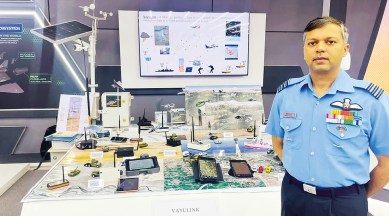
The Indian armed forces are in the process of inducting a homegrown innovation along the country’s northern and eastern borders which will help commanders identify friendly forces in a joint battlespace.
This will facilitate better coordination during complex operations and curb instances of mistaken fratricide as happened in Budgam in the aftermath of the 2019 Balakot air strikes.


The Vayulink system was showcased by the IAF at the Aero India 2023 show in Bengaluru last month.
Senior IAF officers said trials for operational deployment of the system have been completed. “The procurement required for deployment is under process. Once the procurement is completed, mass deployment of the system will start in all forward areas,” an officer said.
Air Marshal Narmdeshwar Tiwari, Deputy Chief of the Air Staff, told The Sunday Express that the Vayulink ecosystem is an in-house developed tactical data link system.
“It integrates inputs available from multiple sources in a joint battlefield and provides near real-time data to operators, thereby vastly improving their situational awareness and consequently aiding in effective decision making,” he said.
“The IAF has already deployed the system on a trial basis at forward locations in the Western and Northern sectors. We are planning to further enhance the reach and applicability of the system in future,” he said.
Wing Commander Mishra said the Vayulink is effectively a data link system which connects all entities, combat and non-combat, through a single link.
“The system can help you get the position of all friendly forces in a battlefield or even those in support roles. When in use in a complex combat situation, the system can help all aircraft see each other’s position and location of ground troops,” he said.
The system, he said, can have a range of applications and is not confined to one service, but can integrate all combat entities through a single link. It has also been inducted into the Army under the name Trishul link.
The system can improve the efficiency of operations, especially complex ones such as the one launched in response to the Pathankot air base terror attack in 2016.
The counter-terror operations in Pathankot lasted nearly four days, despite IAF helicopters supporting the ground forces. Seven security personnel were killed by the terrorists who had infiltrated the air base.
Explaining how the Vayulink can help, another IAF officer said an attack pilot does not have the capability at present to see on a device the exact position of friendly forces.
With more emphasis on future joint battles and the military opting for more indigenous weapon systems, this homegrown solution is expected to benefit all users in a joint battlespace by providing real-time combat identification. It will improve mission execution capabilities and reduce weather-linked accidents.
“When actual contact battle takes place, you do not know where the friendly forces and where the enemy forces are. So, a pilot going for a busting role can face difficulties in identifying his own troops at that time. A system like Vayulink is going to help,” the officer said.
It is learnt that the system can also curb Budgam-like cases of mistaken fratricide by bringing in battlefield transparency that will enable the ground crew to identify friendly forces and be aware of their exact positions.
After the Balakot air strikes in 2019, the IAF had shot down its Mi-17 V5 helicopter at Budgam by mistake, killing six personnel on board. The helicopter’s IFF (Identification of Friend or Foe) system was also switched off, which had led to gaps in communication between the helicopter crew and the ground forces.
Asked about the limitations of the existing IFF systems, the officer said that the IFF system is only applicable to an aircraft and requires radars to function. “On the other hand, the Vayulink system can be carried by an aircraft, individual troops or armoured vehicles on ground, distinguishing them from their enemy counterparts. Secondly, the IFF system has limitations with respect to the line of sight,” the officer said.
The development team is currently focusing on its smooth induction into the Indian armed forces.
The Vayulink system can also arm the pilot with real-time weather details before flying, thereby preventing accidents.


Stay updated with the latest - Click here to follow us on Instagram


