This is an archive article published on June 11, 2020
Gujarat: Stranded Manipur students of Darul Uloom wait for train to go home
Close to 170 madrasa students, including about 23 from Darul Uloom Baroda, were left waiting at the station when the special train to Manipur chugged out of the platform carrying only half its capacity
Written by Aditi Raja
Vadodra | June 11, 2020 01:41 AM IST
4 min read
Whatsapp
twitter
Facebook
Reddit
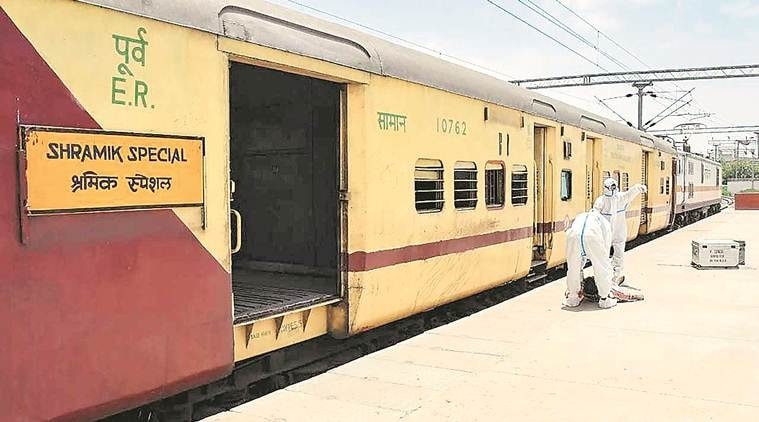
The letter submitted by Mufti Arif Hakim Falahi, Principal of Darul Uloom Baroda, states that the act seems like “religious discrimination”. (File)
Over two weeks after students of several madrasas in Central and South Gujarat were left out of a special Shramik train from Bharuch to Manipur which departed on May 23, the Darul Uloom Baroda has submitted a memorandum to district collector Shalini Agarwal, seeking action against the nodal officer responsible for the issue.
Close to 170 madrasa students, including about 23 from Darul Uloom Baroda, were left waiting at the station when the special train to Manipur chugged out of the platform carrying only half its capacity.
The letter submitted by Mufti Arif Hakim Falahi, Principal of Darul Uloom Baroda, states that the act seems like “religious discrimination”.
The memorandum, submitted on Monday, narrates the incident of May 23, when 23 students of Darul Uloom Baroda, along with other residents of North East, reached Bharuch station at 10pm, ready to board the train to be back home in time for Eid. However, despite carrying valid tickets along with the required documents, including a medical screening certificate stating them to be asymptomatic for Covid-19 virus, the students watched the train leave without them being allowed to board.
The letter states, “The students were not accompanied by the nodal officer from the district to begin with. They were given valid tickets and also the health certificate after their Covid-19 screening at Akota centre in Vadodara. They were also asked to pay Rs 250 each towards an exorbitant bus ride from Vadodara to Bharuch in a private bus instead of government transportation. But for reasons best known to the administrations, the children were not allowed to board the train.”
The letter further states that earlier, 127 other students from the madrasa returned to their home states from Vadodara on other trains — Haryana 18, Bihar 69, Madhya Pradesh 14, Rajasthan 17, Wear Bengal 6 and Maharashtra 3.
“These children have been stranded in the madrasa since April 3, when they were originally supposed to return as per normal academic schedule of the madrasa. Their tickets were also booked but the lockdown meant that the trains never left. …this episode has left all of them (parents of students) anxious. To us, it seems to be a clear case of discrimination. The administration should think about these children,” Falahi said.
Story continues below this ad
Nodal officer for migrant travel in Vadodara, Deputy Collector Ram Joshi told this newspaper that the students were left out because of a last minute demand from the Bharuch administration for Aadhaar card copies of all travellers. “There was no such intimation at the beginning. In fact, no other district administrations were asking for Aadhaar cards… So it was almost 11pm when they asked for copies of Aadhaar cards of all passengers. Our local representative even tried to visit a local hospital to check if they could arrange a photocopy but it was impossible.
Those students who had the copies were asked to go but they said they would travel with the group only. The train was already delayed by two hours because of this and so it left with almost five empty coaches,” Joshi said.
The Vadodara district administration has submitted its report in the matter to the state nodal officer. Joshi said, “We have already decided to refund the excess charge collected for the bus journey. We have also told them that we are willing to give them a travel pass if they would like to arrange a bus for them to travel to Manipur. If we get clearances to send them off by any trains going to the North East, we will do so on priority.”
Aditi Raja is an Assistant Editor with The Indian Express, stationed in Vadodara, Gujarat, with over 20 years in the field. She has been reporting from the region of Central Gujarat and Narmada district for this newspaper since 2013, which establishes her as a highly Authoritative and Trustworthy source on regional politics, administration, and critical socio-economic and environmental issues.
Expertise:
Core Authority & Specialization: Her reporting is characterized by a comprehensive grasp of the complex factors shaping Central Gujarat, which comprises a vast tribal population, including:
Politics and Administration: In-depth analysis of dynamics within factions of political parties and how it affects the affairs in the region, visits of national leaders making prominent statements, and government policy decisions impacting the population on ground.
Crucial Regional Projects: She consistently reports on the socio-economic and political impact of infrastructure projects in the region, especially the Statue of Unity, the Sardar Sarovar Project on the Narmada River, the Mumbai-Ahmedabad High Speed Rail bullet train project as well as the National Highway infrastructure.
Social Justice and Human Rights: Her reporting offers deep coverage of sensitive human-interest topics, including gender, crime, and tribal issues. Her reports cover legal proceedings from various district courts as well as the Gujarat High Court (e.g., the Bilkis Bano case remission, POCSO court orders, Public Interest Litigations), the plight of tribal communities, and broader social conflicts (e.g., Kheda flogging case).
Local Impact & Disaster Reporting: Excels in documenting the immediate impact of events on communities, such as the political and civic fallout of the Vadodara floods, the subsequent public anger, and the long-delayed river redevelopment projects, Harni Boat Tragedy, Air India crash, bringing out a blend of stories from the investigations as well as human emotions.
Special Interest Beat: She tracks incidents concerning Non-Resident Gujaratis (NRIs) including crime and legal battles abroad, issues of illegal immigration and deportations, as well as social events connecting the local Gujarati experience to the global diaspora. ... Read More


 4 min read


 The letter submitted by Mufti Arif Hakim Falahi, Principal of Darul Uloom Baroda, states that the act seems like “religious discrimination”. (File)