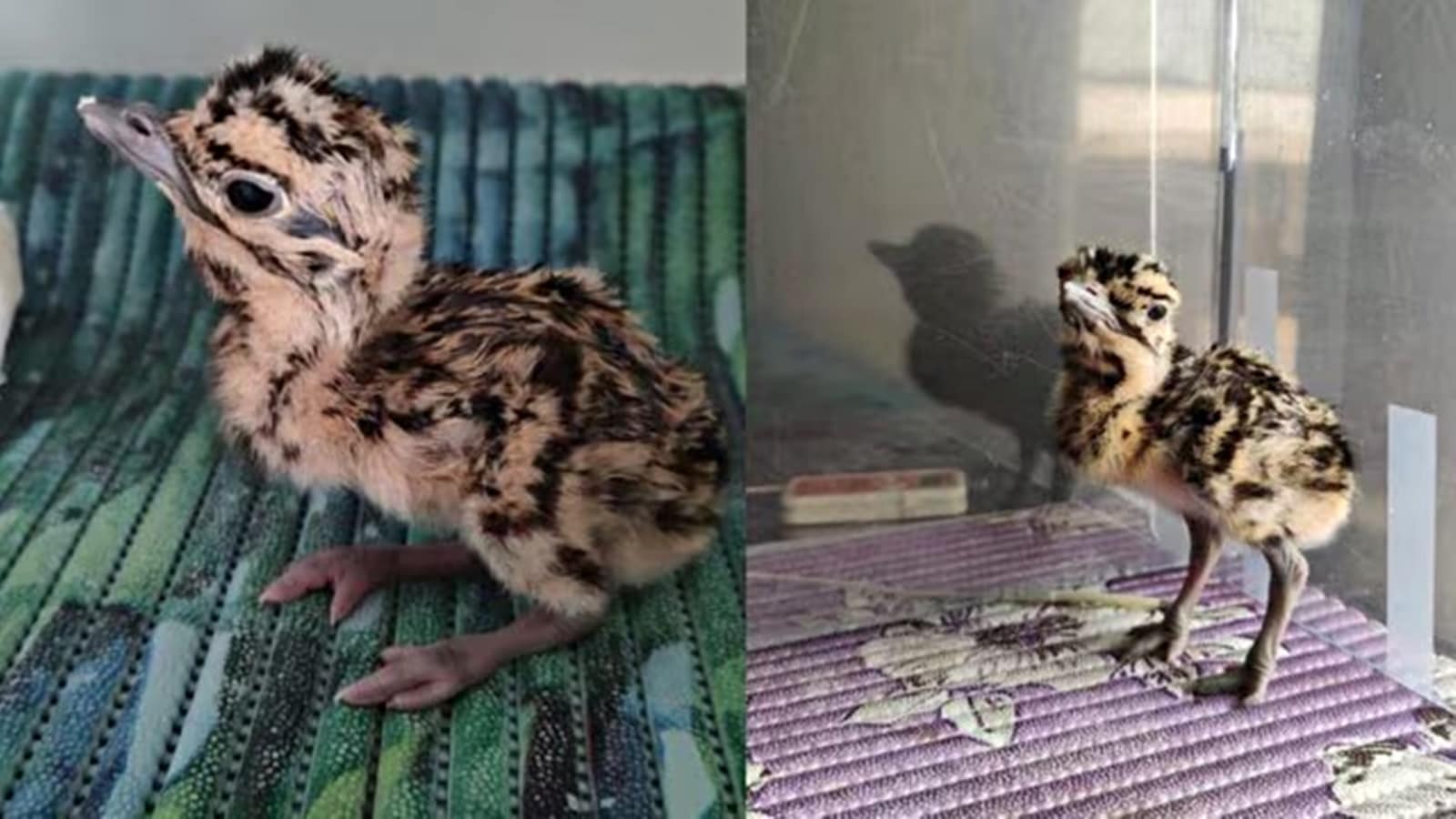
Sindoor, Vyom, Sofiya – newly hatched Great Indian Bustard chicks in Jaisalmer get names that ring a bell
The GIB, a critically endangered species found primarily in Western Rajasthan, is the focus of conservation efforts by the Ministry of Environment.
Written by Parul Kulshrestha
Jaipur | Updated: June 7, 2025 07:53 PM IST
3 min read
Whatsapp
twitter
Facebook
Reddit
The newly-born chicks are trained in semi-natural enclosures to help them adapt to wild conditions. (Source: File/ Representational)
Operation Sindoor has become a symbol of national pride, and its legacy now lives on in an unexpected way — through the naming of newly-hatched Great Indian Bustard (GIB) chicks. To honour the heroes involved in the operation, the Rajasthan Forest Department has named four chicks born in May 2025 after Operation Sindoor and the individuals associated with it.
The GIB, a critically endangered species found primarily in Western Rajasthan, is the focus of conservation efforts by the Ministry of Environment.
Brijmohan Gupta, Divisional Forest Officer at Desert National Park, told The Indian Express, “This is our way of remembering those who stood against the enemies. In May 2025, eight chicks were born. We named four of them: ‘Sindoor’ after Operation Sindoor, ‘Vyom’ after Wing Commander Vyomika Singh, ‘Mishri’ in honour of an undercover intelligence officer, and ‘Sophia’ after Colonel Sofia Qureshi. Our goal is not just to increase the bird population but also to connect wildlife conservation with national interest.”
Operation Sindoor was launched early May 7 by the Indian military to destroy nine terror infrastructures in Pakistan and Pakistan-occupied-Kashmir (PoK) in retaliation to the April 22 Pahalgam terror attack. Subsequently, India responded strongly to Pakistan’s attempts to target its military and civilian areas with drones, missiles and other weapons.
“It’s not just about saving a bird, it’s about preserving the values that define us as a nation,” Gupta added.
At present, there are 65 GIBs at the Centre for Great Indian Bustard Conservation in Jaisalmer. In 2025 alone, 21 chicks were born through captive breeding programmes. The National Conservation Breeding Programme continues to work toward saving the species, whose global population is estimated to be fewer than 150, most of them in Rajasthan.
Once found across India’s grasslands, the GIB has been pushed to the brink of extinction due to habitat loss, poaching, and infrastructural threats like power lines.
Story continues below this ad
To counter this crisis, Project GIB was launched in 2018 as a joint initiative of the Ministry of Environment, the Wildlife Institute of India, and the Rajasthan Forest Department.
The breeding centres at Sudasari and Sam are equipped with AI-enabled surveillance, temperature-controlled incubators, and sensor-based monitoring systems. This advanced infrastructure ensures real-time tracking of egg conditions and chick health.
The newly-born chicks are trained in semi-natural enclosures to help them adapt to wild conditions. The eventual goal is their reintroduction into open desert landscapes, where their survival and breeding in the wild will mark a turning point in India’s conservation journey.
Gupta said the department’s next focus is to enhance survival rates and reduce infant mortality. AI monitoring has already improved outcomes, allowing for early intervention and round-the-clock care.
Story continues below this ad
The team also involves local communities to foster a sense of shared responsibility for protecting this critically endangered species.
Parul Kulshrestha is a Principal Correspondent for The Indian Express, based in Rajasthan. A lawyer turned journalist, she brings a unique cross-disciplinary perspective to her reporting, blending legal precision with deep social inquiry to cover one of India's most culturally and politically vibrant regions.
Expertise and Experience
Legal-Journalistic Synergy: Parul’s transition from a legal background to mainstream journalism provides her with a distinct advantage in interpreting policy, legislation, and judicial impacts. This expertise allows her to "read between the lines" of government orders and court rulings affecting the public.
Diverse Beat: With years of experience across both mainstream newsrooms and independent journalism, she has built high-level authority in several critical areas:
Nomadic Tribes & Marginalized Communities: She is recognized for her sensitive and in-depth reporting on the struggles and rights of Rajasthan's nomadic populations, often giving a voice to those outside the traditional political spotlight.
Gender & Social Justice: Parul focuses on the intersection of law and gender, covering issues ranging from women’s safety and reproductive rights to the socio-economic empowerment of rural women.
Environmental & Political Reporting: She tracks Rajasthan’s complex political landscape—including electoral shifts and bureaucratic changes—alongside critical environmental concerns like water scarcity and land use.
Academic & Professional Pedigree: Her background as a lawyer, combined with her rise to the rank of Principal Correspondent at a national broadsheet, establishes her as a senior voice in the media landscape. ... Read More


 3 min read