Journalism of Courage



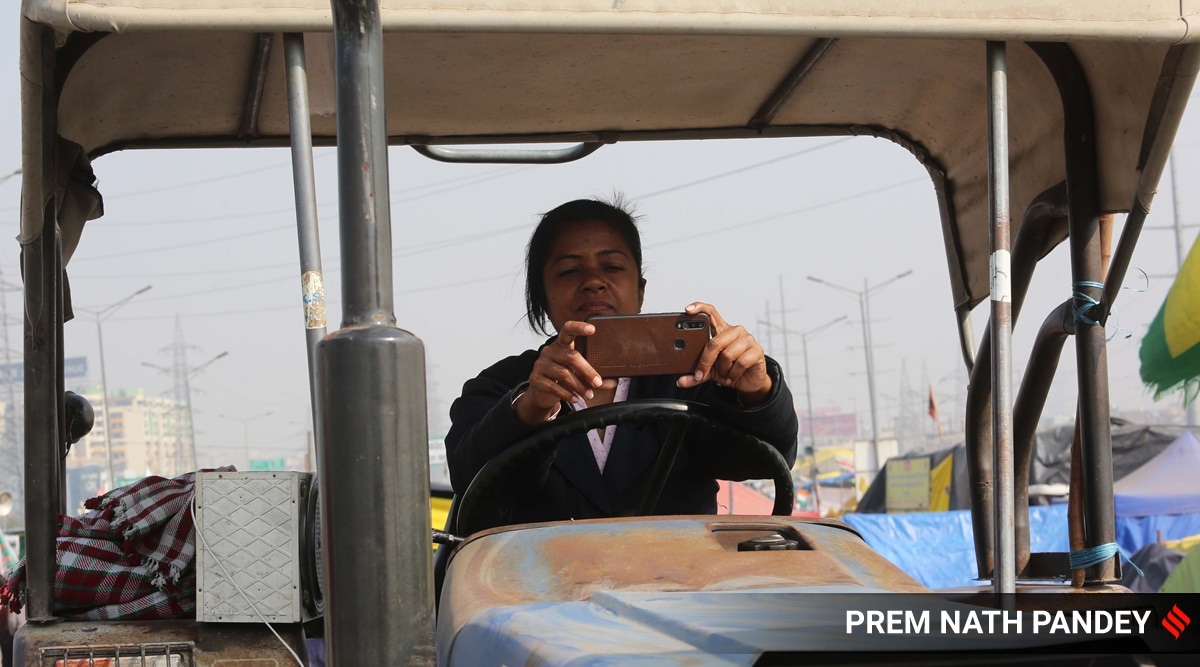 A woman farmer watching news on mobile phone at Ghazipur border on Feb 8, 2021 (Express photo by Prem Nath Pandey)
How to set up a Twitter account, how to amplify messages, how to participate in a topic trending online — a group of students have begun conducting workshops with farmers at the Ghazipur site on how to use social media as part of their protest.
The students, affiliated with the All India Students’ Federation (AISF), have also been running a library at the site for almost a month.
Sanjay Singh, a student from Lucknow University, said many protesters had been asking them for help with setting up social media accounts, which led to them start these workshops on Wednesday. The students have said they will conduct these sessions every afternoon near the main stage.
In these sessions, protesters are taught how to set up an account on a social media platform of their choice — Facebook, Instagram or Twitter. For instance, in the case of Twitter, they are first taught how to create an account; then what it means to like or retweet something, and how they can do that; and how to participate in a trending topic on the site and how to use hashtags.
On Thursday, Sant Kumar, a 28-year-old farmer from UP’s Shamli district, set up his own Twitter account during the session. “We have heard that a lot of people say negative things about us on the site. Many of us want to join so we can also gather and respond with our truth,” he said.
Said Abipsha, a student from Jamia university, “People know that it is essential to do the ground work, but also that the protest has to be carried out online… The main thing is that people want to share their versions online because they feel their movement is distorted in a lot of media. For instance, one farmer was fixing his tent the other day and that image was used by a channel to say that protesters are picking up their tents and leaving, and that Ghazipur is emptying.”
Sanjay said the participants are across different age groups. “There are people who have smartphones but don’t know how to use social media. Or young people who have Facebook accounts, and were familiar with just TikTok… We are also telling them that the discussions online should take place in a constitutional manner,” he said.

 3 min read