





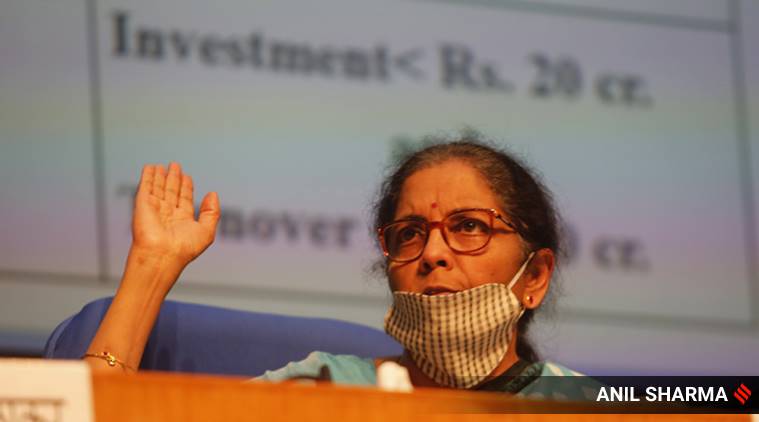
 Finance minister Nirmala Sitharaman during her press conference in New Delhi on Wednesday. (Express photo by Anil Sharma)
FM Nirmala Sitharaman Press Conference highlights: Unveiling the fourth tranche of the Covid economic measures as part of the ‘Atmanirbhar Bharat Abhiyan (Self-reliant India Mission’), Union Finance Minister Nirmala Sitharaman’s announcement on Saturday focused primarily on eight sectors — coal, minerals, defence production, airspace management, airports, MRO, power distribution companies in UTs, space, and atomic energy.
“The structural reforms being announced today will impact those sectors which are new horizons of growth, unleashing new investment, boosting production and creating jobs,” Sitharaman said.

Among the major decisions, Sitharaman said the government monopoly in the coal sector would be removed to allow commercial mining. She also said the foreign direct investment (FDI) limit in defence manufacturing would be raised from 49 per cent to 74 per cent under the automatic route. (Read highlights of FM Nirmala Sitharaman’s speech)
Sitharaman said the government would allow private players to access the space sector, including ISRO’s facilities, by providing a level-playing field in satellites, launches and space-based services. Further, future projects for planetary exploration, outer space travel, etc would be opened to the private sector. (Follow coronavirus India live updates)


Prime Minister Narendra Modi tweets on today's announcements by Union Finance Minister Nirmala Sitharaman: "Important sectors such as coal, minerals, defence, aviation, space and atomic energy have been covered in the announcements by the FM today. The measures and reforms announced will create many business opportunities and contribute to economic transformation."
In case you missed Union Finance Minister Nirmala Sitharaman's press conference today, here are highlights of what she announced. In her fourth press conference, Sitharaman unveiled structural reforms for eight sectors - coal, minerals, defence production, airspace, power distribution, space and atomic energy.
The government is boosting private participation in space activities. This will be done by:
The government says it will boost private sector investments in social-infrastructure projects, like hospitals, by revamping the Viability Gap Funding Scheme. The total outlay for this has been pegged at Rs 8,100 crore.
The government will release a tariff policy with reforms, including consumer rights, promotion of industry and sustainability of sector.
Most aircraft -- civil and defence -- fly abroad for repairs. Due to this, the government has announced rationalisation of MRO ecosystem to favour repairs and maintenence in the country.
The government has announced six more airports for auction under a PPE model. Annual revenue from this in the first round could come up to Rs 1,000 crore/year with an additional downpayment of Rs 2,300 crore for the Airports Authority of India. Additional investment by private players in 12 airports in the first and second rounds are expected to bring in around 13,000 crore. Another six airports will be put out for the third round of bidding.
Only about 60% of Indian airspace is freely available. This means, airlines usually fly longer routes. To help rationalise this, FM Sitharaman says restrictions on utilisation of Indian air space will be eased so that civilian flying becomes more efficient. This will bring a total benefit of Rs 1000 crore a year for the aviation sector. This will also reduce fuel use and time, leading to a positive environmental impact.
FDI limit in defence manufacturing under automatic route to be raised from 49 per cent to 74 per cent, says FM Nirmala Sitharaman. The government will also begin time-bound defence procurement and faster decision making by setting up a Project Management Unit (PMU) to support contract management. It will ensure realistic setting of General Staff Qualitative Requirements of weapons/platforms and overhaul trial and testing procedures.
FM Nirmala Sitharaman says the government will notify a list of weapons/platforms for ban on import with year-wise timelines, and will also ensure indigenisation of imported spares. For this, a separate budget will be given for domestic capital procurement. This will also reduce the huge defence import bill.
In the defence sector, the government aims at improving autonomy, accountability and efficiency in Ordnance Suppliers by Corporatisation of Ordnance Factory Board.
The sectoral reform for mining of minerals will boost growth, employment and bring state-of-the-art technology especially in exploration, says Finance Minister Nirmala Sitharaman.
The government is set to introduce a seamless composite exploration-cum-mining-production regime. 500 mining blocks will be offered through an open and transparent auction process. The govt will also introduce a joint auction of bauxite and coal mineral blocks to enhance aluminum industry's competitiveness. This will help the industry reduce electricity costs, says FM.
FM says there is a need to reduce import of substitutable coal and increase self-reliance in coal production. Therefore, the govt is introducing competition, transparency and private sector participation in coal sector through a revenue sharing mechanism instead of regime of fixed rupee/tonne. This means, now, any party can bid for a coal block and sell in the open market.
For this, entry norms will be liberalised. The govt will offer nearly 50 blocks immediately with no eligibility conditions, but only upfront payment with a ceiling.
The fourth tranche of the economic package will focus on eight sectors: coal, minerals, defence production, airspace managements/airports/MRO, power distribution companies in UTs, the space sector and atomic energy.
The FM says a scheme will be implemented in states through 'challenge mode' for industrial cluster upgradation of common infrastructure facilities and connectivity.
Availability of industrial land/land banks for promoting new investments and making information available on Industrial Information System (IIS) with GIS mapping
Policy reforms to fast-track investment - efforts towards Atmanirbhar Bharat:
The Finance Minister is expected to today announce measures that will focus on structural reforms to help build an Atmanirbhar Bharat (self-reliant India).
FM Sitharaman begins her press conference. By building a self-reliant India, the country needs to prepare for global competition, she says, adding that India also needs to face the challenges of the global value chain. "We are not looking inwards. It is making India rely on its strength, while facing the global challenges," Sitharaman says.
In the last three days, Union Finance Minister Nirmala Sitharaman has announced three tranches of measures to cushion the impact of the Covid-19 pandemic and the lockdown on the economy. On Day 1, she announced relief measures to micro, small and medium enterprises. The following day, she announced measures for migrants, farmers and street vendors. On Friday, funds were allocated to agriculture and allied activities.
Union Finance Minister Nirmala Sitharaman will address the press for the fourth time on Saturday to unveil more measures to mitigate the economic impact due to the coronavirus. Follow our live blog for the latest news and updates.