Journalism of Courage



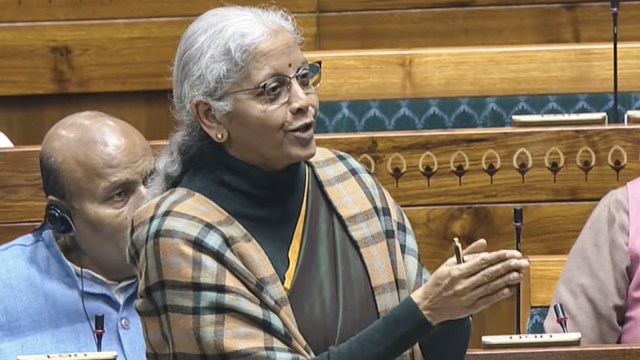 Union Finance Minister Nirmala Sitharaman in Lok Sabha. PTI
With the Opposition flagging that the Securities Market Code Bill, 2025, which was introduced in Lok Sabha Thursday, gave excessive powers to a single body, which was against the principle of the separation of powers, Union Finance Minister Nirmala Sitharaman proposed referring it to the department-related standing committee.
The Bill seeks to merge provisions of the Securities and Exchange Board of India Act, 1992, the Depositories Act, 1996 and the Securities Contracts (Regulation) Act, 1956 into a unified code, aiming at strengthening investor protection and improving the ease of doing business in India’s financial markets.
Opposing the Bill, Congress’s Manish Tewari said, “The Bill results in an unconstitutional concentration of legislative, executive, investigative, adjudicatory, and quasi-judicial powers in a single authority—the Board… This fusion of powers violates the principle of separation of powers and creates a real apprehension of institutional bias, offending Articles 14 and 21.”
He asserted the Bill “entails excessive delegation of essential legislative functions, leaving core policy matters —such as regulatory scope, registration standards, penalties, exemptions, market conduct norms, and even expansion of ‘securities’—to executive-made rules and regulations”. He described it as reducing Parliament “to a mere enabling authority, contrary to settled constitutional doctrine”.
“Several provisions permitting search, seizure, attachment of property, freezing of bank accounts, and prolonged interim orders, including ex-parte actions, lack adequate statutory safeguards, narrow thresholds, and strict timelines,” he added. “These coercive powers, exercised predominantly through delegated legislation and executive discretion, fall foul of due process requirements under Article 21 and the test of proportionality.”
“… The sweeping ‘notwithstanding clauses’, immunity for actions taken in good faith, and wide powers of the central government to issue directions, supersede the Board, grant immunity… together undermine rule of law and equality before law under Article 14.” Sitharaman said since the government has proposed referring it to panel, such details can be discussed there. Krishna Prasad Tenneti, who was in the Chair, said the Speaker will take a call.

 2 min read