Stay updated with the latest - Click here to follow us on Instagram

Journalism of Courage
 4 min read


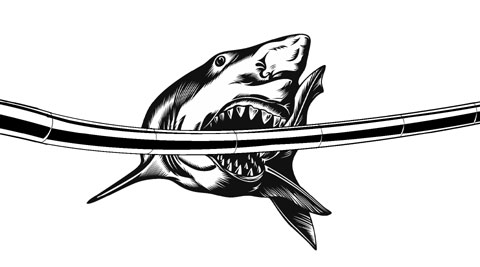 Antarctica is the only continent yet to be reached by a submarine elecommunications cable.
Last week, it was reported that sharks have been attacking undersea data cables around the world. The sharks’ fondness for undersea cables has been traced back to the 1980s when several “shark gnawing” incidents were reported. Google now has footage, recorded by a remote underwater vehicle during a survey operation, capturing one such incident. To counter the problem, Google has decided to reinforce its cables with synthetic fibre to protect its over 1.6 lakh km of private fibre-optic routes.
The Internet doesn’t just happen via satellites. It’s served to us by thousands of miles of physical cabling, and much of it stretches under the sea. More than 99 per cent of international communication is delivered by these undersea cables.
Why would sharks attack these cables?
One theory is that sharks are attracted to the electric field surrounding the cables. Strangely enough, sharks seem picky about which kind of cable they chew on. There are about 1 lakh kilometres of old underwater cables made of copper and not a single shark took a bite out of them, said a Popular Science report. Sharks seem to prefer gnawing on fibre-optic cables. Scientists believe fiber-optic cables emit a deep sea electric current that triggers a feeding reflex from sharks as they possess voltage sensors in their mouths to help them find prey.
Cable failures
* The first recorded shark cable attack happened in 1989 off the Canary Islands.
* One cable failure — between Sicily and Egypt — left more than 50 per cent of India without Net in 2008.
* In 2007, pirates stole over 100 metres of cable that connected Vietnam, Thailand and Hong Kong to the rest of the world. The thieves attempted to sell the cable as scrap.
* On December 26, 2006, the Hengchun earthquake rendered cables between Taiwan, Philippines inoperable.
History
* The foundation of the global map of undersea cables was laid with the invention of the telegraph in 19th century.
* The first successful transatlantic cable was laid in 1858.
* The first ever message sent over it was a congratulatory letter from Queen Victoria to US president James Buchanan on August 16, 1858.
The cables
* A submarine communication cable or an undersea data cable is a long cable laid on the seabed between land-based stations.
* All modern cables use fibre-optic technology, which enables them to carry digital payloads — telephone, Internet and private data traffic.
* It is laid by specially-designed ships that can carry up to 2,000 km of coiled cable. Cable ships can cover 100-150 km per day.
* Traditionally, the cables were owned by service providers, but websites such as Google and Facebook have also started buying them to control their networks.
$100m to $500m cost of each cable
$10 million annual maintenance cost
$10,000 daily repair charges
* New cables such as Apollo offer speeds in ‘terabits’ per second — each terabit is 1,000 gigabits, in turn 1,000 megabits. The Apollo cable is one of Britain’s main connections to the US.
Causes of faults
* According to the International Cable Protection Committee (ICPC), 70 per cent of all cable failures are associated with fishing and shipping activities.
* Dredging, drilling, seabed abrasion and earthquakes also play a role.
* Natural hazards, including seabed abrasion and shark bites, account for less than 10 per cent of all faults.
Trivia
* Antarctica is the only continent yet to be reached by a submarine elecommunications cable.
* Google and five other telcos have agreed to fund a 3,000-km trans-Pacific cable network to link the US and Japan.
* Named FASTER, the network would cost $300 million.
* Its initial capacity would be about 60 terabits a second.
* The cable will span the Pacific Ocean from Chikura and Shima in Japan to California.
* Kevlar, the same tough material spun into bulletproof vests and puncture-proof materials, will protect the FASTER cable from shark bites.
* Google will also wrap the FASTER cable in a polythene yarn and steel wire to further protect the cable.
* FASTER is expected to be completed by 2016.
Compiled by Aleesha Matharu; Graphic by Pradeep Yadav and Dipankar Ghosh.
Stay updated with the latest - Click here to follow us on Instagram