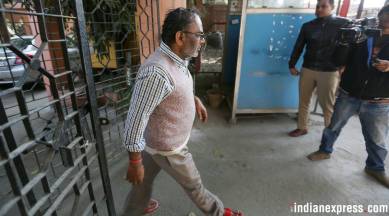
Ankit’s father at Khayala Police Station in Delhi. (Express photo by Gajendra Yadav)
Advertisement
The man she wanted to marry killed, her parents arrested for the crime and her house bolted shut. With nowhere to go after 23-year-old photographer Ankit Saxena was stabbed to death allegedly by her father in West Delhi’s Raghubir Nagar, this 18-year-old woman has stayed at the Khyala police station since the murder two days ago.
“We tried to convince the woman’s family members to take her back. But they were unwilling so we produced her before the Child Welfare Committee (CWC). There are cases when adults are produced before the CWC when they have nowhere to go or face threats. The woman has told the CWC she does not want to stay with her family,” said Deputy Commissioner of Police (West) Vijay Singh.
You’ve Read Your Free Stories For Now
Sign up and keep reading more stories that matter to you.
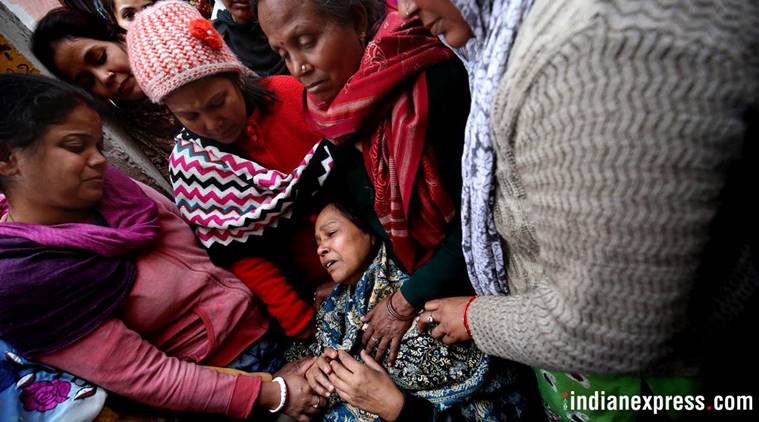
Ankit’s mother with relatives at their home in Raghubir Nagar in West Delhi on Friday. (Express Photo/Praveen Khanna)
Her extended family — some living in the same colony and others in Uttar Pradesh’s Saharanpur and Gorakhpur — told The Sunday Express they were “afraid” to take her in. On Saturday afternoon, her maternal aunt, cousins and 12-year-old sister visited her at the police station.
The police requested them to take the woman home. “She kept crying, she was delirious…We told police we can’t take her home with us. She kept asking about Ankit, her parents and said it was all over for her,” said her aunt.
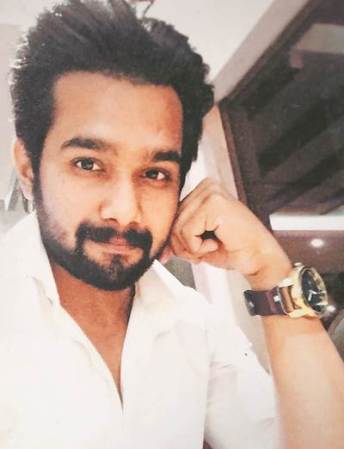
A few days ago, 23-year-old Ankit Saxena jokingly asked his childhood friends to be witnesses at his court marriage to his 20-year-old girlfriend, who belongs to a minority community.
Saxena was stabbed to death near his house on Thursday night, after an altercation with four family members of the woman. Her parents, uncle and 16-year-old brother opposed her “relationship” with Saxena. While her parents and uncle are in judicial custody, her brother was sent to a juvenile home.
On Saturday morning, as armed paramilitary personnel and Delhi police commando units were stationed across five lanes surrounding the colony, the woman’s relatives sat inside their home glued to the television set. “We have not stepped outside since Friday, we haven’t opened our beauty parlour either. We fear we will be attacked… Obviously we can’t bring her here,” said the woman’s cousin, who runs the parlour.
On Friday, her cousin was asked to vacate the parlour. The woman’s maternal aunt said, “We have been living here for nine years now, but will probably sell the house and go to Gorakhpur… itni bandaami aur itne darr ke baad yahan kaise rahe (How can we stay here after this infamy and fear)?”
A few lanes away, shutters were pulled down on the parlour run by the woman’s mother — a desk with cans of wax lay outside. “On Friday, Bajrang Dal members threatened me, asked why I rented out my shop to someone from a minority community. They said if I don’t empty the shop, they would destroy it. I fear for my life and that of wife and children,” said Vinod Kumar, 38, the landlord. The West Delhi unit chief of the Bajrang Dal, Jagjit Singh Goldie said, “Humne parlour band kara diya hai… (We shut the beauty parlour down).”
Anand Mohan J is an award-winning Senior Correspondent for The Indian Express, currently leading the bureau’s coverage of Madhya Pradesh. With a career spanning over eight years, he has established himself as a trusted voice at the intersection of law, internal security, and public policy.
Based in Bhopal, Anand is widely recognized for his authoritative reporting on Maoist insurgency in Central India. In late 2025, he provided exclusive, ground-level coverage of the historic surrender of the final Maoist cadres in Madhya Pradesh, detailing the backchannel negotiations and the "vacuum of command" that led to the state being declared Maoist-free.
Expertise and Reporting Beats
Anand’s investigative work is characterized by a "Journalism of Courage" approach, holding institutions accountable through deep-dive analysis of several key sectors:
National Security & Counter-Insurgency: He is a primary chronicler of the decline of Naxalism in the Central Indian corridor, documenting the tactical shifts of security forces and the rehabilitation of surrendered cadres.
Judiciary & Legal Accountability: Drawing on over four years of experience covering Delhi’s trial courts and the Madhya Pradesh High Court, Anand deconstructs complex legal rulings. He has exposed critical institutional lapses, including custodial safety violations and the misuse of the National Security Act (NSA).
Wildlife Conservation (Project Cheetah): Anand is a leading reporter on Project Cheetah at Kuno National Park. He has provided extensive coverage of the biological and administrative hurdles of rewilding Namibian and South African cheetahs, as well as high-profile cases of wildlife trafficking.
Public Health & Social Safety: His recent investigative work has uncovered systemic negligence in public services, such as contaminated blood transfusions causing HIV infections in thalassemia patients and the human cost of the fertilizer crisis affecting rural farmers.
Professional Background
Tenure: Joined The Indian Express in 2017.
Locations: Transitioned from the high-pressure Delhi City beat (covering courts, police, and labor issues) to his current role as a regional lead in Madhya Pradesh.
Notable Investigations: * Exposed the "digital arrest" scams targeting entrepreneurs.
Investigated the Bandhavgarh elephant deaths and the impact of kodo millet fungus on local wildlife.
Documented the transition of power and welfare schemes (like Ladli Behna) in Madhya Pradesh governance.
Digital & Professional Presence
Author Profile: Anand Mohan J at Indian Express
Twitter handle: @mohanreports ... Read More