5 min read
Stay updated with the latest - Click here to follow us on Instagram

Journalism of Courage



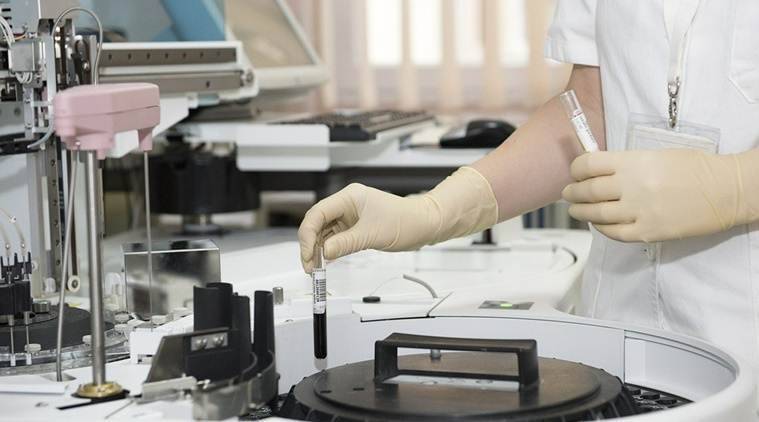 Of these, Dr Lal PathLabs has offered two of its laboratories that fit the government’s criteria — the one in Rohini, which was approved on Monday (March 23), and another in Kolkata, which is still awaiting approval. (File Photo)
Around 10 am, Dr Lal PathLabs senior phlebotomist Kamlesh Thakur received a call from his team to perform the first-ever sample collection for coronavirus test for private laboratories. By 11 am, he was standing outside a “small nursing home” in central Delhi.
Sanitising himself, the 30-year-old arrived at an area designated for him to wear his protective gear. First the shoe covers with his trousers tucked in, then a hazmat suit, followed by a head cover, face mask, goggles and, finally, the gloves.
After asking a few questions to verify the identity of the patient, he performed a nasal and throat swab, putting it in a viral transport medium, stored in a box. He exited the area, took his protective gear off and sealed it in another kit to be destroyed, sanitised himself once more and took off for a transit point, from where the sample would be taken to the company’s lab in Rohini for testing.
 Kamlesh Thakur is a senior phlebotomist at Dr Lal PathLabs.
“Before entering the patient’s room, we have to ensure that not a single part of our body is exposed,” says Thakur, who learnt of the many risks associated with sample collection during some of India’s swine flu outbreaks.
Thakur, who has a three-year-old son, volunteered for the job. “This is about protecting the country. I work in the healthcare sector, so there is no point getting scared (in situations like these),” he says, adding, “But just to make sure, I sanitise myself and remove my clothes before entering my house.”
As many as 300 others like him, working in diagnostic chains across the country, have been trained for such situations and are gearing up to take on the task of collecting samples either from homes or hospitals.
Around 22 private laboratories, including Dr Lal PathLabs, Dr Dangs Lab and Indraprastha Apollo have been approved to help government test patients for the virus. Of these, Dr Lal PathLabs has offered two of its laboratories that fit the government’s criteria — the one in Rohini, which was approved on Monday (March 23), and another in Kolkata, which is still awaiting approval. Each of these labs can perform around 1,500 tests.
“We have started our operations today…We have informed our call centre…and our sales teams have informed doctors that we are now conducting (COVID-19) tests,” Dr Lal PathLabs managing director Dr Arvind Lal said.
The firm has been receiving queries by email, phone calls and their website. “Hospitals also contact us. Even today, a couple of hospitals called us up,” he says.
The company has qualified personnel ready to be deployed for sample collection across the country. It has set the turnaround time for the final reports at up to 48 hours, given the difficulties in collecting and transporting samples in some states. “This (sample collection) is predominantly in Delhi at this stage. In other cities, we have not been able to pick up (samples) because of air freight movement restrictions. Ground transportation has also come to a complete halt,” says Dr Lal.
The company has decided to perform the two tests at once — both initial and confirmatory tests in one go — at the cost of Rs 4,500.
This is a “next to” break-even price for the company which, like other private firms approved for the process, is procuring the kits on its own and bearing costs like that of home collection, transportation, manpower, testing, following biomedical disposal processes and reporting to the government.
“The costs are multifold. It is just not about the kit,” said Dr Lal. “But, at this time, if you say we don’t want to do this, while we have the capability and the capacity, it would be a real shame on everyone (in the private sector),” he added.
However, the government has also helped ease some of the cost issues by ensuring that prices of protective gear are not hiked exorbitantly. Some states have also been helping with transportation facilities and special curfew passes, according to him.
Here’s a quick Coronavirus guide from Express Explained to keep you updated: Are smokers at high risk form coronavirus? | Can Vitamin-C prevent or cure coronavirus infection? | What exactly is community spread of coronavirus? | How long can the Covid-19 virus survive on a surface? | Amid the lockdown, what is allowed, what is prohibited?
Stay updated with the latest - Click here to follow us on Instagram